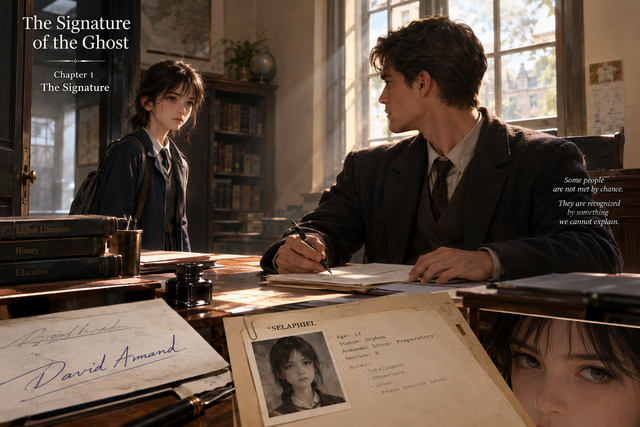
Chapter 1 THE SIGNATURE
© 2026 PENTALKIES_96. All rights reserved. This is the original work of the author. Please do not copy, reproduce, translate, or redistribute this novel without permission.
The war had been over for six years, but David Armand still woke whenever someone slammed a door.
He never told anyone.
There were things a man carried home from a war that could not be explained without making them smaller.
So he had stopped trying to explain.
At nineteen, when the war ended, David had returned home with a duffel bag, two medals he rarely looked at, a scar beneath his left shoulder, and the strange conviction that ordinary life was more frightening than battle.
During the war, every sound had meant something.
A distant engine.
A sudden silence.
Boots against stone.
A rifle being loaded.
A voice calling a name.
At home, there were only doors and dishes and clocks and people asking what he intended to do with his life.
He had discovered that he preferred silence.
That was how he became a teacher.
Not because teaching had been his childhood dream.
Not because he particularly enjoyed children.
He simply needed somewhere to put his mind for a few hours each day.
The academy offered him a position.
He accepted.
The work was orderly.
There were books.
There were examinations.
There were timetables.
There were questions with answers.
Most importantly, there was no battlefield.
He told himself that was enough.
On the morning of his first day at the academy, David arrived early.
The building was older than he had expected.
Its pale stone walls had been darkened by years of rain, and the wooden windows had swollen so badly that several refused to close completely. The corridors smelled of chalk, old paper, furniture polish, and the faint dampness that seemed to belong permanently to buildings that had survived too many monsoons.
His cabin was small.
A desk.
Two chairs.
A steel filing cabinet.
A bookshelf with more dust than books.
One large window stood open to the courtyard.
David liked it immediately.
The air moved freely through the room.
He placed his hat on the desk and removed his jacket.
For several seconds he simply stood there.
No gun belt.
No military boots.
No orders.
No barracks.
Only a desk.
He touched the wooden surface with his fingertips.
“Teacher,” he murmured.
The word still sounded strange.
He sat down.
A few minutes later, the English teacher entered.
Mr. Bennett was a thin, energetic man with silver hair and an almost inexhaustible supply of opinions about his students.
He placed a pile of files on David’s desk.
“Welcome.”
“Thank you.”
“You’ll need these.”
David looked at the files.
“Students?”
“Unfortunately.”
David smiled.
Bennett laughed.
“Don’t worry. You’ll get used to them.”
“I’ve survived worse.”
The English teacher looked at him.
“That’s what I heard.”
David’s smile disappeared.
Bennett noticed.
He was old enough to know when not to ask.
Instead, he pulled out the chair opposite David.
“Your first class is the senior preparatory group.”
David opened the first file.
Bennett began talking.
He talked about the students.
Their strengths.
Their weaknesses.
Their families.
Their habits.
The boy who never brought his books.
The girl who talked constantly.
The twins who cheated during examinations.
The student who could memorize entire pages but couldn’t write an original sentence.
David listened.
He had always been good at listening.
Perhaps the army had taught him that.
“There’s one girl you should know about,” Bennett said.
David looked up.
“Which one?”
“Selaphiel.”
He searched the files.
“Family?”
Bennett hesitated.
“Orphan.”
David stopped turning the pages.
“Both parents?”
“Dead.”
“Relatives?”
“None who wanted the responsibility.”
David looked at him.
Bennett shrugged.
“The academy became the closest thing she has to a home.”
David closed the file.
“How old?”
“Thirteen.”
David nodded.
“Problematic?”
“Not in the usual sense.”
“What does that mean?”
“It means she isn’t troublesome.”
Bennett smiled.
“She’s worse.”
David raised an eyebrow.
“How?”
“She’s observant.”
“That’s hardly a crime.”
“No. But she notices things adults prefer children not to notice.”
David leaned back.
Bennett continued.
“Very intelligent. Excellent English. Reads beyond her level. Doesn’t speak much unless she has something worth saying.”
“That’s unusual.”
“She also has a habit of staring at people.”
“Staring?”
“Studying them.”
David glanced toward the open window.
“And you think I should be concerned?”
“I think you should know.”
Bennett opened another file.
“She’ll probably be one of your best students.”
“Probably?”
“Definitely.”
“Then why warn me?”
“Because she doesn’t behave like one.”
David smiled faintly.
“What does she behave like?”
Bennett considered.
“Someone much older.”
The words remained in the room.
Outside, the academy bell rang.
Bennett gathered his papers.
“I’ll leave you to settle in.”
He stood.
Then he stopped at the door.
“Oh, and one more thing.”
David looked up.
“Yes?”
“Don’t underestimate her because she’s small.”
The door closed behind him.
David looked down at the file.
SELAPHIEL
The name was unusual.
He opened the file.
The photograph attached to it was small and slightly faded.
A child.
Dark hair.
Small face.
Serious eyes.
David studied the photograph for a moment.
Then he closed the file.
He had no reason to remember it.
The door opened again.
David assumed it was Bennett returning.
He didn’t look up immediately.
“Did you forget something?”
There was no answer.
He lifted his eyes.
A girl stood in the doorway.
She was small.
Not merely young-looking, but physically slight, almost delicate. Her school uniform seemed slightly too large for her frame.
She stood quietly.
She had probably been waiting for permission to enter.
David gestured toward the empty chair.
“Come in.”
She stepped inside.
The English teacher had just left the cabin, and she had entered without knowing that the man sitting behind the desk was the new teacher she had been warned about.
David looked at her.
The first thing he noticed was her face.
A child’s face.
Thirteen, perhaps.
Then her eyes.
That was different.
The gaze was steady.
Too steady.
There was none of the nervousness he expected from a child entering a teacher’s cabin.
She looked directly at him.
Not rudely.
Not defiantly.
Simply without fear.
David had seen that kind of gaze before.
Not in children.
In soldiers.
In people who had already learned that fear did not always protect you.
He found himself straightening in his chair.
“What class are you in?”
She answered in a soft but steady voice.
“The preparatory group.”
“Which section?”
She told him.
David nodded.
“And how are the teachers?”
She paused.
“Which ones?”
“Your subject teachers.”
“They’re good.”
“All of them?”
“Most.”
David almost smiled.
“And the students?”
“Some are good.”
“Some?”
“Some are not.”
He leaned back.
“You seem very certain.”
“I’ve been here long enough to know them.”
David looked at the file on his desk.
He had not connected the girl to the photograph.
Not yet.
He glanced toward the corridor.
“Do you know a student named Selaphiel?”
The girl remained silent for half a second.
Then she looked directly into his eyes.
“It’s me.”
David froze.
He looked at her again.
The photograph.
The file.
The child standing before him.
He felt faintly embarrassed.
“You’re Selaphiel.”
“Yes.”
“Mr. Bennett was telling me about you.”
“What did he say?”
David hesitated.
“That you’re a good student.”
She waited.
“And?”
“And that you’re very intelligent.”
She waited again.
“And?”
David smiled.
“He said you observe people.”
“I do.”
“Why?”
“Because people are interesting.”
David nodded slowly.
“Apparently.”
She looked at the desk.
Then at the papers.
Then back at him.
David noticed her gaze settle on the ink bottle beside his right hand.
He picked up the first paper on the desk.
It was one of the administrative forms he had signed that morning.
He had written his name across the bottom.
Selaphiel looked at it.
She frowned.
David noticed.
“What?”
“Your signature.”
David glanced down.
“What about it?”
“It’s strange.”
He smiled.
“Strange?”
“It doesn’t look like you.”
David looked at her.
“You’ve known me for less than five minutes.”
“I know.”
“And you’ve already decided what I look like?”
“No.”
“Then how can you know what my signature should look like?”
She considered the question.
“I don’t know what it should look like.”
David waited.
“I only know it isn’t right.”
A small laugh escaped him.
“You’ve been talking to Mr. Bennett.”
“No.”
“Then where did you learn to speak like this?”
“I read.”
David nodded.
“Of course you do.”
She pointed at the paper.
“You should change it.”
“Why?”
“Because it looks uncertain.”
He looked at the signature.
There was something almost irritatingly accurate about her observation.
The capital D was too large.
The rest of the name seemed to shrink beneath it.
David picked up his pen.
“All right.”
He drew a line through the signature.
Then he wrote it again.
This time he slowed down.
The letters were firmer.
The final stroke was deliberate.
He pushed the paper toward her.
“Better?”
Selaphiel studied it.
“No.”
David stared at her.
“No?”
“You changed it because I told you to.”
“Yes.”
“You shouldn’t.”
“Why not?”
“You should change it because you want to.”
David leaned back.
For some reason, the answer unsettled him.
“You’ve known me for five minutes.”
“Yes.”
“And you’re already giving me advice.”
She nodded.
“Yes.”
He laughed quietly.
“You’re very confident.”
“No.”
“No?”
“I just speak carefully.”
There was something about her voice.
Soft.
Steady.
Without hesitation.
David looked at her again.
The child’s face.
The small frame.
The mature gaze.
For a fleeting moment, he had the strange impression that the person sitting across from him was not thirteen at all.
Not twenty.
Not thirty.
Older.
At least two decades older than the face suggested.
Then the impression vanished.
He dismissed it as fatigue.
He had returned from a war.
Perhaps his mind was still accustomed to looking for danger where none existed.
He signed another blank sheet.
This time without thinking.
Selaphiel watched.
David finished.
“There.”
She looked at it.
“That one is better.”
He smiled.
“So now you’ve approved it.”
“No.”
“No?”
“I only said it’s better.”
David laughed.
She didn’t.
He realized she was serious.
The academy bell rang.
Selaphiel stood.
“Class.”
“Yes.”
She moved toward the door.
Before leaving, she turned.
“Mr. Armand?”
“Yes?”
“You should keep the second one.”
David glanced at the paper.
“Why?”
“Because someday you might forget the first.”
She left.
David remained seated.
The window was still open.
It was nearly noon now.
The sun had climbed high above the courtyard.
A shaft of light entered through the open window and crossed the room, falling directly across the surface of his desk.
The papers glowed pale beneath it.
For a moment, David’s attention returned to the signature.
The light touched the ink.
He traced the final stroke with his eyes.
Then he looked toward the doorway where the girl had disappeared.
Selaphiel.
An orphan.
Thirteen.
Small enough to disappear among the older students.
Yet she had looked at him as though she had known him longer than five minutes.
David shook his head.
He had come to the academy for peace.
That was all.
He wanted books.
Routine.
A quiet room.
A few hours each day during which the world could ask him ordinary questions.
He had not come looking for anyone.
He certainly had not come looking for a mystery.
Outside, the bell rang again.
David gathered the papers.
He looked once more at the signature.
Then he put it away.
He did not know it yet, but the first thing Selaphiel had changed in his life was not his signature.
It was his attention.
And attention, once given to the right person, is difficult to take back.
#Author Note:
“Some people are not met by chance . They are recognized by something we cannot explain.”
Who just crossed your mind? Drop a comment and let me know.