
The Sunrise
“13 and a half kilograms. I’m getting fat...” Eugene thought as he stepped off the scale. The scale had been brought from Earth, and here it showed a weight six times less. He turned off the light and looked up at the enormous dome of armored glass in the ceiling of the main hall. And, for the umpteenth time, he staggered at the dizzying sight of the starry sky, where myriads of multicolored stars shone against a backdrop of pitch-black, icy darkness. He remembered the stars of August well. At the end of summer, the stars burned brighter than usual, as if they were descending closer to Earth and beckoning him to fly toward them. The romantic stars of his youth. And so he flew…
But here the stars shone even brighter, even more fiercely. It seemed as though they wanted to pierce the armor of the ceiling with their piercing rays. Soon, in just an hour, the edge of the Sun would appear on the horizon, and a scorching day would begin—fourteen Earth days—and the piercing stars would fade beside the enormous, blazing sun.
“Are you greeting dawn in the darkness?” David, the station’s computer technician, walked into the room. “What are you planning to do today?”
On the Moon, you can never tell what “today” means—an Earth day or a two-week lunar day. David’s question isn’t random: Eugene is an astrophysicist, and during the day, because of electromagnetic storms, all he can do is study the Sun. But the Sun isn’t his specialty, and all routine measurements of the Sun are conducted automatically.
“I don’t know yet…” said Eugene.
“Let’s head over to the Earth side,” David suggested. “SanSanych has built a waterfall there, in the wall of the Zeno crater.”
“A waterfall?!” Eugene was stunned; water on the Moon is worth its weight in gold.
“This waterfall only runs for an hour, at dawn,” explained David. “SanSanych really wanted to surprise his wife—she was supposed to come visit him. But last week, she was suddenly diagnosed with cancer, and SanSanych flew back to Earth in a hurry. But he managed to finish the waterfall…” You know, the water here falls like thick sugar syrup; it’s as if you’re watching a stream in slow motion. And the stars are reflected in it—it’s so beautiful!
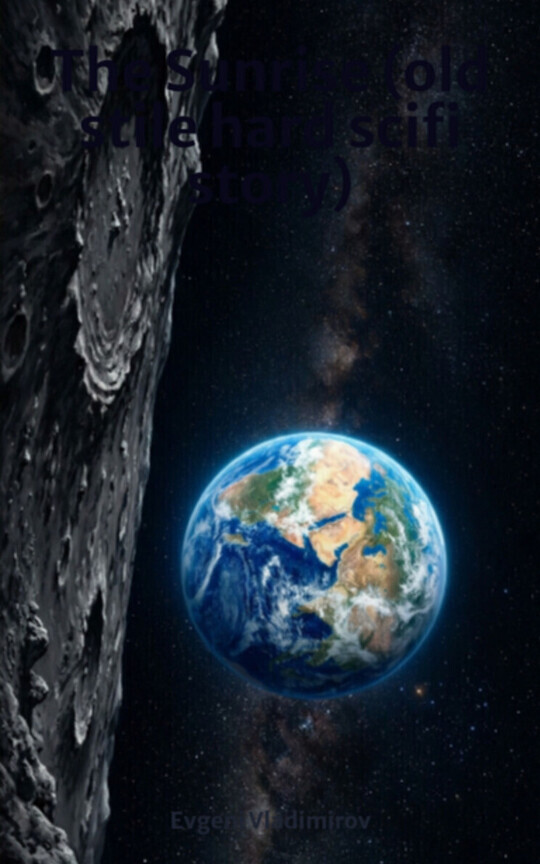
Zenon Station is the closest station to them on the “visible side” of the Moon, which the Selenites call the Earth side. There, the Earth hangs motionless in the sky, as if sewn in place, resembling a huge blue balloon. And it seems as though it doesn’t fall because it’s inflated with warm air... An underground tunnel leads to Zenon Station, and a small capsule-like car runs along ordinary tracks, clacking like the trains of an old subway. There, Eugene closes his eyes and imagines he’s riding beneath London. He even brought a yellow sign from Earth and screwed it to the tunnel entrance: “Mind the gap.”
The railway terminal where the car arrives is built inside a hill. A twenty-meter-long straight corridor connects the station to the terminal; for Eugene, David, and other staff members, it serves as a long-jump training ground, while for newcomers, it’s a fun attraction. Inexperienced visitors are told, with a perfectly earnest expression, that even a child can easily clear the corridor in a single leap, and are invited to give it a try. Earthly habits cause jumpers to push off strongly forward and upward, and the naive victim inevitably smashes their head against the ceiling of the corridor, which is less than three meters high. True, the ceiling is soft...
Fifteen minutes later, a lunar subway car was already waiting at the end of the corridor with its door open. David and Eugene exchanged a glance, took a short run-up, and leaped into the corridor at the same time. You have to push off almost horizontally and fold yourself in half, tucking your head closer to your feet, just like professional long jumpers do. It’s not very comfortable, but it creates an amazing sensation of weightless horizontal flight—the kind you only experience in childhood dreams or space travel. David, a former sprinter, surged half a body length ahead, but Eugene grabbed his shirt mid-air and pulled him back slightly. As a result, both landed side by side and, unable to stop in time, tumbled headlong into the train car.
The railcar had been traveling toward Zenon for half an hour, accelerating to 300 km/h in the airless tunnel. Zenon is a major station, with a tourist spaceport and lunar mineral processing plants nearby. On the way, they both dozed off as usual. Above Zenon, the sun had already fully risen above the horizon, but the jagged eastern wall of the crater still cast long shadows. “The waterfall,” David said, “is located near the western wall, two kilometers from the station, and we need to be there just as the sun’s rays hit the waterfall.” They both donned their spacesuits. Unlike the old, bulky, inflatable spacesuits that Eugene couldn’t stand, the new ones were form-fitting. They were made of a special elastic and “smart” fabric that created the familiar Earth-like pressure on the body, providing thermal insulation and wicking away sweat, while hardly restricting movement at all. Only the air-tight helmet was inflated with a gas mixture from the backpack. The fabric of the spacesuits was dazzlingly white, and the helmet was mirror-like, so that from a distance, people moving around in their spacesuits looked like white, headless toy robots. Among other advantages, the new spacesuits usually came equipped with two micro-jet engines attached to the shins, allowing the wearer to fly short distances. Admittedly, this skill required a special training course.
They were in a hurry now, so they took flight. David, who had a rough idea of the location, flew ahead; Eugene, trying not to fall behind, followed a hundred meters behind him. To the right stretched the wall of the crater, and to the left, drawing their gaze, a huge and beautiful globe hung low over the Moon—one side, illuminated by the Sun, was white and blue, while on the other, unlit side, coastlines and major cities shimmered mysteriously. In the center of the crater, the spaceport’s landing pads glowed with red and green lights. Soon, ahead, in the nearly vertical wall of the crater, a small, artificially carved arch became visible at a height of 7–8 meters above the base of the wall. And beneath it, framed by slabs of lunar basalt speckled with green olivine, lay a small semicircular pool, like a black mirror, reflecting a patch of the starry sky and the inverted mountain.
“Water!” Eugene whispered excitedly.
“Not exactly…” David replied, having heard him. “It’s still ice for now. But it’ll turn into water soon.”
They landed fifty meters from the pool—so as not to kick up dust—and approached it on foot. It was shallow, with the dark bottom covered by about ten centimeters of perfectly clear ice. The sun’s slanting rays had fallen on the pool a few minutes before their arrival, and the top layer of ice had already turned to water. At night, the surface temperature here drops to -170С. But at sunrise, it rises rapidly to +60С.
“We’ll have to wait about ten minutes,” David said, “until there’s enough water and the pump starts working.”
They waited. David explained how the waterfall worked. When enough water had melted, the drains in the pool walls would open, the water would flow to the pump, and the pump would pump the water upward into a tank hidden in an arched niche. Once that reservoir is full, the water will pour down: first along the sloping steps in the arch, and then, from a height of seven meters, in a wide stream into the pool. The waterfall will run for about an hour, until the ice in the pool has completely melted. Then a ceramic lid will tightly seal the pool to prevent the water from evaporating on a hot moonlit day. Solar panels on the lid will store electrical energy, which will then power the pump and the rest of the automated system. That’s the plan…
After a few minutes of waiting, the ice suddenly broke away from the heated bottom and, like an iceberg, floated to the surface. The water in the pool was visibly receding, which meant the pump had turned on. But its operation in the airless environment was completely silent. On the opposite side of the pool, three more people in spacesuits descended. A little further away, a tracked bus carrying tourists came to a stop; the tourists were not allowed to get off the bus. Everyone froze, staring at the rock. Two minutes later, something flashed deep inside the arch, and a wide, unhurried, sluggish tongue of water lapped at the top step, then, just as syrupy and unhurried, with the supple grace of a snake, trickled down the remaining steps, and, after hesitating for a second on the last one, gently plunged downward from a height of seven meters. The stream flowed down in a strangely even and smooth strip, resembling a strip of solidifying liquid glass in which the stars were reflected, quivering. But, already very close to the ground, it broke up into sparkling water droplets, falling slowly enough to allow him to make out the bright white figures against the moonlit landscape on each one.
They stood there spellbound like children, oblivious to the passage of time. Eugene had once heard that there are two things a person can watch endlessly—a burning fire and flowing water. But everything comes to an end. The pump—and with it, the waterfall—stopped. The last large drops fell slowly and reluctantly into the man-made basin. From a crevice in the rock they hadn’t noticed before, a slab with solar panels on top rolled out and covered the pool until nightfall. The rest of the spectators dispersed.
David tugged at Eugene’s sleeve: “Shall we go?”
But Eugene froze in place: next to the pool, right by the rock, in a crevice where the sun never reached, he thought he saw a barely perceptible movement.
“Dave, look, what’s that over there? It’s some kind of green twig or tube, and it looks like it’s moving… maybe because of the heat?”
They both stepped closer. And right before their eyes, something incredible happened: the tube, which looked like a double, tightly coiled spiral, began to uncoil and turned into two fairly long green leaves, between which a tightly closed bud sat on a thin, short stem.
“This can’t be!” Eugene exclaimed. “It’s some kind of electronic, artificial thing…”
They crouched down next to the flower and gently touched the leaves. The leaves looked completely natural. What’s more, the flower had a root that looked entirely natural, extending into a crack in the rock.
“No, it doesn’t look artificial,” David said. “...and SanSanich didn’t mess with things like that. We would have known.”
“How did it end up here? How could it have survived!? It’s -170 degrees here at night! And besides, plants need oxygen too… or is it carbon dioxide?”
“I don’t know, I don’t get it. It’s clear that it grew here because water droplets occasionally reach this spot. Flowers have never grown on the Moon, out in the open! Nonsense. Science fiction. But a fact is a fact… We need to take a picture and tell the biologists.”
Meanwhile, the little stem turned noticeably, and the bud began to open. A blue flower with six pointed petals, resembling a star, emerged from it. The flower gazed longingly at Earth—Earth was its Sun...