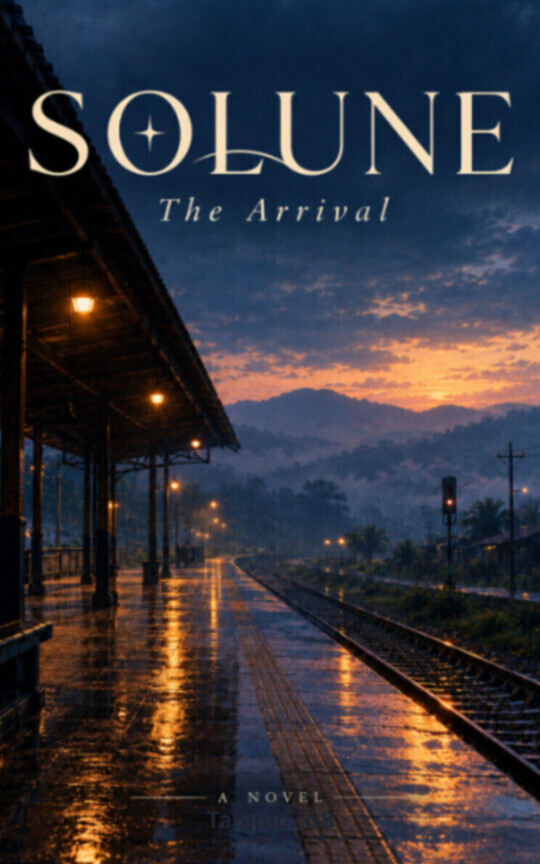

Chapter One: Restlessness
“Some days are so ordinary they feel like a question you don’t know how to answer.”
I.
“Ei bhai, nao.”
Here, brother. Take it.
The tong dokan owner held the cigarette across the counter without looking up. He was already turning back to his gas burner and the aluminum pot steaming in the afternoon heat. The boy who took it was twenty-two, maybe twenty-one, with black hair damp at the edges and brown eyes that caught the light once before dropping to find the matchbox. Light brown skin. A face that didn’t ask for attention and kept it anyway: the jaw, the cheekbones, the almond shape of the eyes that made even a sideways glance look considered.
He was sweating. Everyone was. The sun that afternoon made the whole city feel like the inside of something, and the lane shimmered at its far end.
He lit the cigarette and blew the smoke upward.
“Thanks,” he told the tong seller, easy and unhurried. He had been coming to this counter long enough that thanks had become a formality.
He leaned against the wall and smoked.
The lane outside the university gate was doing its usual afternoon thing. Students filtered out in ones and twos with their bags slung low, conversations trailing off in the heat. A rickshaw waited at the corner with the patience of something that had decided not to want anything.
“Sahir.”
He turned, not fast. A classmate stood there, bag on one shoulder, still stunned the way people are after a long exam. “How was it?”
Sahir took a drag and let a beat pass. The answer was still assembling itself somewhere. “Better than I thought.”
“Same. I blanked on the third question and then somehow wrote two pages.”
“That’s the exam experience,” Sahir said. “You know nothing. Then you write. Then you know nothing again.”
They talked for a few minutes, the low-effort talk of two people who like each other well enough and are both tired. Then the classmate’s phone buzzed, he said he had to go, and he went.
Sahir finished his cigarette. The black mark he made on the edge of the bench joined a dozen others, a record of how many afternoons he had spent in this corner against this wall. The tiredness wasn’t from the exam. It came from the feeling that every day began and ended without being any different from the one before.
He paid for the tea he had already finished, picked up his bag and went home.
II.
His father was where he always was at this hour: in the sitting room with the crossword folded on his knee, the fan on its highest setting, a glass of water going warm on the side table. He had built his life around reliable rhythms. Sahir had never been able to decide whether what he found in them was peace or just the comfort of knowing what came next.
“Classes done?” his father asked, not looking up.
“Done.”
“Eat something.”
“Later.”
It was enough. It wasn’t cold, either. It was the warmth of two people who had stopped needing words to confirm what they knew. His father loved him, and Sahir knew it the way he knew the layout of the house in the dark, without ever checking.
In his room the laptop sat on the desk. He looked at it. He looked at the bed. It was never much of a contest. He lay down for a minute, he told himself, and the ceiling fan ticked its slow circle above him, and he was asleep before the minute was over.
III.
He woke in the dark not knowing where he was. For a moment he was no one, only a body in a room with a humming fan. Then the room assembled itself around him: the desk, the window, and Dhaka outside doing what it always did, which was everything at once. A man argued down the lane. A wedding somewhere pushed its bass through the walls. One dog barked and another answered.
His phone said 9:47 PM.
He watched the fan. Tick, tick, tick. Monday would be the same classes, Tuesday the same reading he hadn’t done. The week was a corridor he had already walked, every door open, every room known. He wasn’t unhappy, exactly. Just stuck.
He sat up and opened his phone for no reason, out of reflex, and the railway app was still open from some earlier aimless browsing. Dhaka to Chattogram. 11:10 PM. Seats available.
He read it once.
He booked it.
There was no deliberation, no list of reasons. It was a click made somewhere below thought, in the part of him that still knew how to want things simply. Later, people would ask him why. Why that night, why Chattogram, why the train. He would smile the way he smiled at questions he didn’t want to answer seriously and say there was no reason, and he would mean it. He was twenty-two. He had woken to the same ceiling for the hundredth time, and a few hours south a city was waiting in the dark. That was reason enough.
He had seventy-three minutes.
IV.
He packed the way he always did, badly and without apology. A change of clothes, pushed down with both hands. His camera, the old Canon his father had held out to him one afternoon for no reason, saying only, here, you always had good eyes. A charger. A paperback he had been reading for a month, its spine cracked in four places. His wallet. Old train tickets in the side pocket, kept for no reason he could name.
On the dinner table he left a note. Abbu, going on a trip with friends, back in 6 days. Please send some money. Don’t get angry.
His tea sat half full on the desk, still warm. He noticed it on his way out and did nothing about it.
The night was a different city. The humidity met him at the door, less weather than presence, Dhaka breathing against his skin. The roads that spent their days as rivers of noise had opened into long amber corridors, with streetlights holding orange pools on empty asphalt and a rickshaw bell chiming somewhere with no reason to hurry. A stray dog lifted its head as he passed, looked at him with ancient patience and went back to sleep.
He walked fast, not quite running.
A tong stall still burned on the corner, one flame under a dented pot, cardamom reaching him from half a block away. He slowed. Checked his watch. Kept going, with the regret of a man who almost always stopped for tea.
He took the shortcut: down the alley, right at the broken bricks, through the gap in the fence nobody had ever fixed, then alongside the tracks. The rails ran close and parallel, catching the distant light. He stepped over them without slowing. He knew he wasn’t supposed to be on this side. He never was, and it had never mattered.
He had twelve minutes.
V.
Kamalapur at night was not asleep. It never was. It was only alive in a different way.
The fluorescent lights in the main hall flickered and never quite went out or steadied. The announcement system spoke in a voice worn smooth by ten thousand repetitions, recognized more than heard, the way you know a song by its shape before the melody arrives. People slept on their luggage. Something about that always moved him, the trust of a body that has surrendered to a waiting room: a child folded into her mother’s side, a man with a cap over his face, a woman with her dupatta drawn against the light. Around them the station kept moving. A porter with a cart. A tea vendor with clay cups. Two young men arguing quietly about something they would forget by morning.
It smelled of tea and diesel and departure. He had loved that smell since the first time his father brought him here as a child, holding his hand on the platform while the train arrived like a promise being kept.
Platform two. The Chattogram Mail sat long and dark, its engine idling with a vibration he felt in his chest before he saw it. A whistle split the air, short and certain.
He ran.
He caught the door of S4 as the conductor moved to close it, grabbed the rail and swung up in one breathless motion, already laughing. It wasn’t at anything in particular, only at the aliveness of it, the late hour and the train and the last-second arrival. The conductor gave him the look of a man who had seen this a hundred times and found it neither charming nor especially annoying.
“Sorry, sorry,” Sahir said, grinning.
He wasn’t. They both knew it.
VI.
His seat was by the window. On a night train there is no other kind.
He put his bag in the overhead rack and leaned against the glass and watched the platform begin to move away, slowly and then less slowly. A vendor made a last pass, his singsong call growing thin as the train drew him into the past.
Then they were moving.
He had felt this many times and never tired of it, the lightness of leaving, the sense that a train pulling out of a platform is the physical act of setting something down. He didn’t look at it closely. He never looked at things closely. Over twenty-two years he had built a careful system for not doing so, powered by humor and motion and the company of strangers and more tea than was wise. But he kept this feeling. Only this one.
The city fell away in pieces. Buildings thinned. The lights grew sparse. The sky over the tracks held a reddish glow, the city’s own exhalation, the color of ten million people living their lives.
He found chips in his bag. He had no memory of putting them there and ate them anyway.
He put on his headphones. A Manna Dey song, old and unhurried, carrying more feeling than its notes should have been able to hold. He had downloaded it at three in the morning six months ago and had never asked himself why.
Across the aisle an old man slept with the total authority of someone who has traveled all his life and knows how. Ahead, a woman fed a small child from a tiffin box, and the child received each bite with the grave attention of the very young. Two rows up, two students laughed without sound, shoulders shaking over something private.
Sahir watched them all the way he always watched strangers, warmly, wanting nothing from them. People were easy to love from this distance. Not always up close, but from here, in this light, they were just people trying, and there was something quietly magnificent in that.
He didn’t notice when he stopped watching. The chips were gone. The song had changed. Outside, the lights had thinned to the occasional lit window, a house, a life, gone before it could be understood.
He hadn’t slept properly in days, he realized. Only now, at one in the morning on a train to somewhere, did it occur to him.
He closed his eyes.
~
The sound of the train changed when you stopped listening to it. It stopped being noise and became rhythm, the pulse of a machine that had been moving before you boarded and would keep moving after you got off. All you had to do was stop resisting being carried.
He half-heard an announcement, station names worn smooth.
Then rain.
It arrived on the window softly, one drop, then a few, then the quiet percussion of rain that has decided to stay. He turned his face toward the glass and felt the cold against his temple. Rain, tracks and the low hum of the engine wove together into something closer to weather than music. The lights of passing towns smeared across the wet glass, orange and white bleeding into each other like a memory going soft at the edges.
His thoughts lost their shape. He thought of the tea going cold on his desk. His father in the sitting room, the crossword nearly done. The old man across the aisle, and the wisdom in that practiced sleep, knowing how to let a moving thing carry you.
Then, at the edge of sleep, where sounds lose their sources:
A chime.
Faint. Metallic. Rhythmic, like something worn at the ankle, like silver passing through a quiet corridor.
That’s strange, he thought.
The rain. The tracks. The dark behind his eyes going softer and warmer. And then the sound again, closer, or deeper, the way some things come nearer not by moving but by becoming more themselves.
Sahir slept.