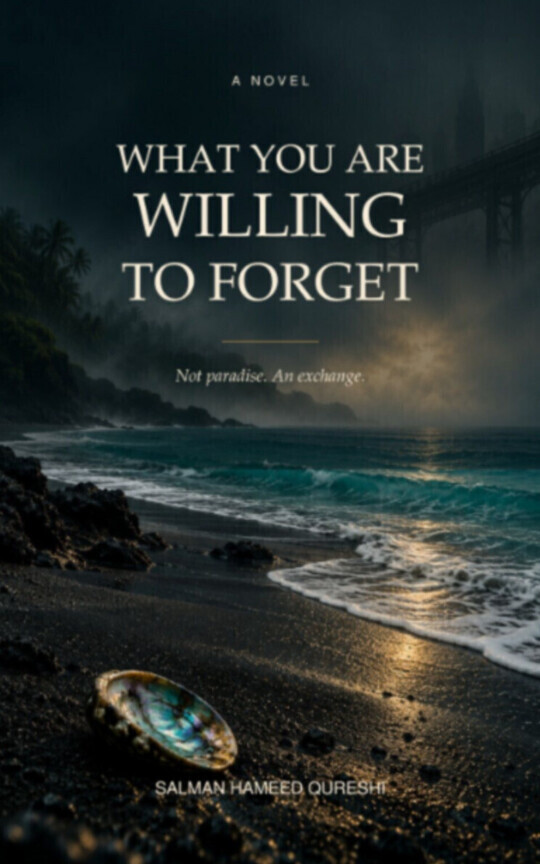

Chapter 01: The Soft Edge
The blackout in Astoria smelled of wet summer dust and the hot iron of the elevated tracks on 31st Street. Zayn remembered the sequence of failures with the granular habit of an analyst accustomed to auditing freight variances: the refrigerator humming down into sudden silence at 11:41 PM; the instantaneous death of the amber streetlamp glare against his bedroom blinds; and the chorus of six car alarms triggering in staggered unison three blocks south along Broadway.
He sat on the edge of his mattress in the dark, listening to the cessation of ambient noise. In New York, silence was never absence; it was the removal of sirens, leaving behind the low-frequency mechanical thrum of eight million window units vibrating through brick. When that thrum died, the city felt hollowed out, like a theatre after the house lights had been cut mid-scene.
He pulled on a pair of rumpled gray linen trousers and a faded navy cotton t-shirt, slid his bare feet into canvas slip-ons, and picked up his keys from the ceramic dish by the door. His phone battery read 43 percent. Holding the screen forward as a weak lantern, he walked down four flights of unlit stairs, rubber soles sticking slightly to the peeling linoleum treads. His intention was ordinary: walk two hundred yards to the corner of 31st Avenue, where the Yemeni grocer kept a diesel generator chained to the basement grate, and buy two gallons of Poland Spring water, saltines, and a pack of blue American Spirits.
He pushed through the heavy glass door of his building, stepped off the sandstone stoop onto the sidewalk, and paused.
The street was pitch black, save for a few bobbing flashlight beams in the distance. He looked up. For the first time in thirty-four years of living in the five boroughs, the sky was unbleached by sodium vapor. The Milky Way stretched between the dark cornices of the four-story tenements like spilled powder.
He took one step toward the curb.
There was no thunder. No rupture in the asphalt. No electrical shock.
Only an abrupt expansion of white light—not blinding, but absolute—that smelled of cold brine and crushed lime peel, like a tumbler shattered against dry ice.
* * *
When consciousness returned, it returned through the skin before the mind could assemble a defense.
Zayn was lying face down on an expanse of dry, fine sand. The texture against his cheek was startling—not the coarse silica of Jones Beach, littered with crushed filters and dried kelp, but something cool and powdery as sifted flour.
The warmth above him was radiant and clean. It was not the suffocating August heat of Queens that trapped exhaust against the pavement, but a deep warmth soaking into the meat of his back. A steady breeze blew off open water, carrying an alkaline freshness that filled his lungs with sharp clarity.
He pushed himself up onto his hands and knees, coughing, spitting white grains from his dry tongue.
His canvas slip-ons were gone. His linen trousers were gone. His t-shirt, his cotton boxers, his keyring with the brass fob to his lobby, his phone, and his Seiko Automatic—the brushed stainless steel watch with the black dial and the faint scratch across the mineral crystal over the four o’clock marker—were entirely absent. His wedding band, which he still wore on his right pinky out of seven years of unthinking muscle memory, was gone as well.
He was entirely naked.
Zayn scrambled to his feet, heart hammering against his ribs with the reflexive panic of an animal caught outside its enclosure. His hands flew to his groin, elbows pressed tight against his ribs, spinning in a tight circle, scanning the glare for police cruisers, delivery bikes, bodega awnings, or the rusted fire escapes of 31st Street.
There was no concrete. There were no wires. There was no glass.
He stood in the center of a wide crescent of white sand curving for two miles toward towering headlands of amber sandstone. Before him lay water so intensely turquoise it looked artificial, like a retouched brochure. Thirty yards out, the sea was transparent enough that he could make out the ribbed ridges of the bottom, the dark purple silhouettes of brain coral, and schools of silver fish darting through the shallows.
Behind the high-tide mark rose an unbroken wall of tropical canopy: fan palms, silver-trunked ironwood, and thickets of wild hibiscus heavy with scarlet blossoms.
“Hello?” he called out.
The sound of his voice was thin, dry, swallowed by the rhythmic sigh of the surf.
“Is anyone there? Hello?”
He took three stumbling steps toward the tree line, bare soles sinking into soft quartz. The sand was warm, but did not scorch. The air smelled of salt, damp loam, and blooming jasmine. A fugue state, his mind offered, grasping at clinical terminology. Heat stroke on 31st Street. An ambulance, or an emergency room at Mount Sinai Queens, and this is a hallucination triggered by hypoxia.
A hundred yards down the beach, two figures emerged from the green shadow of the forest.
Zayn froze, dropping into a half-crouch behind a mound of drift sand.
They were women. They were walking unhurriedly along the wet, packed sand where the surf flattened into glass.
Neither wore clothing.
One was tall, with honey-toned skin and dark brown hair falling past her shoulder blades. The other was shorter, broad-shouldered, with deep copper skin and tight curls framing a sharp face. The taller woman carried a wide basket woven from split reeds, piled high with pale green fruit.
They were talking in low voices, their laughter drifting across the sand. They moved with the centered balance of people who had never worn rigid leather soles on pavement.
As they drew closer, Zayn felt a sickening rush of shame crawling up his neck. Thirty-four years of urban conditioning screamed that he was an intruder, a naked man hiding in the brush. He looked around frantically for a palm frond, a piece of driftwood, anything to shield himself.
The taller woman looked up from her conversation and caught his eye.
Zayn flinched, bracing for a scream, a defensive turn, or a demand to know what he was doing there.
None of those things happened.
She did not pause. She simply raised one sun-browned hand in an open greeting and offered a calm smile.
“Good morning,” she said.
Her voice was low and clear, carrying an accent with rounded vowels—someone who had spoken European languages in childhood before settling into neutral English.
Zayn straightened slowly from his crouch, arms clamped awkwardly across his chest. He cleared his throat.
“I... I don’t know where I am,” he managed to say. “Was there a transformer explosion in Queens? Did a ferry capsize?”
The two women came to a stop five paces away. The taller woman set her basket down on the sand with a soft rustle. Up close, Zayn saw the crust of dried salt along her collarbones and the fine laugh lines at the corners of her amber eyes. She was in her early thirties, looking at him with the quiet interest one might show an acquaintance arriving late to a garden.
“You’re thirsty,” she said. It was a statement of fact.
She reached into the basket, took a heavy green fig the size of a grapefruit, and split it down the middle with her thumbs. The interior was deep ruby-pink, glistening with clear nectar. A citrus-floral fragrance bloomed in the air. She extended one half toward him on her open palm.
Zayn stared at the fruit. His analytical mind, trained by a decade of reviewing contract clauses, looked for the catch.
“Technically,” he stammered, the habit of corporate evasion surfacing before he could stop it, “I don’t have my wallet. I don’t have currency on me. I can’t compensate you.”
The shorter woman with the copper curls laughed—a quick, bright sound. “Compensate with what, Zayn? Shells?”
Zayn’s hand froze mid-air. The blood drained from his face.
“How do you know my name?”
The two women exchanged a brief glance—the kind shared by people who had watched the same tide roll in for years.
“Lira told us you were waking up,” the taller woman said gently. “Take the fruit. The brine is on your tongue.”
Zayn looked from her eyes down to the glistening flesh of the fruit. His throat burned with a dry, metallic ache. Slowly, his fingers took the fig.
The skin was velvety. When he bit into it, the juice was shockingly cold, sweet without being heavy, with a tart undercurrent of lime and mineral salt. He ate the half in three bites, juice running down his chin. He had never tasted anything so sharp.
The taller woman picked up her reed basket and pointed toward a shadowed archway in the canopy twenty yards away.
“The freshwater spring is thirty paces along that path,” she said. “The basin is black basalt. You can wash the brine from your hair and drink.”
“Wait,” Zayn pleaded, wiping his chin with his forearm. “Please. What territory is this? What country? Is there a coast guard station?”
“The island is here,” she replied. “And you are here.”
Without waiting for further questions, both women turned toward the turquoise water. They walked into the surf, their bodies moving easily through the shallows until the water reached their waists. Together, they slipped beneath a rolling swell in a clean flash of sunlit shoulders.
Zayn stood alone on the white sand, the sweet taste lingering on his tongue.
The panic had not vanished, but it had lost its edges. In New York, panic had procedure: spreadsheets with red numbers, emails from directors, lease agreements, court dates. Panic had forms.
Here, there was nothing to push against. The total absence of friction felt like falling into warm water.
Establish coordinates, he told himself. Measure what you can.
He turned toward the tree line and found the dirt path. The shade beneath the canopy was twenty degrees cooler. The air smelled of damp moss, decomposing cedar, and wild vanilla.
He counted his paces aloud: “One, two, three... twenty-seven, twenty-eight.”
On the twenty-eighth pace, the path opened into a grotto of limestone boulders. In the center, cold water bubbled from a fissure in a massive block of black basalt, spilling over a stone lip into a deep pool before trickling through emerald moss toward the sea.
Zayn dropped to his knees at the edge. He plunged his face into the water, drinking in desperate gulps. It tasted of crushed mint and cold slate. He scooped handfuls over his head, scrubbing dried salt from his hair and shoulders.
When he stood up, dripping in the cool shade, his mind seized upon the necessity of a fixed point.
If you don’t mark where you started, you walk in circles.
At the edge of the grotto stood a slender coconut palm, leaning at a forty-five-degree angle toward the patch of sky above the pool. Its gray trunk was scored with distinct ringed ridges.
Beside the stream lay smooth volcanic stones and several large, heavy clam shells with sharp edges.
Zayn picked up a shell. Gripping it firmly, he approached the palm. With hard pressure, he gouged a horizontal notch into the bark, four feet above the mossy ground. He sawed the shell back and forth until he cut through the fibrous skin into the pale sapwood beneath. A small bead of fragrant resin welled in the wound.
“Marker Alpha,” he said aloud.
To make the point unmistakable, he gathered three gray stones from the stream bed. He knelt at the base of the notched palm and stacked them into a neat pyramid: two stones on the bottom, one balanced on top.
He stood back. The notch was five inches wide; the pyramid was solid.
“Point of origin,” he said.
He turned his back on the grotto and walked thirty paces down the path to the edge of the beach. He looked out at the ocean, noting the sun. It hung high in the sky, slightly south, blazing with steady brilliance. No clouds, no contrails, no ships.
He turned around to look back down the path into the forest.
The leaning coconut palm was gone.
In its place stood a broad, spreading jacaranda tree with smooth gray bark and a canopy heavy with pale violet blossoms.
Zayn’s breath seized.
He stepped forward, bare feet splashing through ferns, and reached the base of the jacaranda.
There, nestled in the green moss exactly where he had placed them, sat the three gray stones, stacked in their neat pyramid.
The tree was gone. The stones were still there.
“You’re looking for the line you cut,” a quiet voice said.
Zayn spun around, his heel catching in the moss.
Sitting on a fallen cedar log ten feet away was a woman.
She appeared to be in her early thirties, with long, straight black hair pulled back with a bone hairpin. Her skin was warm olive, her dark eyes clear and alert. Beneath her left ribcage, curving along the intercostal space, ran a pale scar—a healed surgical line roughly four inches long.
She wore nothing. But unlike the two women on the beach, her posture was erect and guarded—the posture of someone accustomed to reading difficult contracts.
“You took the tree,” Zayn said, his voice dropping into defensive gravel.
“Nobody took it,” she said. Her voice was steady and dry. She stood up from the log, meeting his gaze directly. “Things that are watched stay where they are. Things that are only remembered for a specific purpose tend to drift.”
“That’s physically impossible,” Zayn said, pointing at the violet blossoms. “I notched a coconut palm. A monocot. This is a dicot. Trees do not metamorphose into different botanical families in thirty seconds.”
The woman looked at him with mournful patience. “You have a great deal of vocabulary for a man without trousers.”
“I am an analyst,” Zayn said, his Queens defensiveness flaring. “Mercer-Vance Logistics at 450 Lexington. I reconcile inventory variances across distribution centers. I know how systems behave. What is your name?”
“Lira.”
“Lira,” he repeated, trying the name out like a key in a lock. “Who runs this place? Where is the administrative office? Who brought me here?”
“Nobody brought you, Zayn,” Lira said softly. She took two slow steps toward him, stopping just outside reach. Her dark eyes searched his face, lingering on his jaw and the pale band of skin on his right pinky. “You arrived because you ran out of room.”
“I have an active lease through next October on 33rd Street in Astoria.”
“And what were you doing in that apartment?” Lira asked.
Zayn hesitated.
“You were waiting,” she said. “You spent five years waiting for your marriage to die, and then two years waiting for someone to tell you what to do with the quiet. You walked down the stairs into the blackout because you hoped the street wouldn’t be there when you opened the door.”
A cold sweat broke out across Zayn’s forehead. “You don’t know me.”
“I know the shape of the room you left,” Lira said. She looked down at the stones at the base of the jacaranda. “You can walk along the shore to test the perimeter. You can build a raft. Nobody will stop you from trying to leave.”
“Has anyone left?”
Lira was silent for several long seconds. The trade wind rustled the violet blossoms, dropping petals across her dark hair.
“Some have walked very far,” she said quietly.
“Did they get back?”
“They walked until they stopped asking if they were back.” She looked directly into his eyes, her expression unsparing. “Let me ask you something, Zayn, before you start walking.”
“What?”
“What are you willing to forget?”
Zayn stared at her. The question felt like an ambush—not an intellectual riddle, but a scalpel sliding between his ribs.
He opened his mouth to deliver a sharp retort about spreadsheet models, quarterly KPIs, his 401(k), the N train route.
Instead, he closed his eyes and tried to summon New York.
He tried to picture the sidewalk outside his building on 31st Avenue—the specific square of concrete where delivery bikes were chained to the standpipe.
He could remember the smell of the halal cart.
He could remember the sound of the chain rattling against iron.
He could remember the price of a can of seltzer at the bodega.
He tried to picture the color of the concrete.
Was it light gray? Dark charcoal? Was it stained with motor oil, or cracked by frost?
He opened his eyes in the tropical sun.
The concrete was entirely gone.