
Chapter 1 Echoes Across the Infinite
Behold the vast and wonderful multiverse. An infinite collection of galaxies which stand alone, unique in their own plane of existence. As unaware of each other as are secluded neighbors in a universal cul de sac, these bubbles of reality drift through the cosmic ether, each spinning a singular thread of history. Yet, to look only at the surface is to see but a fraction of the tapestry. Peer well beyond the elements of creation, beyond the given rules of life, and you will see that they are all undeniably similar. They are mirrors reflecting the same fundamental truths, destined to be linked to one another by the invisible gravity of existence, whether they know it or not.
However, for this beginning, we must focus on the beauty of the distinct. While the worlds of the multiverse are, in essence, doppelgangers—sharing the anatomy of stars, the rhythm of gravity, and the ache of mortality—there are a few that possess elements so singularly unique they defy the common logic of the cosmos. Whether these anomalies are the fruit of natural evolution or the scar tissue of a catastrophic event brought about by the meddling of their inhabitants, they stand apart. Their cultures, core beliefs, and governing mechanisms shift like light through a prism as one moves from one world to the next.
Consider Moja. To the inhabitants of the third planet gravitationally bound to its central star, the universe is a finite, singular concept. As far as they know, their home is the only world there is. But Moja is a world of defiant architecture. Here, the tectonic plates, those restless giants that shatter the geography of other worlds, have remained static. The continents never split; they never drifted across the globe to isolate cultures behind oceans. Instead, they remain a cohesive, sprawling landmass that breathes as a single entity.
At the heart of this vast, unbroken expanse sits Alkebulan. It is more than a continent; it is the magnificent womb of all life. From the verdant jungles that whisper secrets to the wind to the towering plateaus that scrape the belly of the clouds, every plant, every beast, and every pulse of intellect blossomed from this sacred soil. It is a world where nature did not fight itself for space, but rather layered its history in strata of vibrant, concentrated life.
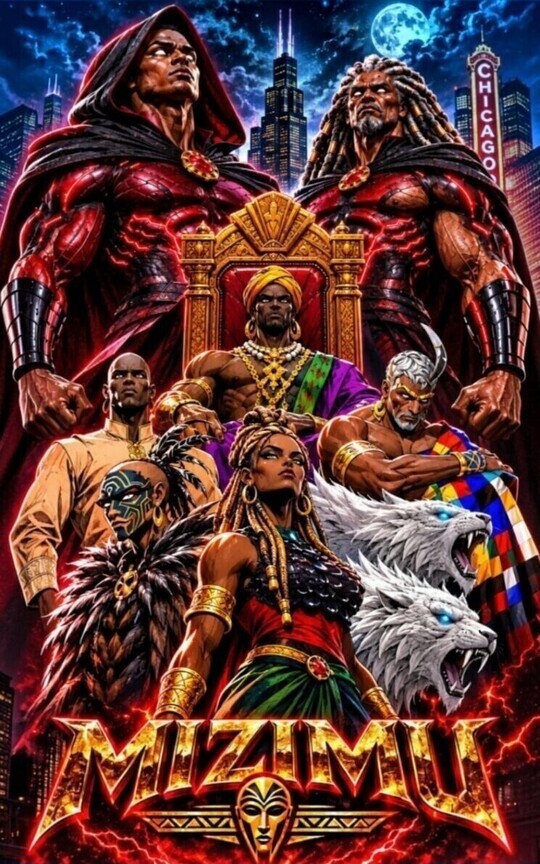
Today, the air over Alkebulan is heavy, not with humidity, but with the electricity of anticipation. On the sacred grounds of the Principal Village of Twa, the world is gathering for a momentous event: the inauguration of a new epoch. This is the ritual of Xu Shai—the Time of Transference.
The Xu Shai is a ceremony of profound duality. It marks a great ending, a shedding of the old skin of history, but it signifies that the greatness of the past will continue, channeled through the vessels of the future. To witness the Xu Shai is to witness the heartbeat of Moja. The villagers of Twa, adorned in silks dyed with the crushed pigments of the iron rich soil, stand in perfect, concentric circles. There is no chaos here, only the rhythmic vibration of drums that sound not like instruments, but like the pulse of Moja itself.
During this ceremony, the people of Moja do more than celebrate a transition of power; they commemorate the way of the first, KaJama, the Kwe Nu. To understand Moja, one must understand the man who gave it its soul. KaJama is Moja’s first global Lord and the Father of its divine ethos. His philosophy is carved into the very foundation of the village, repeated by every child before they can hunt or harvest:
"The fall of all and the rise of one."
It is a paradox that defines the Mojan spirit. Nineteen hundred and nineteen years ago, the land was a cacophony of competing tribes, a fractured mosaic of ideologies teetering on the brink of self destruction. It was then that the warrior, Chief KaJama, rose to become the instrument of action. History speaks of him not as a conqueror who sought to erase the identities of the tribes, but as a catalyst who sought to synthesize them. He understood that for the many to survive, the many had to become a singular, unified intent.
His rise was the "fall of all"—the collapse of the petty, warring personas of the clans—and the "rise of one," the birth of the Kwe Nu, the collective consciousness of Moja. Through actions that were as brutal as they were visionary, KaJama brought equilibrium to the lands of Alkebulan. He replaced the borders of blood with the borders of belief. He codified the laws of sustainability, ensuring that since the land could not spread, the people would have to learn to live in depth rather than width.
As the sun begins to reach its zenith over Twa, the elders step forward. They hold the ritual staff of the Kwe Nu, a relic fashioned from the first tree that sprouted in the center of the village. The atmosphere is thick with the weight of nearly two millennia of continuity. They are not merely performing a ritual; they are anchoring their reality. They are reminding themselves—and perhaps, in some subconscious bridge of the multiverse, reminding the other worlds—that unity is a choice made daily.
Watching this from the perspective of the multiverse, we see the true significance of Moja. In a sea of infinite chaos, Moja is a monument to the power of the singular. While other worlds fracture, break, and drift into the silence of isolation, Moja holds fast. It is a world that chose to be whole.
As the Xu Shai reaches its climax and the new leader steps into the circle to accept the mantle of the Kwe Nu, we must ask ourselves what we learn from this secluded neighbor. Is it possible that the "link" between worlds is not physical, but ideological? That the struggle to reconcile the "all" and the "one" is the universal constant?
Moja continues its orbit, beautiful and distinct, a bright gem in the universal cul de sac. It remains blissfully unaware that it is being watched by the infinite, yet it fulfills its role perfectly. It teaches us that even when existence seems finite, even when geography is fixed and destiny feels penned in ink, there is always room for the ritual of change. The Xu Shai ensures that the legacy of KaJama does not fade into the dust of the nineteenth century of his reign, but remains a living, breathing force.
And so, the ritual concludes. The drums fade, the transition is sealed, and the Kwe Nu begins another four centuries of stewardship. On Moja, the continents remain still, held together by the gravity of their history. The multiverse, vast and indifferent, rolls on. But somewhere, in the silent, shimmering spaces between galaxies, the echo of the Mojan drums lingers—a reminder that in the grand, infinite collection of existence, it only takes one world to prove that unity is the ultimate truth of the cosmos. For now, the ceremony is done, the path is set, and the greatness of Moja continues—linked to us all, whether we acknowledge it or not.