Chapter 0: The Mother Tree
So it is told in Silveria. So the elders teach it to the children, by lamplight, on the eve of the tithe, when the little ones ask why there is hunger in the world.
Before the kingdoms, before the empire, before the walls, there was the paradise of Great Iam.
It was a place without winter and without weeping. There the day never ended: it turned to gold, then to silver, then to gold again, and no one had ever seen a star go out. All things breathed, and sang, and were, in perfect order. The Seraphim, six-winged, burned with devotion about the throne. The Cherubim kept watch over wisdom. The Thrones, vast wheels of justice, held in balance all that Iam had made. Every creature knew its place and loved it. No one ruled with a lash, for no one had need of one. Heaven was obedient out of love.
All of it flowed like one long melody. Everything, except the clay.
For Iam, in His boundless goodness, wished to make creatures of the earth as well. He took a handful of clay from the edge of the Garden, warmed it between His hands, and from it shaped a man and a woman: Jacob and Lilith. He breathed into their mouths. The clay became flesh, and the flesh knew cold, and knew hunger, and knew sleep.
They were frail. They sweated. They wounded themselves on thorns. But Iam gave them a gift He had given to no angel, not to the Seraphim, not to the Thrones: the freedom to choose.
“I am with you,” He told them. “Be happy.”
And for a long time, they were.
* * *
Lilith loved the heavens as they were. She gave names to things, because she loved to hear them answer: the river, the grass, the wind that tangled her hair. She would sit and listen to the choir of the Seraphim until she fell asleep with her head in Jacob’s lap. It was enough for her.
It was not enough for Jacob.
He loved Lilith too. This the elders did say, and they said it slowly, for it was the part that grieved them most. He loved her with the meekness of one who has a single thing that is truly his own. But Jacob watched. He watched the wings, he watched the light, he watched how the angels need never sleep, nor age, nor scratch at their skin, and something within his chest began to ache, though he could not have said its name.
The lesser angels, those not yet ripened into the legions, hovered about the pair with a curiosity that was not always kind. They perched upon the low branches and looked down at them from above.
“Why do they scratch themselves?” one would ask.
“Because their skin itches,” another would answer, and they would laugh.
They mocked them for being unable to fly. They threw fruit at them to watch them stain themselves. They aped their clumsy gait, the way they huddled against the cold, the sound of their empty bellies. When Jacob stumbled, the chorus of laughter followed him until he was out of sight. Once they shoved him into a stream amid applause, and he had to drag himself out, soaked, streaming with water and shame, while above his head a cloud of white wings drifted off amid peals of laughter.
That night Lilith wove him a crown of flowers and set it upon his head.


“Pay them no mind,” she said. “They are children.”
Jacob smiled. He let her see the smile. Then he waited until she slept, and took off the crown, and unmade it, flower by flower, in the dark.
Children’s things, say the elders of Silveria. Mischief without malice. No angel ever meant harm.
But Jacob kept them all. Every laugh, every glance, every finger that pointed at him fell upon his chest like a stone. Lilith shrugged and went on her way. Jacob counted them. He measured himself against them, and each time he came away the lesser, and that wound he named injustice.
* * *
One day Iam called the pair to the edge of the Garden, beneath the first of the trees. He showed them the vastness of what He had given them: the rivers, the fruits, the glades where the light came down warm.
“Of all this you may take,” He said, and His voice was deep and calm, as a father’s is. “All of it is yours, save one thing. Beyond those hills stands the Mother Tree. Its fruits are Mine, and to no one is it given to touch them. Whoever touches them shall not return to what he was.”
Lilith nodded with her head bowed. Jacob nodded too. But he went on gazing at the hills long after the voice had faded.
The days passed. Jacob stopped eating with Lilith, and she noticed. She asked him once what he was looking at, when he looked so far away.
“Nothing,” he answered.
That was his first lie.
Lilith knew it. She knew it by the way he avoided her eyes, and she said nothing, for she did not know that one could lie, and did not wish to learn it. She only took his hand, and pressed it a little harder than was needed.
One night, when the choir of the Seraphim lulled the realm to sleep, Jacob rose without a sound. He stood a moment beside Lilith, watching her sleep. He could have stayed.
He set out toward the hills.
* * *
He crossed the valley barefoot, beneath a silver light that never wholly died. When he reached the heights, he stopped. Below, in a clearing, stood the Mother Tree.
It was like no other tree.
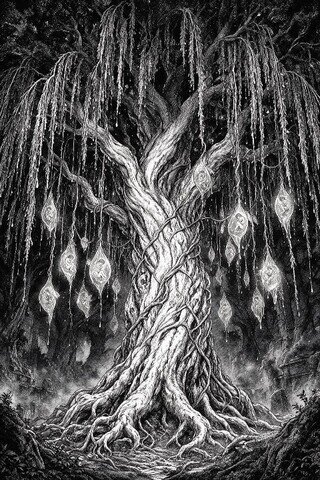
It was vast and pale, a sickly white like soaked bone. Its roots throbbed beneath the earth like golden veins, and with every beat the ground swelled and slackened, like a breast that draws breath. The bark was covered in a warm dampness that shone in the light and dripped without a sound.
And from its branches hung the fruit.
They were babes. Hundreds of angel babes, swaddled in cocoons of milky light, clinging to the boughs by fine, pulsing cords that vanished into the bark. They slept curled upon themselves, knees drawn to their chests, tiny wings folded across their backs. Their eyelids were closed, but beneath them their eyes moved slowly, as though they all dreamed one and the same dream. They breathed as one. Hundreds of tiny chests rising and falling in the same measure, and in the clearing there was no other sound but that damp, even murmur, like a choir of sleeping lips.
Now and then one would open its mouth and move its lips without a sound, as if it suckled at something that was not there.
They awaited the day of their ripening, when they would join the legions of heaven. That was what an angel was: a thing that had first hung from a branch. The air smelled of power, of eternity, and beneath that, of warm milk.
Jacob stood motionless a long while, listening to the tree breathe.
He remembered the voice of Iam. He remembered Lilith, asleep far away, her hand still open where his had been. He took a step back.
But the hunger that Iam had not given him, the one born in him alone, tightened about his chest. He took another step, this time forward.
And another.
He came to the lowest branch. His hands, stained with the earth of his making, closed with care around the luminous form of a winged infant. He hesitated, and for an instant all of heaven seemed to hold its breath. Then he pulled.
The cord snapped with a wet crack. From the trunk welled a thread of golden light that ran away into the soil.
Jacob opened his mouth and sank his teeth into the divine flesh.
* * *
It was warm. That was the first thing he thought, and it seemed a cruelty to him that it should be warm. The cocoon of light gave way, and what lay within stirred. Two small hands opened against his face, tiny, the fingers still fused like those of one not yet finished being born. One of them touched his cheek. Touched his lips.
The little one woke.
It did not cry out at first. It opened its eyes, which were enormous and without shadow, and looked at Jacob with perfect trust, the trust of one who has never known harm. And then the first mouthful reached the bottom of him, and Jacob felt something fill his throat, golden, thick and burning, tasting of scorched honey and of iron.
The weeping was a thin thread, shrill, almost musical. Tiny feet kicked against his chest. Jacob bit down and heard it crunch, a soft and slender sound, the sound of a thing not made to break. He wished to let go. His hands would not obey. His mouth went on working by itself, and the gold ran down his neck and stained his chest, and with every swallow something within him opened, ravenous, vast, and begged for more.
The weeping ceased all at once.
Only the sound of chewing remained.
All around him, upon the branches, hundreds of little ones went on breathing in unison, without waking. But the measure had changed. They breathed faster, in broken gasps, and one of them, the nearest, moved its lips and let slip a sleeping moan, as though it dreamed that something hurt.
Jacob swallowed the last piece. He stayed upon his knees, hands open, wrists dripping, staring at the empty branch where the cord still throbbed, seeking something that was no longer there.
The tree let out a long, silent groan that shook the ground beneath his knees.
Then, say the elders, heaven fell silent. And the punishment began.
* * *
They say the first thing was the heat.
A heat that rose from Jacob’s belly, as though he had swallowed a furnace. He fell to his knees beside the roots of the Mother Tree and vomited a black liquid that smoked where it touched the grass. His entrails boiled. He tried to scream and no voice came.
His body of clay was not made to hold the essence of a god.
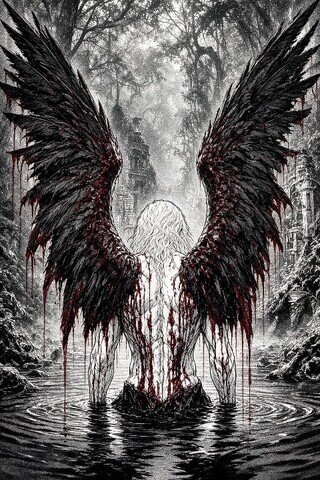
His bones lengthened with a dry crack. They broke and knit again into sharp, twisted shapes that no human body should bear. The skin of his back swelled, as if something strove to come out from within, and tore open with a wet rending. From the wound rose two immense wings, but not of light: they were of a deep blackness, drenched, dripping with their own birth.
His copper skin dried in moments and left him pale, cold as marble. His jaw wrenched from its joint. His nails became claws of obsidian. When at last he raised his eyes, his human eyes were gone. In their place burned two pits of incandescent red, and from them fell thick tears that would never cease to fall.
He was no longer clay. Yet neither was he light. He was something the world had never seen.
The elders of Silveria lower their voices at this point. They say even the wind stopped blowing.
* * *
Lilith woke to the scream.
She had heard it within her dream, and knew before she opened her eyes that it was Jacob’s voice. She ran barefoot through the valley, thinking of nothing, and when she reached the crest of the hill, she stopped. Below, among the pale roots, something knelt.
She saw black feathers. She saw scraps of gold upon the grass. She saw the opened back, and the wings, and she pressed her hands to her mouth so as not to cry out.
The creature turned its neck toward her, slowly. There was a sickening crack.
Lilith went down the hill. She did not know why. Perhaps because he was the only thing she had ever known, and her legs carried her before fear could.
“Jacob...?” she whispered, halting a few paces away. “Jacob, what have you done?”
The being rose to its feet. It was far taller than Jacob had ever been, and around it the heavenly leaves withered in an instant.
“That name belongs to the earth,” it answered. It was no longer a man’s voice, but a deep and frozen echo. “I am Lucyfer.”
Lilith stepped back. Her eyes were full of tears. And yet she held out her hand.
“Iam will forgive you,” she said, though she did not believe it. “If you return now. If you beg His pardon... I will stay with you. I promise. Come.”
Lucyfer looked at Lilith’s open hand for a long while.
It was the same hand that had taken his that night, in the grass, when he lied. The same that had set a crown of flowers upon his head. In it he saw all that he had been: the weakness, the cold, the clay, the humiliation of one who measures himself and falls short. She alone had known him before, she alone knew who Jacob was. To become something new, he thought, he must tear that out by the root.
Lilith saw his face change, and understood. She drew back her hand.
She ran.
She did not get far. Lucyfer vanished from where he stood and appeared before her in the blink of an eye. His hand closed about her throat and lifted her from the ground. Lilith kicked, clawed at the pale arm without leaving so much as a mark.
“Jacob,” she managed, with what air she had left. “Please.”
There was no mercy in the red eyes. Lucyfer raised his other hand and plunged it into Lilith’s chest as easily as one tears an old cloth.
She did not cry out. She only looked at him, her eyes wide and filled with an almost childlike surprise, as if she still waited for him to stop. Then the light left her face.
The breath that left her mouth was the first sound of death ever heard in the realm of Iam.
Lucyfer drew back his hand and let the body fall upon the roots of the Mother Tree. What ran upon the grass mingled with the gold spilled from the fruit. The tree, behind him, had begun to weep.
He stood, breathing, his wings still wet. Then he spread them slowly, to their full span, and cast upon the clearing something that had never before existed in heaven.
A shadow.
* * *
The elders say that Iam came down that night.
There was no thunder. The Seraphim fell mute in the midst of their song. The sky, which had never known dusk, darkened from end to end, and for the first time there was a place the light did not reach.
Iam looked upon the body of Lilith lying across the roots. He looked upon the wounded tree. He looked upon the creature that had been Jacob, and spoke without raising His voice.
“What have you done with what I gave you?”
Lucyfer did not answer. He did not retreat, nor bow his head.
Then Iam, who was good, wept. The elders say it was the first time heaven saw its God weep, and that every tear fell upon the earth and became rain. And after that the Thrones rose up, and the Seraphim spread their six wings against the shadow, and cast him out of paradise, down, down toward the clay from which he had come, and his fall lasted nine days and nine nights.
But the shadow did not fall alone. With it fell the hunger for what one does not have, the envy, the thirst to be more. And these things, they say in Silveria, mingled with the clay from which Iam had made men. That is why the children of Jacob are born cold. That is why they are born hungry. That is why, in every generation, there are those who look upon their neighbor’s table and feel something gnawing within.
It is the venom of Lucyfer, they say. And it does not leave.
Since then, every shadow belongs to him. And that is why children must sleep with a lamp burning.
* * *
In Irlia, where oil is scarce and the lamps go out before the children fall asleep, the tale is told as well. But it is told less often, and more softly.
That night, as the rain fell upon the tin roofs, an oil lamp burned low in a rented house. And in the darkness that was drawing near, someone was about to be born.