
CHAPTER ONE
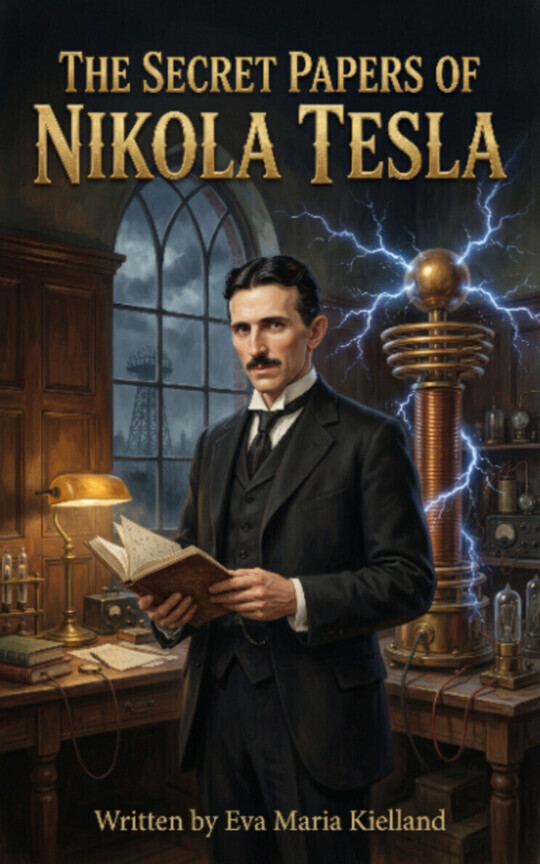
THE SECRET PAPERS OF NIKOLA TESLA
Genius, Sabotage, and the Missing Trunks of Room 3327
Written by Eva Maria Kielland
Prologue
Room 3327 at the Hotel New Yorker
On the morning of Friday, January 8, 1943, a maid at the Hotel New Yorker in Manhattan unlocked the door to Room 3327—ignoring the “Do Not Disturb” sign that had hung on the handle for two days—and found eighty-six-year-old Nikola Tesla lying peacefully in bed, dead alone and deep in debt.
On paper, it was the quiet end of a forgotten eccentric. Newspapers printed polite obituaries praising the elderly Serbian-American inventor who had helped light the modern world half a century earlier before spending his final years feeding pigeons in Bryant Park.
Yet behind closed doors in Washington and New York, the reaction to Tesla’s death was anything but quiet.
Within hours of his body being discovered, agents from the U.S. Office of Alien Property—accompanied by FBI personnel and military intelligence officers—swept into Room 3327, cracked open Tesla’s hotel safe, and confiscated dozens of locked trunks, metal boxes, notebooks, and technical blueprints stored across Manhattan hotels and warehouses.
That urgent seizure raised an immediate legal and historical puzzle. Under federal wartime law, the Office of Alien Property only had authority to seize the belongings of enemy nationals—yet Nikola Tesla had been a naturalized United States citizen since 1891. Why did government agencies break their own jurisdictional rules to confiscate every scrap of paper belonging to a supposedly penniless, retired inventor?
Over the next eleven chapters, we will trace Nikola Tesla from a midnight lightning storm in his childhood village to the War of the Currents, his secretive Colorado Springs laboratory, the sabotage of Wardenclyffe Tower, and the classified vaults where his missing trunks vanished after January 1943.
Chapter One
The Boy Who Harnessed Lightning
Every great scientific mystery begins with a mind that sees the world differently from everyone else around it.
Nikola Tesla was born at midnight between July 9 and July 10, 1856, in the mountain village of Smiljan in the Austrian Empire (modern-day Croatia)—during a fierce summer lightning storm so violent that the midwife reportedly called him a “child of darkness,” to which his mother replied, “No. He will be a child of light.”
From early childhood, Tesla possessed an extraordinary eidetic memory and an almost uncanny ability to visualize complex machines in three dimensions inside his head. Without ever drawing a blueprint or building a wooden prototype, he could assemble an entire electrical motor in his imagination, run it for weeks in his mind, and inspect its imaginary parts for wear and tear.
After studying physics and engineering in Graz and Prague—and working for telegraph and telephone companies in Budapest and Paris—twenty-seven-year-old Tesla boarded a steamship bound for New York City in June 1884. He arrived at Castle Garden immigration station with four cents in his pocket, a book of poetry, calculations for a flying machine, and a letter of introduction to America’s most famous inventor: Thomas Alva Edison.
The letter, written by Edison’s European manager Charles Batchelor, contained a single prophetic sentence: “I know two great men and you are one of them; the other is this young man.”
Within months, those two great men would become bitter rivals in a technological battle that shaped the modern world.