𝕾𝖎𝖑𝖛𝖎𝖆 𝕶𝖗𝖕𝖆𝖙𝖔𝖛𝖆
@silvia121
Inkitt is a little unfriendly to my books in formatting (and promoting). For a smoother reading experience, find them on Wattpad in perfection :) https://www.wattpad.com/user/SilviaKrpatova

𝕾𝖎𝖑𝖛𝖎𝖆 𝕶𝖗𝖕𝖆𝖙𝖔𝖛𝖆
6 months ago
Did you know that two other writers get constantly credited with Steven King's quote about killing our darlings?
One is William Faulkner. The other is Allen Ginsberg, who actually believed the opposite— his famous writing mantra was: "First thought, best thought."
He and Jack Kerouac believed that your initial, raw, uncensored impulse was where the true art lived. They felt that traditional, heavy-handed editing often stripped the soul and rhythm out of prose. Kerouac famously wrote On the Road on a single, continuous scroll of telegraph paper precisely so he wouldn't stop to look back and cut things.
The actual credit for our quote goes to a British professor and author named Sir Arthur Quiller-Couch. During a lecture at Cambridge University (1914), he told his students:
"Whenever you feel an impulse to perpetrate a piece of exceptionally fine writing, obey it—whole-heartedly—and delete it before sending your manuscript to press. Murder your darlings."
Over the decades, writers swapped out the word "murder" for "kill," and it became a staple of writing workshops.
Stephen King later popularized the modern, blunt phrasing in On Writing, cementing it into the minds of modern authors.
𝕾𝖎𝖑𝖛𝖎𝖆 𝕶𝖗𝖕𝖆𝖙𝖔𝖛𝖆
6 months ago
When people think of writing, they picture the romantic part—the lightning strike of inspiration. But professionals know that the real book is built during the rewrite.
Stephen King popularized an editing rule in his memoir On Writing that has broken the hearts of creators for generations:
"Kill your darlings, kill your darlings, even when it breaks your egocentric little scribbler's heart, kill your darlings."
A "darling" is a line of dialogue, a character, a description, or a whole scene that you, the writer, absolutely love. You think it’s the cleverest thing you’ve ever written.
The problem is that sometimes your most brilliant sentence doesn't actually serve the story. It’s just you showing off. You’re standing in front of the camera instead of letting the characters speak.
Editing requires zero sentimentality. If a beautiful 4-page backstory slows down the pacing of a thriller, it has to go. King is telling us that to make a piece of writing great, you have to be willing to murder your favorite parts for the good of the whole.
𝕾𝖎𝖑𝖛𝖎𝖆 𝕶𝖗𝖕𝖆𝖙𝖔𝖛𝖆
8 months ago
Just a quick update for those who might be waiting for the new chapters in A Kind of Magic and Of Tales and Rabbit Tails
I'm still unable to save the chapters I upload to the app. It allows me to create the draft but then doesn't let me save the chapters, insisting that I did not enter a title. Every time I try to save a chapter I get the same message and the chapter multiplies in the draft. I have to restart the phone to save each chapter and delete the copies.... It's too difficult.
𝕾𝖎𝖑𝖛𝖎𝖆 𝕶𝖗𝖕𝖆𝖙𝖔𝖛𝖆
8 months ago
Just a heads up to the readers of my ongoing stories.
Inkitt hit me with yet another glitch - it won't save my chapters, insisting a title is missing, when it's there! This has been going on for days now and I can't solve it.
I'll keep trying and post the chapters as soon as this is solved by Inkitt.
In the meantime, for those who don't want to wait, you can read the my books on Wattpad.
𝕾𝖎𝖑𝖛𝖎𝖆 𝕶𝖗𝖕𝖆𝖙𝖔𝖛𝖆
10 months ago
𝕾𝖎𝖑𝖛𝖎𝖆 𝕶𝖗𝖕𝖆𝖙𝖔𝖛𝖆
a year ago
𝕾𝖎𝖑𝖛𝖎𝖆 𝕶𝖗𝖕𝖆𝖙𝖔𝖛𝖆
a year ago
𝕾𝖎𝖑𝖛𝖎𝖆 𝕶𝖗𝖕𝖆𝖙𝖔𝖛𝖆
a year ago
𝕾𝖎𝖑𝖛𝖎𝖆 𝕶𝖗𝖕𝖆𝖙𝖔𝖛𝖆
a year ago
My story has been shortlisted for the Wattys! :)
If anyone would like to vote for it over on Wattpad, you can do so from September 22-28.
𝕾𝖎𝖑𝖛𝖎𝖆 𝕶𝖗𝖕𝖆𝖙𝖔𝖛𝖆
a year ago
Today, I have a common parable for you :)
A disciple asks his Guru why he should continue to read books when he inevitably forgets most of what he reads.
The Guru then tells the disciple to take a dirty, old sieve and fetch water from a nearby pond. The disciple is confused, knowing that a sieve has holes and cannot hold water, but he obeys. He goes to the pond, scoops up water, and by the time he returns to the Guru, all the water has drained out.
The Guru tells him to do it again. And again. Each time, the water leaks out before he can bring it back.
Finally, the disciple, frustrated, asks, "Guruji, the sieve always drains out, so why do you keep making me bring water in it?"
The wise Guru smiles and replies, "Shishya (disciple), the sieve may not have fetched you the water, but if you have noticed, in the process, the sieve itself has become clean."
The moral of the story is that while you may not recall every single piece of information from every book you read (the water), the act of reading (the process of fetching water) still has a profound effect on your mind (the sieve). It cleanses, refines, and shapes your thinking, even if the specific details fade away. You might not remember every plot point or fact, but the act of engaging with ideas, expanding your vocabulary, and experiencing different perspectives subtly changes and improves you.
I just love this one :))) You?
𝕾𝖎𝖑𝖛𝖎𝖆 𝕶𝖗𝖕𝖆𝖙𝖔𝖛𝖆
a year ago
Long time no see :)
This app is still as difficult as it has been, so I'm spending most of my free time on Wattpad. There's hope Inkitt will work properly one day for me, too. I can't wait to have a possibility to engage more on this platform with both readers and fellow writers ♡
In the meantime, find me on Wattpad for the complete Lost in the Castle trilogy and more stories ♡♡♡
𝕾𝖎𝖑𝖛𝖎𝖆 𝕶𝖗𝖕𝖆𝖙𝖔𝖛𝖆
2 years ago
I apologise for being inconsistent with updating my books lately, but I've been put off by how very, very, very slow this app became for a phone+app user like me.
However, I just need to get on with it, I guess.... 😒
I just updated A Kind of Magic and promise to update Lost Without You soon. There're still one more book in Lost in the Castle trilogy after this volume :)
For those who prefer not to wait, all of my books are available on Wattpad.
𝕾𝖎𝖑𝖛𝖎𝖆 𝕶𝖗𝖕𝖆𝖙𝖔𝖛𝖆
2 years ago
𝕾𝖎𝖑𝖛𝖎𝖆 𝕶𝖗𝖕𝖆𝖙𝖔𝖛𝖆
2 years ago
A Kind of Magic is a 'lotresque' adventure romance for all lovers of epic quests, love at first sight, humour, the old Highlander movies, Lord of the Rings, magic, dragons, stubborn female leads...
Synopsis:
Alaric, the King of Silmarea, recently married to his beloved husband, needs an heir of his own blood to secure the throne.
With the help of Emrys, his court magician and best friend, he recalls his youthful escapades and discovers a daughter he once had with a woman he had loved in The World Beyond The Stones (our world).
He sends an unlikely but trusted trio on a quest to find her and bring her home-- a brooding dragon shifter and Highlander who owes him a favor, a dashing elf whom he loves like the son he never had, and a loyal, kindhearted dwarf, the elf's best friend.
Alaric, the last scion of the old gods, weary of ruling the country and ready to retire and enjoy his love life, doesn't know that this quest will bring much more than he ever bargained for, setting in motion events plotted by the destiny that will challenge his kingdom and legacy.
𝕾𝖎𝖑𝖛𝖎𝖆 𝕶𝖗𝖕𝖆𝖙𝖔𝖛𝖆
2 years ago
The vacant chair on her right was just beginning to claim Sophia's attention-- Who was the cousin they were all waiting for?-- while she listened to her Uncle James talking above the soft clutter the servants caused as they moved around the table to fill everyone's plate with food no one would be allowed to touch until Aunt Jane's last visitor finally, most tardily, arrived.
"His Grace, the Duke of Chandos, Marquess of Carnavaron," the butler announced pompously a moment later.
A young man dressed just as fashionably as her aunt and uncle and their friends walked through the door and at the the sight of him, Sophia, barely stifling a gasp of surprise, felt underdressed in her black frock for the first time since she had arrived at Rosings.
The dashing young lord was, quite unmistakably-- she would recognise those almost elfin ears of his anytime because she used to tease him for them as often as he teased her for her freckle-covered, upturned nose-- the annoying Cousin Henry who never missed an occasion to pull her hair and skirts when they climbed the age-old trees of the forest spanning behind his family's Middlesex mansion eight years ago.
𝕾𝖎𝖑𝖛𝖎𝖆 𝕶𝖗𝖕𝖆𝖙𝖔𝖛𝖆
2 years ago
After a while, which could have been a minute or an hour, he broke the spell by letting his gaze drop at the book that I was clutching to my chest. He shook his head, smiling, and walked past me towards the door. When his arm brushed against mine, I felt my knees tremble, and I had to lean against the wall, lest I would fall. The man must have felt something unusual, too, because he looked at me again, but this time, even though I craved the sight of those strange, mysterious eyes, I avoided meeting them.
"Welcome to Castelul Bran," he said in a clear, imposing voice while closing the great door. It slammed shut, frightening me and leaving us in near complete darkness. A gust of cold wind rushed through the hall, and when my eyes got used to the tenebrosity, I saw him standing on top of the great stairs.
How did he get there so fast?
𝕾𝖎𝖑𝖛𝖎𝖆 𝕶𝖗𝖕𝖆𝖙𝖔𝖛𝖆
2 years ago
She looked through the open window and took another deep breath, the cool air filling her lungs, clearing her mind, as she noticed that the countryside finally started to change. The flat, neverending plain encompassing the town morphed into low, then higher hills, their contours blurring, then vanishing in the thickening dusk. Albert crawled slowly up the nearly empty, long, winding road, and Nora started to feel happier when she spotted her destination.
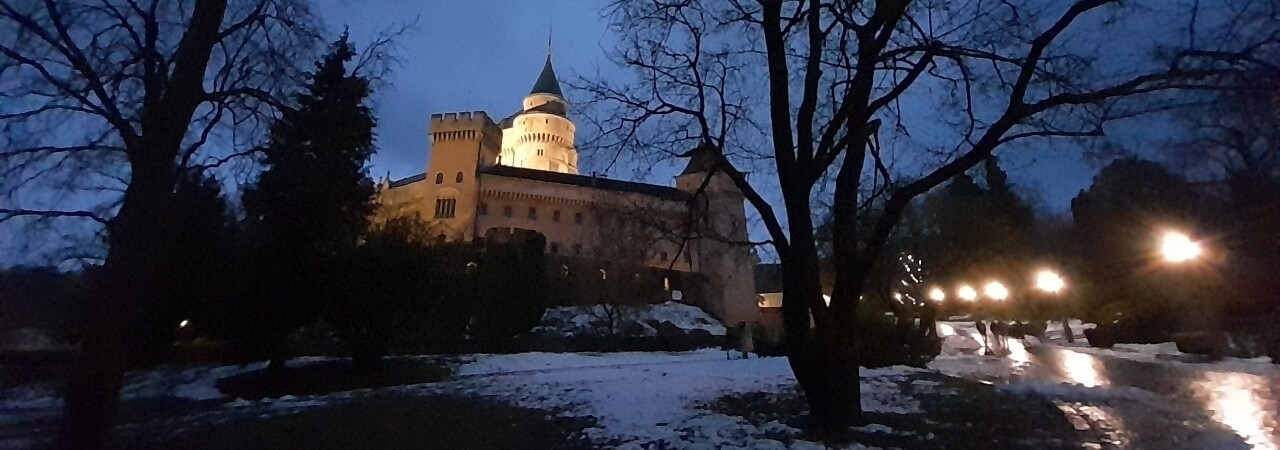
It was still quite far, but she could see the fairytale-like castle clearly now. Perched at the foot of a tall, forest-covered hill range, it was illuminated brightly against the velvety sky of the falling night. Since the owner decided to use one of its towers as a hotel, it looked much more lively. The old castle, usually forlorn and forgotten all winter, got a second chance at life.
𝕾𝖎𝖑𝖛𝖎𝖆 𝕶𝖗𝖕𝖆𝖙𝖔𝖛𝖆
2 years ago
Her reverie was disturbed by the sound of hoofbeats muffled by the layer of the first fallen leaves, reaching them from the forest beyond the clearing, followed by a faint clatter coming from Garreth's direction.
Turning towards her cousin, Ginny glanced from the tip of his crossbow, ready to shoot to the clearing at which it was pointing. A magnificent deer appeared in its middle, noble and proud like the king of the forest.
Garreth shifted his weight, adjusting the angle of his arm for the perfect aim when Ginny saw them-- a graceful doe, her hide shining like gold in the sunlight filtering through the branches, and a couple of the cutest fawns, the bright specks on their backs sparkling like dew-drops at sunrise. Without thinking, she bent down, unpredictable and impetuous like the wind, picked a pine cone, and threw it at her cousin, upsetting his fancy velvet hat, making him drop the crossbow with a clatter.
𝕾𝖎𝖑𝖛𝖎𝖆 𝕶𝖗𝖕𝖆𝖙𝖔𝖛𝖆
2 years ago
Pleasant shivers ran up my spine as I contemplated the haunting silhouette of the castle, set against the backdrop of the tree covered hills of the Carpathian Mountains. The motionless trees were incredibly colourful, as if painted by an eccentric artist, with thin stripes of fog coiling through them like a rugged veil. A stray ray of the sun, already beginning its descent towards the far horizon, illuminated a narrow, silvery ribbon of water rushing along the bottom of the deep gorge on the right side of the road.
This view reminded me of the setting of Bram Stoker's book. I wanted to believe that this really was the castle that had inspired his story, and something more-- a special place where time stood still, and anything was possible. Especially on a Halloween night. Absorbed in my fantasies, it was easy to imagine hearing a distant, ominous howling of wolves, clatter of wheels of an invisible carriage rushing past me, and a silent, chilling laughter carried towards me on a swift gust of wind.
𝕾𝖎𝖑𝖛𝖎𝖆 𝕶𝖗𝖕𝖆𝖙𝖔𝖛𝖆
2 years ago
Away with the Fairies
This is a story about H. Ch. Andersen, about how he became a writer and why most of his stories are so sad and melancholic. Also, about why he never found real love... Yes, that's what I read about him (among other things)-- he kept falling in love with unatteinable women.
My story portrays Hans Christian Andersen as a young, fourteen-years-old boy. It's set in Odense, Denmark, in the late summer of 1818-- soon after Hans' mother, a poor washerwoman, remarried (two years after his father's death) and shortly before he was sent to a school for poor children where he had to support himself. Where he became, to be able to afford his schooling, first a weaver's, then a tailor's apprentice, a singer, an actor and finally, once his excellent soprano voice changed, a writer.
Hans and Louise, his (fictional) step-sister, seek refuge from a summer storm in an old shed. There, they meet Rosalind, a lost Flower Fairy. When they decide to help her find the Butterfly Fairy boy she loves and intends to marry, she takes them into a fantastical world of Terra Sonalis, her home. A land of dreams populated by fairies, goblins, elves, mermaids, talking animals... All those mysterious creatures that fuelled Andersen's imagination for the rest of his life.
𝕾𝖎𝖑𝖛𝖎𝖆 𝕶𝖗𝖕𝖆𝖙𝖔𝖛𝖆
2 years ago
Let it Snow!
'Despite the freezing mist emanating from the countryside streaked with half-melted patches of snow, she rolled down the window and breathed the place in. The air had changed immediately after she had driven through the large, busy town, the last one of many standing between the city where her stepmother lived and her new home, the heavy traffic thinning into a lazy trickle even as her anxiety morphed slowly into a calm, and then the first real excitement. The world here smelled of snow, pine needles, and the damp soil of the narrow fields lining the road on both sides. To her, this was the most beautiful scent, the perfume of happy memories.'
𝕾𝖎𝖑𝖛𝖎𝖆 𝕶𝖗𝖕𝖆𝖙𝖔𝖛𝖆
2 years ago
In the world where love doesn't exist, a girl who understands old novels better than reality is sent to save her medieval country existing centuries in the future from creatures who, just like love, were not supposed to be real.
Astrid, a child-adult princess who never set foot beyond the walls of her castle, learns on reaching the age of ascension when all future queens must face a trial, that she lived surrounded by a web of lies.
Her search for fallen angels, enemies of her kingdom, becomes a quest for descovering the truths and finding love.
𝕾𝖎𝖑𝖛𝖎𝖆 𝕶𝖗𝖕𝖆𝖙𝖔𝖛𝖆
2 years ago
She would be such a marvellous addition to their household, well bred, meek and demure as she was, a thing becoming always rarer in the new generations, Lady Jane mused, smiling at the girl as she approached her, reaching out and pushing one of her indomitable auburn curls that had escaped her chignon behind her ear. The children adored her, and she, with her wisdom beyond her seventeen years paired with her infinite patience, would be a perfect governess... But it would be below her social status. Even though reduced to almost poverty by the vicissitudes of life, Sophia's family was just as important as Jane's. Her distant cousin's eldest daughter should marry well to help her unfortunate parents and not seek employment. And Jane would help her with that.
~~~
Sophia Save the Queen is a Christmassy short story set in the Victorian era. Give it a read and let me know what you think :)
𝕾𝖎𝖑𝖛𝖎𝖆 𝕶𝖗𝖕𝖆𝖙𝖔𝖛𝖆
3 years ago
𝕾𝖎𝖑𝖛𝖎𝖆 𝕶𝖗𝖕𝖆𝖙𝖔𝖛𝖆
3 years ago
If you like H. Ch. Andersen's fairy tales open my new story, Away with the Fairies. It might just be your cup of tea ;)
𝕾𝖎𝖑𝖛𝖎𝖆 𝕶𝖗𝖕𝖆𝖙𝖔𝖛𝖆
6 months ago
The Magical Realist perspective of writing: Gabriel García Márquez
Gabriel García Márquez (One Hundred Years of Solitude) was the king of making the impossible feel completely ordinary—ghosts eating dinner, rain falling for four years straight, people floating away into the sky.
You’d think a guy who wrote like that would have a very whimsical, airy view of writing.
Instead, he dropped this quote: "Ultimately, literature is nothing but carpentry... Both are very hard work. Writing something is almost as hard as making a table. With both you are working with reality, a material just as hard as wood."
This is the ultimate antidote to the "fluffy artist" stereotype.
The craft is physical: Márquez believed that writing isn't about waiting for a magical muse. It’s manual labor. A table has to stand on four legs; if the joints are loose, it collapses. A story is the same. Even if you are writing about a man with giant wings, the technique of the sentences must be structurally sound, or the reader won't buy it.
He stripped the mystery away to show that "magic realism" is just incredibly precise woodwork. You measure, you saw, you sand down the rough edges. It takes a ton of sweat to make something look effortless.
𝕾𝖎𝖑𝖛𝖎𝖆 𝕶𝖗𝖕𝖆𝖙𝖔𝖛𝖆
6 months ago
Today, let's look at one of the most profound voices in American literature: James Baldwin.Baldwin wasn't just a novelist and essayist; he was a witness to history. His prose has a rhythmic, searing clarity that cuts right to the bone of human psychology and societal tension. He had a brilliant way of looking at the cultural duty of an artist, captured perfectly here:"The importance of a writer... is that he is here to describe things which other people are too busy to describe."While Kafka looked inward at his own neuroses, and O'Connor looked at how the mind constructs thought, Baldwin looks outward at society.He recognized that most people are caught in the exhausting gears of survival—working jobs, paying bills, dealing with immediate friction. They don't have the luxury or the time to sit back and parse why they feel a certain ache, or why a culture is fracturing.To Baldwin, a writer's job is to stop running. They are paid in attention. A writer stands still, observes the subtle injustices, the unspoken griefs, or the fleeting moments of beauty, and puts a name to them.By describing what others are "too busy" to notice, the writer provides a mirror. When that busy person finally reads the book, they see their own hidden feelings articulated on the page and think, Yes. That is exactly how it feels. I just never had the words for it.Baldwin's perspective strips away the idea that writing is a selfish act. It’s not just about curing your own madness or figuring out your own thoughts—it is a public service. It’s a way of saying, "I see what you're going through, and I'm going to document it so it isn't lost."
𝕾𝖎𝖑𝖛𝖎𝖆 𝕶𝖗𝖕𝖆𝖙𝖔𝖛𝖆
7 months ago
Since Kafka gave us the 'tortured artist' vibe, let's pivot to Flannery O’Connor. She was a master of the Southern Gothic, known for her sharp wit and her refusal to sugarcoat the reality of the human condition.Her take on the writing process is less about 'monsters' and more about the hilarious, frustrating unpredictability of the mind:"I write only because I don't know what I think until I see what I say."While Kafka felt that writing was a release of something already inside him, O'Connor suggests that writing is a discovery tool.Many people think writers have a grand blueprint before they start. O'Connor argues the opposite: the act of typing or scratching ink onto paper is actually the process of thinking itself.Have you ever started a sentence and ended it somewhere you didn't expect? O'Connor leaned into that. She believed the 'truth' of a story reveals itself to the writer in real-time, often surprising them.It’s a very grounding quote. It takes the pressure off 'having a great idea' and puts the focus on 'doing the work to find the idea.'Fun Fact: O'Connor wrote most of her masterpieces while raising peacocks in rural Georgia. She once said she liked them because they were 'kingly' and 'difficult'.Does your brain work more like O'Connor's—where you have to talk or write things out to understand them—or do you usually have the 'vision' fully formed before you begin? I'm very much like her :)))
𝕾𝖎𝖑𝖛𝖎𝖆 𝕶𝖗𝖕𝖆𝖙𝖔𝖛𝖆
7 months ago
Guys, do all have your stories translated into other languages by Inkitt, for the purpose of growing audience?
I just found a ten days old email (Gmail hid it under promotions in my mailbox, and I missed it) telling me that my stories are translated unless I deactivate the option.
I like the idea and opportunity but how does this work? Can I see how good the translation is and in which languages my stories are available? I can't figure it out.
𝕾𝖎𝖑𝖛𝖎𝖆 𝕶𝖗𝖕𝖆𝖙𝖔𝖛𝖆
7 months ago
"A non-writing writer is a monster courting insanity." — Franz Kafka
Kafka’s brand of 'dramatic' usually came from a place of deep, personal agony. He viewed writing not as a hobby or even a career, but as a biological necessity.
For Kafka, writing was the only way to justify his existence. When he wasn't writing, he felt like he was physically and mentally rotting. He viewed his creative energy as a literal force trapped inside his body. If that force isn't channeled into words, it turns inward and becomes destructive.
A writer who doesn't write is 'monstrous' because they are living a lie. They have the sensibilities, the observations, and the sensitivity of an artist, but no output. This creates a disconnect between who they 'are' and what they 'do', leading to a sense of self-loathing. Without the 'drain' of the pen, the thoughts just loop. For Kafka, writing was the only way to organize the chaos of his mind. Without it, the chaos wins—hence, 'courting insanity.'
Kafka’s relationship with writing was a double-edged sword. He often felt that writing was a 'prayer,' but also a 'descent into the dark.'
Most writers feel a version of this 'Kafkaesque guilt.' It’s that nagging feeling that if you aren't producing, you are losing your identity. It’s a bit extreme, but for someone as tortured as Franz, the pen was quite literally his only lifeline.
If he wasn't capturing the absurdity of the world on paper, he was forced to drown in it.
Do you feel that pressure when you go too long without working on a project? I do! :)
𝕾𝖎𝖑𝖛𝖎𝖆 𝕶𝖗𝖕𝖆𝖙𝖔𝖛𝖆
8 months ago
An unreliable narrator is a character whose credibility is compromised, meaning the reader cannot fully trust their version of events. This device is one of the most effective ways to create suspense, as it forces the reader to act like a detective, sifting through the story to find the "objective" truth hidden behind the narrator's bias.
Reliability isn't a binary (true or false); it exists on a spectrum.
Unreliability usually stems from one of four core 'blind spots':
●Ignorance or Naivety The narrator lacks the experience or maturity to understand what they are seeing (often seen in child narrators or those from a different culture).
●Mental Instability
The narrator’s perception of reality is altered by illness, trauma, or extreme emotional distress.
●Personal Bias The narrator is so deeply opinionated or self-centered that they unintentionally colour every event with their own prejudices.
●Malicious Deception
The narrator knows the truth but actively chooses to lie to the reader to protect themselves or justify their actions.
Authors rarely come out and say a narrator is lying. Instead, they use specific literary 'tells':
●Inconsistencies
The narrator describes a scene one way but later mentions a detail that contradicts their previous statement.
●Gaps in Memory Frequent use of phrases like "I don't recall" or "Everything became a blur" suggests the narrator is hiding a specific moment.
●Hyperbolic Language Over-the-top praise or extreme vilification of other characters often signals that the narrator’s emotions are overriding the facts.
●Addressing the Reader
When a narrator constantly tries to 'convince' you of their honesty ("I'm telling you the truth, I swear!"), it usually suggests the opposite.
The goal of an unreliable narrator isn't just to 'trick' the reader. It is used to explore the subjectivity of truth. By trapping the reader inside a flawed mind, the author demonstrates that reality is often shaped by our own fears, desires, and secrets. It transforms the act of reading from a passive experience into an active, psychological puzzle.
𝕾𝖎𝖑𝖛𝖎𝖆 𝕶𝖗𝖕𝖆𝖙𝖔𝖛𝖆
8 months ago
I'm back and returning to literary devices :)
To see some of them in action, let’s look at one of the most famous openings in literature: the first few lines of F. Scott Fitzgerald’s The Great Gatsby. Fitzgerald was a master of using small, rhythmic devices to build massive themes.
The Passage:
"In my younger and more vulnerable years my father gave me some advice that I've been turning over in my mind ever since. 'Whenever you feel like criticizing anyone,' he told me, 'just remember that all the people in this world haven't had the advantages that you've had.'"
While this passage seems straightforward, it uses several key devices to set the stage for the entire novel.
●Characterization (Direct and Indirect): Fitzgerald uses this dialogue to immediately establish Nick Carraway as a "reliable" narrator. By showing us Nick's internal struggle with this advice ("turning over in my mind"), we see he is reflective and observant.
●Metaphor: The phrase "turning over in my mind" is a common but effective metaphor. It treats a thought like a physical object—a stone or a coin—that can be rotated and examined from different angles.
●Juxtaposition: The advice itself sets up a contrast between "advantages" and "criticism." This prepares the reader for the class divide (Old Money vs. New Money) that drives the rest of the plot.
●Foreshadowing: This is the most subtle. By starting the book with a warning against judgment, Fitzgerald is actually signalling to the reader that this story will be full of judgmental, elitist, and morally questionable people. It’s a "soft" warning of the tragedy to come.
Fitzgerald doesn't just say, "Nick was a fair-minded guy from a wealthy family." Instead, he uses imagery (the mental "turning over") and dialogue to show us Nick’s moral compass. This allows the reader to trust the narrator's perspective before the action even begins.
𝕾𝖎𝖑𝖛𝖎𝖆 𝕶𝖗𝖕𝖆𝖙𝖔𝖛𝖆
9 months ago
While there are hundreds of specialized devices, Imagery is the bedrock of storytelling. It’s the primary way writers achieve the golden rule of "Show, Don't Tell" by appealing to the reader's five senses.
However, depending on how we define "device," there are three heavy hitters that dominate the landscape:
Imagery - Uses figurative language to represent objects, actions, and ideas. It creates a "mental movie" for the reader.
Metaphor - Makes an implicit comparison between two unrelated things. It is used to explain complex emotions or concepts quickly.
Irony - Creates a contrast between expectations and reality. It's used to add depth, humour, or a "twist" to the narrative.
Why Imagery takes the lead?
Every genre - from high-fantasy epics to gritty crime noir - relies on imagery. Without it, a story is just a list of events.
Visual: "The crimson sun dipped below the jagged horizon."
Olfactory: "The air was thick with the scent of wet asphalt and rotting leaves."
Tactile: "The cold wind bit into his skin like a thousand tiny needles."
If we’re talking about the structure of the story itself rather than just the sentences, Foreshadowing is arguably the most common device. It’s the "glue" that keeps a reader turning pages, planting subtle hints about what’s coming next so the ending feels earned rather than random.
Fun fact: People often confuse "writing devices" with "literary elements." Elements (like Plot, Setting, and Theme) are requirements for a story to exist, whereas devices (like Similes or Personification) are tools used to enhance it.
𝕾𝖎𝖑𝖛𝖎𝖆 𝕶𝖗𝖕𝖆𝖙𝖔𝖛𝖆
9 months ago
William Makepeace Thackeray’s Vanity Fair (1848) is widely considered one of the greatest satirical novels in the English language. Its most famous characteristic is its subtitle: A Novel without a Hero.
Thackeray’s goal was to show that in a world obsessed with status, money, and vanity, nobody is truly a saint.
The story follows two young women as they navigate 19th-century British society during the Napoleonic Wars:
Becky Sharp: The ultimate anti-heroine. She is poor, brilliant, and utterly ruthless. Becky uses her wit and charm to climb the social ladder, caring little for who she steps on along the way.
Amelia Sedley: Becky’s school friend and polar opposite. She is wealthy (at first), sweet, and passive. While she seems like the good one, Thackeray often mocks her for being weak and overly sentimental.
The title comes from John Bunyan’s The Pilgrim’s Progress, where "Vanity Fair" is a never-ending market representing the world's attachment to material things. Thackeray uses this metaphor to argue that everyone—from the lowliest servant to the highest lord—is part of a "fair" where everything (including love and marriage) is for sale.
The Battle of Waterloo is the pivot point of the novel. While the history books focus on Napoleon, Thackeray focuses on the characters in the background: the soldiers’ wives, the debt collectors, and the frantic socialites trying to flee Brussels.
Thackeray often interrupts the story to talk directly to the reader. He describes himself as a "Puppet Master" and his characters as mere wooden dolls, reminding us that we are all just players in the grand, ridiculous comedy of life.
The book was revolutionary because it refused to give the reader a traditional happy ending. Even when characters get what they want—whether it’s money or the person they love—they often find themselves bored or disappointed. It’s a bit of a "cynic's bible", but it's told with so much humour and sharp observation that it feels remarkably modern.
I've read this one twice :)