Chapter 1


Paris, 1891.
The narrow streets of the popular Montmartre district were a living canvas, where every nook and cranny told a story. Buildings from another century leaned over one another, creating shady, mysterious alleyways where sunlight struggled to penetrate. Buildings with peeling facades housed a mosaic of life: craftsmen busy in their stalls, housewives chatting in the windows, and children playing hopscotch on the uneven cobblestones. The local market displayed its colourful treasures, from fresh vegetables to shimmering fabrics. The air was filled with the intoxicating scent of street food, where crispy pancakes and golden waffles crackled on hot plates. It was a neighbourhood where time seemed to stand still, where each street had its own personality, where echoes of the past could still be heard in the laughter and conversations of the locals.
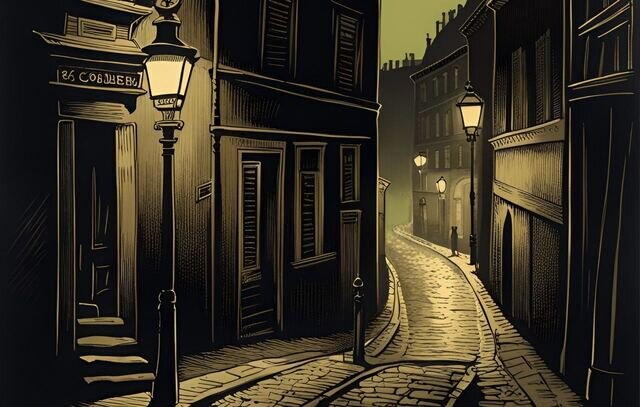
But as night fell over Paris, a veil of mystery descended over the city. The fog, dense and mysterious, crept through the winding streets of Montmartre, enveloping the darkened streets in an enigmatic aura. The streetlamps, like lone stars in the darkness, cast a pallid glow over the damp cobblestones.
The streets were quiet, except for the distant sound of the sporadic footsteps of night-time passers-by, now rare because of the cold night. Ancient buildings stood like silent sentinels, guardians of forgotten histories and lost secrets. The shops were closed, their wrought-iron signs illuminated only by the dim light of streetlamps.
The city of love and light had donned a cloak of darkness and uncertainty. The winding alleys were conducive to mystery, chance encounters and unexpected discoveries. It was a Paris that belonged to the curious, the dreamers and those in search of nocturnal adventures. Nightlife in Paris in 1891 was imbued with an atmosphere of mystery, where every corner of the city held secrets, dangers and riddles to be solved.
A man, slightly tipsy after an evening spent in a Parisian pub, was walking home. His footsteps echoed in the silence of the night, barely breaking the ambient calm. He was unfamiliar with walking through these alleys at night, but it was time to get home.
Suddenly, a dim glow from a nearby streetlight illuminated a macabre scene in his path. The man froze, breathless, as his eyes widened in horror. At his feet lay the lifeless body of a man, stretched out on the damp pavement. His face was frozen in an expression of terror and pain. Mysterious symbols were traced on his naked body in black wax, creating a chilling spectacle. The scene evoked a strange ritual, the meaning of which escaped him.
Without wasting any time, the man took an old theatre ticket out of his pocket and noted the exact position, then rushed to the nearest police station to alert the authorities. The discovery of this macabre painting would trigger an investigation that would plunge Paris into an unfathomable mystery, setting in motion a series of events that would shake the City of Light to its foundations.
Henri Lefèvre, a detective with the Paris police, was a strong thirty-nine year-old man, but the beginning of his weathered face bore witness to years spent peering into the darkness of the city's criminal underworld. His piercing eyes were accustomed to seeing what most preferred to ignore; his gaze was penetrating, imbued with wisdom and experience accumulated over countless investigations. He sported a neatly trimmed moustache and dark hair that lent his appearance a special gravity.
What set Henri apart from many of his colleagues was his unwavering dedication to his profession as a detective. He had joined the Paris police force at a young age, driven by a profound aspiration to uphold justice and protect the citizens of the city he loved. This passion for solving mysteries and maintaining order guided him throughout his career, and his keen sense of justice and commitment to the truth were the driving force behind his work. He spared no effort to solve even the most complex investigations, and never hesitated to plunge into the darkness of Parisian streets to track down criminals.
For Henri, every investigation was a personal quest to right the wrongs of the past. He was ready to face darkness, to confront mystery and to dig as deep as necessary to uncover the truth. He was a dedicated detective, driven by a deep sense of justice, and it was this passion that drove him to persevere, even in the darkest moments of his investigations.
Henri's dark coat billowed slightly with each of his slow and confident steps echoing in the darkness. He approached the crime scene with a measured gait, seeming to absorb every detail in calculated silence. His seasoned eyes scrutinised the inert corpse, the mysterious symbols traced in black wax on the victim's bare skin, and the expression of terror frozen on his face.
Henri knelt beside the body, his breath forming wisps of steam in the icy air. He took a silk handkerchief from his pocket and slowly unfolded it. Carefully, with the help of the handkerchief, he examined the body.
He began by examining the victim's face, which bore an expression of frozen terror. The dilated pupils and pallid complexion indicated recent death. Then he turned his attention to the symbols traced in black wax on the victim's naked body. They formed a series of mysterious, interlocking glyphs, reminiscent of esoteric symbols. Henri took precise notes of the runes, hoping they might shed light on the motive for the murder.
He examined the apparent wounds on the body. Bruises and contusions testified to a violent struggle before the victim's death. The body also bore numerous signs of abuse and torture. He noted the position of the wounds and their severity, trying to reconstruct the sequence of events.
The crime scene itself was particularly intriguing. The body had been carefully laid out on the pavement, in a foetal position, as if part of a ritual. Henri noticed burnt candles, incense residue and bird feathers scattered around the body, suggesting some kind of mystical ritual. The detective took samples of the residues and symbols using paper bags and grippers. Each element collected could prove crucial to the investigation ahead.
Henri stood up, his notebook full of precise details and drawings. All around him, the police were hard at work, cordoning off the crime scene with small wooden barricades, a symbolic barrier between the world of the living and that of the dead.
Not far away, he found Superintendent Durand, an austere and respected member of the police department. The man stood by his car, a brand new Panhard & Levassor Type A lent to him as part of his duties, his scrutinizing gaze fixed on the detective.
"Henri," called the superintendent in a deep voice, "we need answers quickly. This scene is most disturbing and unusual. I am sure the Prefect will want us to find the person responsible as soon as possible."
Henri nodded solemnly. He had already started taking detailed notes on the clues he had found, but he knew that solving this case would require total cooperation inside the police force.
"Superintendent," he replied, "we have mysterious symbols on the victim's body, as well as what seems like ritual elements around the scene. This certainly looks like a ceremonial murder. I'll continue my investigations and gather all possible information."
The superintendent nodded, showing his approval. "Work with the… "scientific" experts, Henri. I don’t like their barbaric methods but I guess we might need every piece of the puzzle to solve this mystery."
Around them, investigators and crime scene technicians continued to inspect the area, searching for further clues. In the year 1891, forensic science was still in its infancy, slowly emerging from the darkness of mystery that surrounded criminal investigations. Investigative methods were still rudimentary, relying heavily on the experience and meticulous observation of the investigators. The clues collected were limited to elements visible to the naked eye, such as wound marks, objects found at the scene and witness accounts. Investigations were often hampered by a lack of tools and scientific knowledge.
Nevertheless, despite these limitations, there was a growing desire to apply science to solving crimes. Forensic pioneers such as Alphonse Bertillon had even begun to develop fingerprinting techniques. Detective Henri Lefèvre, although working at a time when forensic science was in its infancy, recognized the value of these new approaches and was open to technological advances, believing that they would change the investigation universe.
Night thickened more and more, shrouding the crime scene in an even darker veil. Police investigators and technicians had completed their initial work, carefully documenting the scene. The victim's body was ready to be transported for autopsy. The coroner, a middle-aged man with thick grey hair but also the onset of baldness at the top of the forehead, was already waiting at the morgue, having been called with urgency to perform a thorough autopsy to determine the cause of death as soon as possible. The experts were limited in their capabilities, but their expertise was invaluable in revealing as much information as possible about the victim.
The funeral convoy was on its way to the morgue, through the silent streets of Paris. Lanterns lit the dark path as detective Henri Lefèvre walked alongside. Arriving at the morgue, the detective greeted the coroner as they shook hands. Henri knew that despite his eccentric manners, Dr. Martin was a dedicated expert. They exchanged a few words about the complexity of the case before them.
"Dr. Martin," said Henri, "I haven’t been able to pinpoint the exact cause of death despite the numerous wounds. I'm counting on your expertise to get as much information as possible on the cause of death from this autopsy."
The coroner nodded, understanding the importance of his role, and his ego flattered that his skills would be needed so urgently.
"Inspector Lefèvre, you can definitely count on me to determine the cause of death. Come back tomorrow evening, and I'll be able to report to you then. I am certain the autopsy results will allow you to move forward."
Henri left the morgue, the weight of the night and the mysteries surrounding him still heavy on his mind. He headed for home, where he would spend a restless night awaiting the results of the autopsy. The road was quiet, lit only by the glow of Parisian street lamps. His thoughts were obsessed with mysterious symbols, ritual elements and the motive behind the murder.
Henri had finally returned home, to his flat in the heart of Paris lent to him as a detective. The glow of a street lamp outside peeked through the shutters of his window, leaving mysterious shadows dancing on the walls of his living room. His flat was modest, functionally furnished, but impeccably tidy, reflecting the methodical and dedicated nature of its occupant. The only notable exception was a desk cluttered with files and notes which occupied part of the bedroom, a space where he spent many hours studying business and drawing up plans.
Henri removed his heavy frock coat, revealing an impeccably pressed white shirt and dark tie and vest. His tired eyes reflected the challenges of his job as a detective with the Paris police. To his mother’s despair, he had stayed unmarried, his life devoted to solving crimes. Finding his flat without life wasn’t unusual to him.
He prepared a cup of herbal tea in his kitchen, enjoying the comfort this hot beverage offered him after a long day's work. The bitter taste of herbs was a silent companion that kept him company during his sometimes long nights of reflection and deduction.
As he sat down at his desk, he switched on the desk lamp, plunging the rest of the room into darkness. Files on old unsolved cases covered the work surface, awaiting another one of his scrutiny. Henri had always been determined to do everything in his power to bring justice to the victims and peace to the tumultuous streets of the City of Light, even if it meant looking at a case years after it was closed.
He spent long hours going over the notes he had taken that night, analysing every clue and detail, while looking for possible links with previous murders. The streets of Paris stretched in darkness beyond his window, a constant reminder of the complexity of his mission.
When he finally felt that his eyelids were leaden, he rose from his desk and prepared for a short night's sleep. He lay in bed, wrapped up in his solitude, knowing that the next day would bring new challenges and new puzzles to solve, as it would bring the results of the autopsy. He would then be ready to begin his quest to solve the mystery that would plunge the City of Light into Darkness.