Prologue


At the same time, I intend to avoid boredom by starting with an event recognized worldwide.
Usually, when we hear that a text will "involve sex," it intrigues and excites us. Therefore, I also begin the story by exploring phenomena related to eroticism and sexuality.
I simplify my task by starting the story with the most controversial interaction between men and women: the issue of "paid sexual services." You must admit that most statements heard from acquaintances, friends, and family about strippers, nightclubs, and call girls aren't sincere and are often hypocritical.
Nonetheless, let's take a risk and begin our discussion. Has there recently been a globally recognized event related to eroticism that is controversial and "begs" for insightful commentary?
According to British Guardian columnist Anna Billson, awarding several Oscars this year to the film "Anora"[1] fits this criterion. "Anora" tells the story of "Ania" Mikheeva, a 23-year-old stripper living in Brighton Beach, an neighborhood in Brooklyn, New York.
Filming such a life story could seem incidental and random. However, I agree with Anna Billson’s observation, clearly expressed in her article's title, that Hollywood is obsessed with sex workers. It's enough to recall "Pretty Woman" and Anna Billson’s list of 19 other Oscar-winning films prominently featuring "a girl for hire."
For the purposes of this "Prologue," it's important to briefly explain why this happens. As one film critic explains, "It's male projections of the kind of women they think they'd like. And for actresses, it's a juicy role, a stretch, a chance to be bad and desirable and rebellious."
Many men readily admit this perception. I believe we should harness it for greater good, which is precisely what I attempt in this book.
The predisposition of some women to be sex workers, coupled with their attractiveness to many men, can inspire many women who don't wish to charge fees but desire independence, autonomy, freedom, and sometimes even rebellion.
I attempt to explain this need for independence, freedom, and activity to achieve fulfillment in life through chapters discussing the message of an accessible Japanese series titled "Asura."
The series has a cheerful tone. It can be watched purely for relaxation and peace.
However, it's easy to observe that the fight for freedom and independence can escalate, and rebellion can become excessive, thus necessitating illustration through literary or cinematic works. For this purpose, I utilize the series titled "Medusa."
My narrative clarifies optimal, beneficial boundaries for dominant women’s actions, using the easy-to-access series "Medusa."
Thus, by encouraging viewers to watch three films (series), it is possible to facilitate understanding of a comprehensive strategy for life.
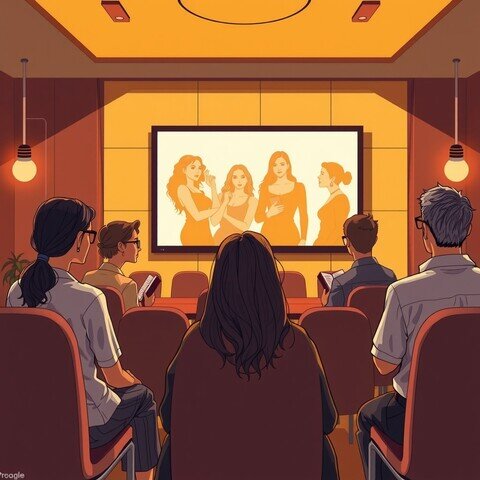
Naturally, entire films can't fit into this publication. However, I can provide links to trailers, compelling you, readers, to decide whether to go to the cinema or find these series on streaming platforms. Illustrations accompanying the text, openly created using various AI systems, serve as introductory visualizations.
Users of the Inkitt platform often visit it precisely because textual imaginations can surpass "ready-made film visualizations," explaining their preference for novels.
It's unsurprising, then, that for such readers, the message described in this Prologue can be reinforced by literary stories illustrating these ideas. Consequently, the book includes several erotic stories.
I haven't finalized this publication yet, believing that more texts will be added to this collection – stories depicting the actions of courageous, ambitious women who strive to be true to themselves.
It would also make sense to reference erotic texts conveying similar messages within my book. However, Inkitt’s vastness makes it challenging to navigate and identify content that aligns perfectly with this book's intent.
Thus, for now, I will include only a few mentions of stories written by other authors.
This book is, therefore, a new type of tool that assumes readers log in not only to Inkitt but also streaming platforms to access the discussed films or at least their trailers.
This enables understanding a comprehensive message that might be missed if the included stories are approached separately.
Additionally, it's important to note that the chapters address several specific issues requiring upfront commentary to avoid accusations of overlooking controversial aspects discussed in the book.
For instance, there's often debate about whether sex workers can maintain independence and resistance to traditional forms of domination from men and criminal organizations.
Having consulted various opinions, it seems justified to assert it's possible, depending on social, legal, and economic contexts.
Today, many sex workers choose independence, leveraging online platforms, social media, and direct marketing. The internet has reduced dependence on third parties who might control their activities. Concrete examples support this statement.
One such example is Australian activist Tilly Lawless, who openly discusses her profession through books, lectures, and public debates [2]. Lawless consciously chose her profession, controls all aspects of her work, and defines her service boundaries. British activist Juno Mac follows a similar path, independently managing her career and publicly advocating for sex workers' rights [3].
Notably, such independence is possible primarily where sex work is either legal or at least not criminalized. In countries like the Netherlands, New Zealand, or Australia, sex workers can run their businesses legally, ensuring legal protection and autonomy in their professional lives.
In places where sex work is illegal or heavily stigmatized, independent functioning diminishes, exposing individuals to exploitation by intermediaries or pimps. Full independence is achievable, but it depends on regional legislation, social awareness, and the women's courage. In short, when discussing violence or coercion against women in a particular country, one should first consider that country's legislation.
Although initial chapters focus on Mikey Madison's role in "Anora," I also discuss other women celebrated for similar portrayals. One noteworthy example is Janet Gaynor in "Street Angel" (1928), directed by Frank Borzage, recognized as a melodrama classic of silent cinema from the 1920s. Gaynor portrayed Angela, a poor girl from Naples forced into prostitution to escape poverty and domestic abuse, who ultimately finds true love. Her acclaimed performance earned her the first-ever Best Actress Oscar in 1929, alongside her roles in "Seventh Heaven" and "Sunrise: A Song of Two Humans."
Among the 19 Oscar-winning portrayals of sex workers, I also focus on Jane Fonda’s role in "Klute" and Kim Basinger's role in "L.A. Confidential."