
The Almost Stranger Game
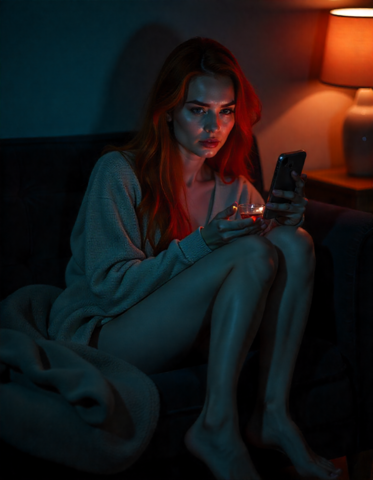


A lot of them.
Rule 1: No married men. Blocked on sight.
Rule 2: If they had a girlfriend, fiancée, or “it’s complicated” status—dead on arrival. No second chances.
Rule 3: If they used too many emojis, especially red flags, bananas, or flames—deleted mid-sentence, sometimes mid-word.
Rule 4: No dating apps. She was too tired of filtered faces, weaponized bios, and emotionally constipated one-liners like “just looking for vibes.” No—she didn’t want vibes. She wanted mystery. Real mystery.
So, she played a different game.
She called it The Almost Stranger Game.
At night—usually late, around the time her apartment felt too quiet and her thoughts too loud—Azalea would curl up on her velvet sofa with a notebook, a throw blanket, and a glass of wine (half-full, half-justified), and she’d open her phone.
Not a dating app. Not even her contacts list.
Just the idea of her contacts list.
She’d take someone she already knew—an old friend, a past lover, an ex-client, sometimes even her dentist—and slightly alter one or two digits in their number. A ripple. A nudge. Enough to remain tethered to coincidence, but just far enough to slide into the unknown.
9XXX3XXXX1 became 9XXX2XXXX1.
Sometimes she’d reverse a 6 into a 9. Other times she changed one number twice, like casting a personal sigil through chaos math.
Then she’d text. Just once.
“Hey. This is random, but… do I know you?”
Most people didn’t reply. Some sent a question mark, then blocked her.
Some turned out to be women—she politely removed those. Not her flavour. She was looking for a man, after all. Not just any man. Someone near her age. Someone unattached. Someone emotionally available—a unicorn she believed might exist if she poked the multiverse hard enough.
She always asked them two questions, early in the conversation:
“How old are you?”
“Are you single?”
She asked like a surgeon: fast, clean, no hesitation.
If the man was over 40, under 20, or answered “not really, but it’s complicated”—he was gone.
One guy said, “I’m 33, and my wife doesn’t mind me chatting.”
Blocked. With flair.
Another wrote, “I’m 28 and kind of poly, I guess?”
Deleted mid-message. She didn’t need poly. She needed solitary.
Some guys flirted too quickly. Some asked if she sold feet pics.
One tried to sell her crypto.
Another asked for her favourite Bible verse.
One said “hiiiiiii” with seven i’s and an unsolicited gym selfie.
Her game was a spreadsheet of disappointment.
But she didn’t mind.
It was oddly comforting—the sifting. Like beachcombing for shells and finding old soda tabs instead. She was too educated to believe in fate. Too lonely not to hope.
She did this maybe once a week, sometimes twice. Sometimes she got tipsy and did five in one night—her own version of speed dating, but without eye contact or pants.
Her best friend, Daisy, called it “digital trespassing.”
“It’s weird,” she’d said over coffee. “It’s you, so it’s charming. But if a man did it, he’d be in jail.”
Azalea just smiled and stirred her tea. “If a man did it, he’d add a fire emoji.”
Still, she liked the ritual. She kept it tidy. She didn’t chase anyone. Didn’t double-text. Didn’t ask for photos or give hers. She made it just random enough to be excused by curiosity.
And then, one Tuesday night—after a miserable session with a client who’d described their trauma like a grocery list—she poured herself a glass of cheap French wine and tried again.
She flipped through her contact list.
Settled on “Dan (College – Film Club).”
Changed one digit in the middle.
Texted:
“Hey. This is going to sound strange, but I think we met years ago? You feel familiar.”
No response.
She sent two more that night.
Nothing.
Closed her phone. Slept.
Woke up at 3:44 a.m. to pee.
Checked her screen.
One unread message.
“Familiar can be dangerous.”
No name. No emoji. No punctuation after the period. Just seven words, perfectly spaced, like a line from a poem or a very elegant threat.
Her heart skipped. She reread her message, pushing back a wave of hair the colour of dusk-lit copper.
She didn’t reply right away. She wanted to wait until morning.
But she didn’t wait.
She wrote:
“You’re poetic for a wrong number.”
He answered within seconds.
“Am I a wrong number? Or just one you haven’t called yet?”
She stared at the screen. The wine still on her lips. The old ache curling in her stomach like smoke.
This one was different.
“Hey mister (I hope you aren’t a Mrs. tho). Flirting, huh?”
No answer right away.
She rolled her eyes at herself and sipped more wine.
Somewhere between that and half-laughing at a dumb line in the movie she wasn’t watching, her thumb slipped.
Sent a voice note.
Ten seconds.
Just her laugh—unfiltered, husky from wine, half-snorted near the end.
She cursed under her breath and scrambled to delete it—
too late.
Message sent.
She froze. Watched it play back.
Her laugh sounded... lighter than she remembered.
Like someone she used to be.
His reply came two minutes later:
“You sound like someone who laughs alone a lot.”
She stared.
Then laughed again—quieter this time, into the back of her hand.
“You stalking my phone mic now?” she typed.
He responded instantly.
“No. Just listening. Most people forget how to do that.”
That made her pause.
Then type slower:
“Do you always sound like a poem having a cigarette?”
His reply:
“Only when the muse has a laugh like yours.”
Her heart kicked once.
Then settled.
She played the voice note again.
Just once.
Then again.
She didn’t hate it this time.
He didn’t ask what she looked like. Didn’t ask her name.
Which, somehow, made her want to tell him.

















This chapter was a pure magic funny, flirty, and spooky in the best way
Azalea’s game is so funny but also lil weird?? 😂 I was like girl what r u doing?
"Familiar can be dangerous." The following line says "those seven words." This isn't 7 words, or syllables for that matter.