Chapter 1 – A New Beginning



Natalia’s narration
I like the headquarters of our Publishing Agency. It is bright here, springlike and cheerful, and the sunlight, boldly streaming through the large windows, illuminates every detail of my favorite furniture, as if it wanted to bring out the depth of color and the hidden texture of the wood. Outside, the shrubs are covered in lush, almost vivid green, promising a new beginning.
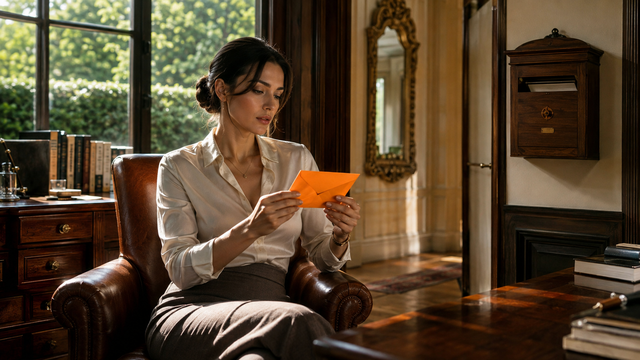
I glanced briefly at myself in the mirror hanging in the hallway. In this spring light, my skin had a warm, healthy tone, and my slightly unbuttoned silk blouse lay softly over my breasts, emphasizing the ease I felt that morning. In our traditional mailbox—a charming anachronism in an age of ubiquitous digitization—I found something intriguing today: an orange envelope, its color so intense it almost burned the eyes.
I sat down in the armchair by the main computer, feeling the smoothness of the paper under my fingers. My movements were unhurried, almost ceremonial. Inside was a letter addressed to three women: to me—Natalie Marks, to Patritia Healer, and to Geneviève Cantal. Bron Collins, the grandson of the legendary Vivian Reims, invited us to an initiating meeting of the “Third Conference” of the descendants of the Arrivals. We were to discuss a project with a telling title: The Arrivals’ Seminar on Love & Sex. The sender also referred to the traditional procedure of the “orange envelope,” already used twice. He wrote that the justification and outline of the planned Seminar followed from the published text “Sex, Anthropology & Logic.”
I read the letter three times. Its content surprised me, but also pleased me. I like challenges. I had met this man recently, but as far as I remember, I never told him that I am the granddaughter of Brenda, who landed on Madeira. He must have read Sissi the Alien and conducted his own inquiries. I also already know Patritia well—this “Healer Girl.” She is a charming girl who captivated me. Besides, you can easily get to know her too, because she openly publishes everything about herself. However, I have never yet met Geneviève. As far as I know, she stays in Corfu. Apparently, she also visits here, in the country. Okay! I would gladly hear what this Bron has come up with. I will wait impatiently until Friday.
A week later, on Friday evening, April 2nd, when I pushed open the heavy brass door of the “Scottish Bar,” the smell of oak, noble malt, and good tobacco hit me at once.
You know this place, because I described that bar in the first chapter of my most important book, Illumination.
The place pulsed with discreet life. Patritia and Geneviève were already there. They were sitting at my favorite table in the back, forming a striking scene—such that almost every man entering the bar involuntarily let his gaze linger on them.
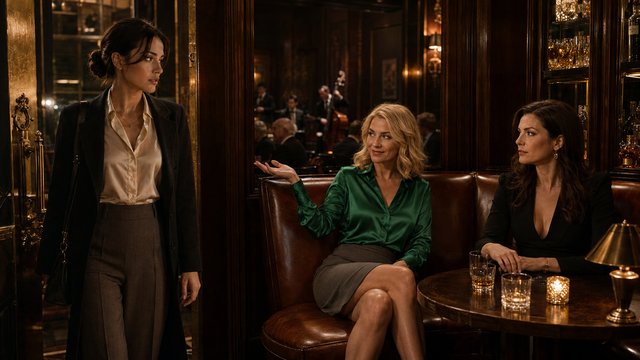
Patritia looked stunning. She wore an emerald blouse with a deep neckline, which perfectly complemented her fair complexion and her cascade of shining hair. A short gray skirt revealed her unbelievably long, slender legs, which she now casually crossed, catching the attention of an older gentleman passing by, who almost stumbled at the sight of her. When she noticed me, her face lit up with a mischievous smile, and her hand made a relaxed, almost dancing gesture of invitation.
Next to her sat Geneviève—a statuesque brunette with almost predatory features. Her beauty was cooler, more distinctive. She wore a fitted black dress that clung to her hips in a provocatively elegant way.
Geneviève stands out with her decisiveness, assertiveness, and eloquence. Her beauty matches her demanding character. I wonder whether she can be kind to men in bed. You surely remember her speeches during the last sessions of the first conference of the descendants of the Arrivals, held in that mountain lodge. There is a full transcript of everything that was said there. It can be found in The Stars’ Promise of Rescue.
When I approached, Geneviève measured me with an appraising, intelligent gaze in which there was a hint of recognition. Invisible sparks crackled between us—curiosity mixed with instinctive female rivalry.
“Hi, Natalie! You look radiant. These browns emphasize your eyes beautifully,” Patritia said, her voice low and soft like velvet. She slid her hand across the table, as if by accident brushing mine. I did not withdraw my hand; I only slightly raised an eyebrow.
A young waitress approached us, clearly intimidated by the energy radiating from our table. We ordered white wine, and as the girl walked away, I saw her discreetly adjusting the folds of her skirt, trying to match our elegance.
“Tell me, before our host arrives, what do you think of him?” Patritia asked, leaning toward us. The scent of her perfume—a blend of jasmine and musk—filled the space between us. “You, Natalie, seem to know him. Tell us quickly, before he gets here—what do you think of him?”
“Yes, that’s true. I know him. I met him two weeks ago when I was at an oncology conference. I slept with him. I like him. I didn’t suspect, however, that he was so interested in the message contained in Sex, Anthropology and Logic,” Natalie replied.
“I only read that book yesterday, but I can guess what his intention is regarding this conference—which he calls a ‘seminar’ instead. Well, it’s true that people have left many details unresolved about how to arrange matters at the intersection of the most important relationships. Women for money and their widespread exploitation, promises and vows based on unagreed, merely assumed conditions—” Patritia immediately and sharply took up the central topic.
Without waiting for the mysterious man who had invited us, we began a direct discussion about the content of the letters sent to us in orange envelopes.
“It is indisputable that everything happening here on this planet between men and women grates and arouses uncertainty—if not horror. Again and again the question arises whether something constitutes punishable incest, improper infertility treatment, sex without consent because there is no written proof, or the so-called ‘me too.’ But I doubt whether we, the descendants of the Arrivals, have better competence,” Natalie said slowly, thoughtfully.
“I’ll tell you right away! I spoke with Bron on the phone. I’ve known him since that first conference in Cubyhole. I know he has come across new arguments suggesting that certain beings from Andromeda are highly competent because they know the future. He came to this while rewatching the film Arrival, based—as you know—on Ted Chiang’s story Story of Your Life,” Geneviève said.
“Now I understand why you’re here today. You’ve known Bron for a long time, and after all, you’ve been running that ‘Conference Secretariat’ for two years. You there on Corfu are immersed in analyzing those extraordinary stories. Has anything significant changed? Did I miss something?” Patritia asked.
“One could say that, but let’s wait for Bron, because I have no idea what thematic scope he will promote for this third conference,” Geneviève replied.
“Since we have the chance to talk before our CEO arrives, tell us roughly what this extraordinary reason for sending those orange envelopes is,” Patritia said.
“There’s no point in waiting. It does make sense, because… it’s something that simply doesn’t fit in the head. To understand it, you have to talk about it in different ways, many times, so there is a chance we will take it seriously,” Geneviève replied.
“Oh my… if it’s that serious, then please—give us the first brief explanation,” Natalia said emotionally.
“Do you know what mathematicians mean when they try to explain elements of topology to laypeople by talking about so-called flatlanders?” Geneviève asked.
“Well that’s something—I thought we’d be talking about how to fuck sensually and healthily, and she’s talking about topology!” Patritia almost exclaimed.
“I’ve met Bron and his preferences, so I assure you that at this third conference it will mainly be about how to ‘fuck sensually and healthily,’ but Geneviève has intrigued me. Let her explain what flatlanders are. Geneviève—please—go on!”
“Okay. Imagine that you are—right now living beings—but unfortunately only two-dimensional, so you can move forward, backward, left, and right, but only on a plane, because your world is only a plane—not a globe, but a plane. Flatlanders have limited possibilities. They cannot jump to another place on the board; they must search along the plane for a free path. However, flatlanders can imagine powerful ‘higher’ beings operating in three-dimensional space. Such a higher, three-dimensional being can move a flatlander from one place on the board to another by lifting and placing it there—but then the operation occurs in three-dimensional space. That higher being can do it, but flatlanders cannot.”
We were staring at Geneviève’s face and what she was drawing on a café napkin when suddenly the atmosphere at the table changed abruptly. We felt a wave of warmth and confidence before we even saw him. Bron Collins stood at the table. He was handsome in an understated, masculine way. He wore a well-tailored suit that could not conceal his athletic build.
When Patritia stood up to greet him, Bron stepped closer to her—almost intimately close. I saw her nostrils slightly tremble as she took in his scent—a mixture of cedar and fresh air. He embraced her firmly and kissed her on the cheek, his hand resting for a moment on her waist. Patritia accepted it with an almost lustful smile, ignoring all conventions.
“I see you’re drinking white wine. An excellent choice to begin a revolution,” Bron began, sitting down among us. His presence filled the space, making the bar around us suddenly seem muted and irrelevant.
“Let’s begin the meeting,” Bron said. “We are launching an important undertaking, even if it may seem that a meeting of four people in a not particularly refined venue is a weak start. Since in the letter you received, I wrote — let me quote — ’the justification and outline of the planned Seminar follow from the published text “Sex, Anthropology & Logic’, I will immediately open the discussion.”
“Okay, Bron, but start with your vision. Tell us how you imagine it,” Patritia said.
“I only have an outline in mind. Of course, we will not only talk and discuss, but I propose that we publish a transcript immediately. From our perspective, it will be a transcript of our conversations, but for readers it will be a story—perhaps a kind of novel. We have already done this twice, and it works.”
“And where will we meet, and will anyone else join us?” I asked.
“Let me emphasize again—I am not the boss here. I belong only to a four-person initiating group. Everything depends on you. I will present only an initial proposal. I suggest first publishing several stimulating, provocative stories, and then conducting the seminar based on online meetings. However, we can also foresee real meetings in an attractive tourist location, in a pleasant conference room of a hotel we choose,” Bron said.
“Apparently, it’s a simple plan. However, I will point out the difficulties. It seems, Bron, that you assume those initial published stories will concern adventurous erotic experiences that do not fit average Earthly customs, although they align with our own habits—what you once called B-morality, which is not ‘amorality,’ but rather something ‘on the edge.’ As we all know, Natalia has published many such stories in her Illumination. There are stories about girls for money, strange tantric sessions, encounters that formally are not incest. You assume, however, that this time this B-morality, these ‘edge behaviors,’ will be legitimized and theoretically justified. So I ask—at least for now, as the so-called ‘Healer Girl’—how are we going to achieve that?” Patritia said.
“A good question. We probably need to begin by listing all possible sources that determine what is and what is not moral,” Bron replied.
“I’ll try to help you, Bron. Morality here on Earth is defined by the Ten Commandments. But if we consider the teasing discussion on this subject in The Arrivals from M31 Galaxy Are Among Us, they refer instead to what results from the need for the survival and development of the human species—Homo sapiens sapiens—that is, from anthropological knowledge,” Natalia said.
“Yes, caring about proper moral principles may arise from such concern. This is also confirmed by the sincere, convincing prediction presented in the final chapter of the volume Where Are We Heading?. It says that we are striving to find a suitable planet to place the seeds of life and then guide the evolution of a race similar to us, which must have certain moral principles implanted,” Patritia said.
“Yes, we have a certain future-based legitimacy—not as great as that possessed by the Heptapods, but still based on something very solid: the future, what will happen,” Geneviève said, deeply thoughtful.
“For heaven’s sake, where did you get these Heptapods from—what is that?” Natalia exclaimed.
“You’re a difficult case, since you haven’t read—as I see—Ted Chiang’s Story of Your Life, but you must have seen the film Arrival,” Geneviève replied.
“I need to reconcile you now. Heptapods are beings that exist in four dimensions, perhaps five—it depends how you count. Put simply, they see not only the present but also the past and the future. Naturally, they are therefore more competent than we are in judging whether something is ethical or not. But ladies—stop! We are getting into details that will need to be explained, but not now. Now—I ask you, my dear ladies—how and when we will present arguments more difficult than stimulating erotic stories,” Bron said.
“Our man is right. Today we are only discussing how to organize the conference. Not everything at once,” Patritia said.
“I don’t know—we won’t come up with anything better. I propose that in the published book, after a series of intense erotic stories showing our normal life, we insert a theoretical essay. Roughly speaking, I think we need three series of stories and six difficult texts,” Natalia said.
“Who will write those difficult, risky, and dangerous texts?” Patritia asked.
“I suggest we leave that as an open question. We will look for volunteers. We will devise appropriate methods,” Geneviève said.
“Listen. I’ve had enough for today! I just want someone to clearly state what the goal is—or what result this Seminar is supposed to achieve,” Patritia said tiredly.
“She’s right—it must be clear and concrete,” Natalia said.
“Alright, I will attempt to define it—of course ‘for here and now,’” Bron said.
“We’re listening.”
“The published book should be a kind of compendium on ‘what to do.’ It should establish a guide and an educational program. However, I emphasize that it is not necessary to say today who should complete such, let’s say, postgraduate studies.”
“I am satisfied with that answer,” Patritia said.
A moment later, we were already outside. Dusk was falling, and the cool evening air only intensified the warmth radiating from our closely standing bodies. We stood in silence, looking at one another—it was clear that this sudden synchronization of the four of us was not accidental, but a rare, magnetic chemistry impossible to ignore.
Patritia broke the silence—in her own style: boldly, without hesitation. Her hand rested on Bron’s shoulder, her fingers gently tightening on the fabric of his jacket.
“I like you,” she murmured, her voice confident but carrying a soft, inviting huskiness. “I want you to be with me tonight. If we are to create something great together, we must first achieve full coherence… let’s begin with the most basic one—at the level of bodies.”
I was not surprised. In fact, looking at them, I felt only a growing tension that spread to all of us. Geneviève seemed to read my thoughts, because a spark of understanding flashed in her eyes. Symmetry in nature always heralds harmony, and in love—pure pleasure.
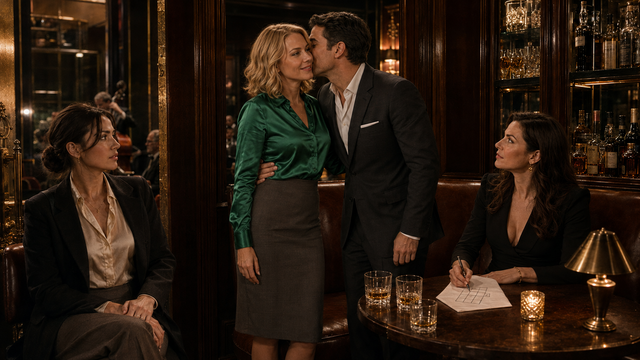
Geneviève turned toward me, smiling ambiguously.
“Well then, Natalia…” she said, pausing as she stepped closer. “Let’s not disturb them in this romantic meeting, one on one. It’s beneficial for all of us. Let’s take care of ourselves. My hotel is nearby. Will you come with me? I’ll show you something.”