
CHAPTER 1



The same patch of rain had followed Caline Estago for ninety-three miles. Somewhere around mile twenty, she’d begun keeping track out of spite.
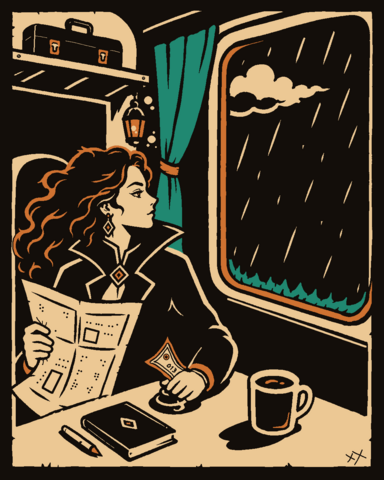
A rainfront could travel beside a train. Ordinary enough. But keeping pace through two tunnels, a mountain cut and a change in the prevailing wind? No chance.
There was a shape within the rain, though it seemed to be made of the rain itself. A soft gray edge that pressed against Caline’s window, as if waiting to be invited in. She lowered her newspaper.
The gray edge pressed closer. “No,” she said. Then, after a moment, “Maybe later.”
A child two seats ahead turned around and stared at her.
Caline lifted the paper again, mostly to block the child’s stare. A short piece on the second page announced the completion of Veldrum’s newest atmospheric tower. Caline lingered over the accompanying diagram until she had worked out how the new pressure array had been routed and identified one maintenance access she would have placed differently.
The provincial trains had many deficiencies. Hard seats, iron-tasting tea, cold air slipping through the windows at every curve. There was something strangely comforting about it. It reminded her of her first train rides as a kid, before Veldrum’s rail service had spoiled her. After one journey in their private compartments, she had never wanted to go back.
Tap.
Tap tap.
Irritated, she peered over the newspaper. Nothing outside the carriage should have been able to make that sound. She folded the newspaper. A knot of rain the size of a melon hung beyond the glass, bobbing alongside the carriage with visible effort. Its edges curled inward when she leaned closer. Then it bumped itself against the window.
Tap.
“Would you stop? I’m trying to pretend to read.”
The child turned to his mother. “Mum,” he whispered loud enough for half the carriage to hear, “the lady’s talking to the rain again.”
“It started it,” Caline said.
The child’s mother made a strangled sound. Caline returned her attention to the thing outside. The rain sagged against the window, then slowly crept upward. Why this train?
Caline had spent most of the journey ruling out every ordinary explanation she could think of, including turbulence from the train itself. The pressure reader would normally be useless at this speed, but the train was finally slowing.
She pulled it out and unfolded it—
The brakes took hold beneath the carriage.
A brass bell chimed overhead.
SUNGLADE — ARRIVING.
Caline looked from the pressure reader to the thing outside.
Of course.
Until regional atmospheric services can be adequately regularized.
That was how the appointment had put it. Caline knew what it meant. She would remain in Sunglade until the problems were fixed, however long that took. At thirty-four, however long was the sort of phrase careers disappeared inside. It got her out of Veldrum without anyone having to say when—or whether—they wanted her back.
The engine released a long breath of steam as the train slowed beneath a roof of mismatched slate. Sunglade Station consisted of a narrow platform, a station office, several sacks of flour and a sleeping brown dog.
A woman in a red coat was standing there holding up a placard that read:
CALLINE ESTARGO, WELCOME TO SUNGLADE
She had somehow managed to misspell both names.
Caline stepped down onto the platform. The woman was already crossing toward her, arms spread wide, when the knot of rain collapsed over Caline in a sudden sheet. Cold water soaked through her coat, plastered her hair to her face, and ran into one boot.
The woman stopped with both hands over her mouth. “Oh, you poor thing.”
Above Caline, the knot of rain shuddered violently, shedding enough water to spatter the platform around her. As it emptied, its edges softened and lifted until what remained looked more like a small gray cloud.
“I don’t suppose you know what that thing is?”
“No idea. But it seems happy to meet you. So am I, for that matter.”
Caline moved several steps down the platform, and the little cloud drifted after her, lagging just enough that she could almost blame the air currents. Then she stopped, and a moment later it did too.
“Oh, that’s wonderful.”
At least it had stopped raining on her.
The woman offered her hand. “Elsebeth May Hallowell. Postmistress and temporary keeper of your keys.”
Caline took the offered hand. “You waited until after the weather stopped attacking me.”
“Of course, dear. I’m friendly, not reckless.”
There were four cases waiting in the baggage carriage: one for clothing, one for books and papers, one for atmospheric instruments, and one containing a field regulator she had been specifically advised not to bring.
It had taken her nearly four years to bring the regulator’s calibration into exact sympathy with her working habits. She was not starting over because someone in an office had called the Sunglade equipment perfectly adequate.
The porter rolled over a squat luggage trolley with a small brass boiler mounted beneath the handles. It gave an unhappy hiss when he released the brake.
The little cloud contracted sharply at the hiss. The porter glanced up. “Does it always do that?”
“Don’t ask me. I haven’t worked out what it is yet.”
“Ah.”
He reached for the regulator case, and she stopped him. “That one stays upright. The internal vanes—”
“Caline,” Elsebeth said with a small smile, “I’m sure he knows how to do his job.”
The porter lifted the case with both hands and set it on the trolley with the care usually reserved for expensive instruments.
The boiler hissed again, and the cloud puffed outward until it was nearly twice its size before slowly gathering itself back together.
Elsebeth watched it. “Did that cloud just flinch?”
“Clouds don’t flinch.” Caline unfolded the pressure reader.
“I’m pretty sure it flinched.”
Before Caline could raise the instrument, a man carrying two wooden crates backed directly into her path. She pulled the reader against her chest before he could knock it from her hand.
“Anything for me?” he asked Elsebeth.
“Three letters and a parcel.”
“From my sister?”
“No idea.”
He frowned at the parcel. “Then how am I supposed to know if I want it?”
Before Elsebeth could answer, someone called her name from the ticket window.
By the time Caline had a clear line for the pressure reader, the cloud had drifted toward the station roof, still visible between the iron supports but too far away for a useful reading.
She folded the pressure reader and put it back into her coat. “You know everyone’s post?”
“Most of it.”
“And apparently whether they want it.”
“Especially that. Saves everyone a great deal of trouble.”
Behind them, the porter secured the last case and pulled a brass lever beneath the trolley handle. The gears caught with a grinding clunk before a thin plume of steam escaped from underneath.
“It works better once it’s warm,” he said.
Elsebeth picked up Caline’s smallest case and tucked it under one arm before starting toward the station doors.
“I can carry it myself.”
“I know,” Elsebeth said, and kept walking.
Caline followed, glancing back as a gust swept along the platform. The little cloud had disappeared. For several steps, she let herself believe the gust had carried it elsewhere.
At the station doors, the cloud was waiting above them. It drifted slightly lower when she stopped beneath it.
“Oh, come on.”
Elsebeth pushed open the door. “Are you coming?”
“Yes.”
Sunglade’s main street was wider than Caline had expected and considerably muddier. Pale stone houses climbed the lower hillside in uneven rows, their steep roofs built for weather more serious than the mild afternoon deserved. Dripping coats hung beneath the eaves beside nearly every doorway. Umbrella stands appeared outside every few shops and houses, none containing quite the correct number of umbrellas for the people nearby.
The luggage trolley rattled behind them as people called to Elsebeth from shops and garden gates. A baker wanted to know whether his daughter had written; two boys had dismantled a wheel beside the public pump with no obvious plan for putting it back together.
Caline had been in villages during the war, mostly because something had gone wrong nearby. Sunglade seemed to be getting on perfectly well without that prerequisite.
Nobody paid her much attention, which suited her.
Then a woman carrying cabbages pointed over Caline’s shoulder. “Got yourself weather, Elsebeth?”
Elsebeth glanced back at the little cloud, which had kept several yards behind them since leaving the station. “Apparently not mine.”
The woman looked at Caline, then at the cloud again as though deciding which was more unusual.
Across from the bakery, a stuffed fox wearing spectacles stood in a shop window between bottles of lamp oil and a stack of copper pans.
Caline slowed.
“Mr. Leland thinks it makes the shop look educated,” Elsebeth said.
Caline considered the spectacles. “It doesn’t.”
“I like it.”
A little farther on, Caline glanced back at the cloud drifting several yards behind them despite the shifting air between the buildings. “Have you ever seen that sort of thing before?”
“A cloud that follows people?”
“Yes.”
“No, I don’t think so.”
“Good.”
“Why is that good?”
“It means I’m not failing to identify something obvious.”
The shops thinned as they climbed, giving way to low stone walls and gardens in various states of surrender. An apple tree leaned so far across one wall that generations of pedestrians had polished a path beneath its branches, and farther on someone had left three pairs of muddy boots upside down on a gatepost to dry.
Beyond the last close-set houses, the valley opened.
Orchards stepped down the slopes in long green terraces, broken here and there by stone sheds and narrow lanes. Fields stretched toward a river that flashed silver between the trees, and beyond it the mountains rose blue-gray against the afternoon sky, larger than anything in the appointment papers had suggested.
Caline slowed without meaning to.
Sunglade was smaller than Veldrum, smaller than anywhere she had chosen to live as an adult, and far from almost everything she considered useful.
Unfortunately, it was beautiful anyway, which seemed likely to impress people who cared about that sort of thing.
Elsebeth kept walking without comment, which Caline appreciated enough not to mention.
The weatherkeeper’s cottage stood near the end of the lane.
Up close, the weatherkeeper’s cottage looked considerably less spacious than it had in the appointment photograph.
Pictures, she had learned during the war, benefited from strategic angles.
It had a blue door, two chimneys, one upper window, and a garden in which something broad-leafed had overrun most recognizable borders. Beside the gate stood a wooden sign:
WEATHERKEEPER
Underneath, in smaller letters:
PLEASE KNOCK UNLESS WEATHER IS ON FIRE
Caline narrowed her eyes. “That cannot be official.”
“The previous keeper set that up.”
“Why? Was the weather frequently on fire?”
“Once.” Elsebeth opened the gate. “Barley pollen.”
Caline followed her through the gate. “How does barley pollen catch fire?”
“Long story.”
“Was anyone hurt?”
“Only the keeper’s feelings. And his professional reputation.”
The little cloud remained outside, hovering just above the stone wall. Caline ignored it.
Inside, the cottage held the deep chill of a place that had been empty for too long. The floorboards were clean, the cupboards mostly bare, and the air smelled faintly of dust and cold iron, but Caline liked it almost immediately.
The front room held a table, two chairs, an iron stove, a narrow desk beneath the window and three empty shelves. A faded rug occupied the middle of the floor.
No ornaments, no collections, no painted mottos about the proper enjoyment of hearth and home. Caline approved.
Elsebeth opened the shutters. “You hate it, don’t you?”
“I don’t.”
“Oh.”
“Why do you sound disappointed?”
“I had a speech prepared.”
By the time the porter arrived with the luggage, Elsebeth had already begun opening cupboards. Caline supervised the porter as he carried the regulator case into the front room and watched him leave with considerably more goodwill than she had felt upon meeting him, then turned to find Elsebeth examining three mismatched cups, six jars of preserves, a chipped teapot, a sack of flour and a bottle of brandy.
“These aren’t in the inventory. Whose are they?”
“Yours.”
“I don’t recall ordering this.”
“They’re welcome provisions.”
One of the jars had a paper label tied around its neck: FOR THE NEW KEEPER — DON’T LET ELSEBETH TAKE THIS ONE. Caline picked it up. Blackberry.
When she turned around, Elsebeth was already holding the brandy.
“Put that back.”
Elsebeth glanced at the label. “I was checking the quality.”
Caline pointed to the spot beside the preserves.
Elsebeth put it back.
Caline shrugged out of her damp coat, and Elsebeth looked at the faded line across Caline’s shoulder where the rank braid had been removed, then at the remaining silver embroidery of the Veldrum Atmospheric Corps.
Elsebeth didn’t ask.
Instead, she opened her basket and produced an onion pie.
Caline liked her slightly more for both decisions.
“I’ll show you around some more tomorrow,” Elsebeth said as she found two plates. She cut the pie and passed Caline a slice. “There are records waiting for you, and apparently half the valley has something it wants to complain about.”
“Weather complaints?”
“Mostly. There’s a patch of rain over the lower market. Been weatherfast over the same bit of street since this morning.”
Caline’s fork paused over the pie. “Weatherfast?”
“Won’t move.”
“Just a patch?”
“That’s what they say.”
The little gray cloud hovered on the other side of the glass, dense and perfectly still.
Elsebeth nodded toward Caline’s plate. “Is it good?”
Caline took a bite. “I’ve had worse.”
They ate while evening settled over the valley. The pie was excellent, with sharp cheese, onions cooked until almost sweet and enough pepper in the crust that Caline wondered whether it had been added deliberately or by accident. She had not realized how hungry she was until half the first slice had disappeared.
For several minutes neither of them spoke.
The quiet was different from the train. No wheels underfoot, no strangers breathing too close, no whistle at the windows—only the stove beginning to tick as it warmed and the occasional soft scrape of Elsebeth’s fork against her plate.
Outside, lamps appeared across the village one by one.
Caline watched them for a while before asking, “You live far?”
Elsebeth pointed with her fork. Through the side window, just beyond the garden wall, stood another cottage.
“That one?”
“Yes.”
Caline lowered her fork. “That’s very close.”
“I know. Isn’t it great?”
Caline returned to her pie.
Elsebeth stayed long enough to show her the firewood and warn her about the bedroom window, which had to be lifted before it would latch. On her way back through the kitchen, she added that one of the cupboards stuck whenever it rained.
Then she packed the empty pie dish into her basket and pulled on her red coat.
“I’ll come by tomorrow.”
“Knock first.”
Elsebeth paused with one hand on the door. “I was going to.”
“And wait until I answer.”
“Even if I can see you?”
“Especially then.”
Elsebeth considered this. “All right.”
Once the door closed, Caline finally had the correct number of people in the cottage.
Caline unpacked only what she needed that night: nightclothes, wash things, two books and enough instruments to make the desk usable. The pressure reader went beside the condensation gauge and regulator keys, while the rest could remain in their cases until morning.
The familiar objects made the room feel a little less borrowed.
The bottom desk drawer stuck halfway. Caline pulled harder and found it crammed with old working ledgers, loose reports, folded notices and a bent ruler that appeared to have been used as a bookmark more often than a measuring instrument.
She pulled out the top ledger and opened it at the desk.
Rain totals. Frost dates. Reservoir measurements. Orchard reports. Complaints about fog, hail, late dew and one entry concerning “wind turning wrong after sunset,” underlined twice without further explanation.
By the fifth page, she had stopped unpacking.
The rainfall totals were low, and the distribution was worse. Upland fields had gone weeks without useful rain while two eastern orchards had flooded badly enough to damage their roots, an imbalance that appeared across several months of records.
Caline turned back three pages and checked the dates, then checked them again.
The notes were inconsistent in format, but the observations themselves were detailed. Whatever was happening in the valley, it wasn’t one faulty gauge or an inattentive keeper.
Near the back, she found a folded sheet of winter projections and read it twice. If the pattern held, the valley would enter winter already short of water. So much for a quiet provincial assignment.
Tap.
The little cloud hovered just beyond the window. Caline picked up the pressure reader before something else could interrupt her and held it toward the glass.
The needle barely moved.
She checked the calibration, brought the reader closer to the window, and tried again, but nothing changed. A dense cloud should have registered something.
Outside, the cloud pressed closer.
Tap.
















What a great opening chapter! With enough details to get me oriented, and plenty of breadcrumbs to leave me hanging... I especially loved the dialogue. I'll do my best to keep up :D
This is an interesting first chapter. You have captured my interest. Keep it up.
Oh my god! Hahahaha. Nice! You've made drastic improvements. Adding a space before and after line dividers, putting the bold letters in a separate line, and even put pictures!
Keep it up! The dedication is REAL! <3