PROTAGONISTS : THE MARTYRS
Copyright © 2026 H_Kverse. All rights reserved. Character and world concepts were visualized using Nano Banana/AI-assisted tools.
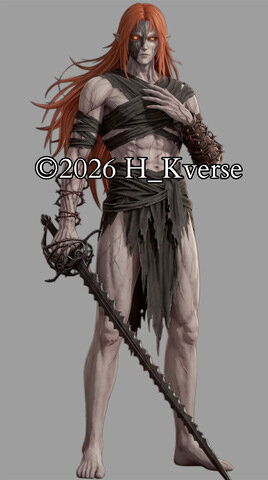
1.The Name(Title): Drovanic Ozentravbell
Attire: Forgotten’s Loincloth
A scrap of coarse charcoal cloth, knotted at the hips and wrapped with bindings of the same, worn by the Flagellants of the lower wards who stripped themselves of all but this before taking up the scourge. It hides little and guards less. To the Cathedrals, the flesh was a thing to be offered, not covered, and the Flagellant who wore more than this was thought to be hoarding his sins beneath the cloth. The name was given by the faithful of Gravemoor, for those who wore it had forgotten their names when they took up the blade, and were remembered by none when they fell.
Weapon: The Jagged Teeth
A long, narrow blade of dark steel, its whole edge worked into hooked saw-teeth, its hilt caged in swept bars of black iron. Such swords were forged for the Flagellants of the Cathedral, whose sacrament was to open the flesh of the faithless so slowly that they might confess each sin with each tooth. The blade does not cut clean. It tears, and it catches, and it drags, and the wounds it leaves never close neatly. The Flagellants who carried it whispered that the teeth themselves were hungry, and that on long nights in the reliquary, the blade could be heard giggling.
1.1.The Name(Title): Drovanic Ozentravbell
Attire: Martyr's Vestments
Martyr’s Wide-Brimmed Hat
A tall black capotain, its band hung with fine chains and small iron crosses that chime faintly as the wearer walks. The Martyrs of the old faith wore these to the crossing-grounds, where the brim kept the sun and the spittle of the crowd from their eyes and the chiming told the condemned that somebody had come, and that they would not die entirely unattended. The sound carries further in the fog than a man expects. Some in the wards still stop and turn when they hear it, though they can no longer say why.
Martyr’s Shawl
A voluminous cowl of shredded dark cloth, torn deliberately rather than by wear. Each tear was made by a Martyr for one soul they could not save, and the cloth was never mended, for a mended shawl is a lie. It is drawn up over the mouth when passing the Ivoravon, less against the smell than against the singing; a great many who have sung the Damned Song of the Eye did so with no intention of singing anything at all.
Martyr’s Robes
A floor-length trench cloak of tattered dark weave, worn over a leather breastplate stamped with three raised crosses: one for the wood, one for the nail, and one for the hand that drives it. The Martyrs claimed no grace, no office, and no protection from the Cathedrals. They went to the crossings uninvited and stood where they were not wanted, and were often nailed for it beside those they had come to attend. The leather is thick enough to turn a stone hatchet and worthless against anything better. This was always understood.
Martyr’s Leggings
Dark trousers reinforced with hard leather over the thigh and shin, and harness straps at the knee. They were made for kneeling on broken stone for the length of a dying, which in Vaelcrucis may be three days. The knees of every genuine pair are worn through and re-patched a dozen times over. A pair without such patches was never used, and among the old Martyrs it was said that such a pair should be buried rather than worn, for a Martyr who never knelt was only a spectator in a good hat.
Weapon: Martyr's Longsword
A long single-edged blade of dark steel, its flat cut through with the eldritch signs of the Bullet-slayers: the old script the mortal orders used when there was still an order willing to hunt the grey. The signs take fire when a hand of the proper blood closes on the grip, and the tip and lower edge burn red with a flame that gives little light and no warmth, but which will not be quenched by rain, by water, or by blood. It was made to cut things that do not stay cut. Its makers carved no prayer upon it and left no maker’s mark, for they held that a weapon for killing the holy should ask nothing of heaven. It is lighter in the hand than it ought to be, and those who carry it long report that it grows lighter still, and that this is not a comfort.

1.2.The Name(Title): Drovanic Ozentravbell
Attire: Gravemoor Knight Armor Set
Gravemoor Knight Helm
An engraved helm of darkened steel with narrow eye-slits, made for the ward’s own order, who were never the Cathedrals’ men and never swore to the Eye. The scrollwork across the brow was cut by a smith of the lower ward who worked only for them and who is said to have put a different pattern on every helm so that the order’s dead could be told apart. The eye-slits are narrow past the point of practicality. The order held that a knight who could see too much of a crossing would start looking at faces, and that a man who looks at faces does not last the year.
Gravemoor Knight Chest Plate
A breastplate of darkened steel, filigree-worked across the chest and pauldrons in a fine scroll that serves no purpose and was never meant to. The Gravemoor Knights took no coin from the Cathedrals and received no gift from them, and so their plate was made by the wards that housed them, out of whatever the wards had, and decorated by whoever in the lane could cut a line. There are forty such plates and no two patterns agree. Thirty-nine of them are in the ground.
Gravemoor Knight Leggings
Articulated faulds and leg guards of the ward’s order, engraved down the shin and built heavy at the knee, for the Gravemoor Knights spent more of their service kneeling at crossings than standing at walls. They were not permitted to cut down the crucified; the Cathedrals forbade it on pain of the wood. So they knelt, and stayed, and spoke to the dying for as long as the dying lasted, and the knees of every surviving pair are worn through the engraving to bare steel.
Gravemoor Knight Boots
Sabatons of darkened steel, plain where the rest of the harness is worked, for the order held that a man ought not to decorate the part of himself that stands in other people’s blood. The soles are nailed in a pattern that grips wet stone, and the ward’s children learned the sound of them on the cobbles and would come out to the doorways when they heard it, which is a thing several of the order wrote down and none of them explained.
Weapon : Fading Grace Sword
A longsword of dark steel with an ornate crossguard and a deep engraved fuller, carried by three generations of one Gravemoor family and named by the first of them, who never explained the name and was mocked for it by every knight who heard it. Its point is stained a dull crimson that has gone into the metal and cannot be polished out. The last of the line, Harrow Fennel, wrote that he had tried four times to change the name and could not, and that he had come to understand it late: that grace does not break and does not fail, it only thins, year on year, until a man looks up one morning and finds there is not enough of it left to live inside.

1.3.The Name(Title): Drovanic Ozentravbell
Attire: Home Set
Tattered Loose Shirt
A loose shirt of undyed grey-brown weave with wide sleeves, frayed to ribbons at the hem and the cuffs. The lower wards have a custom regarding such shirts: a garment that has been torn in the course of keeping somebody alive is not mended at the tear, only at the seam, so that the damage remains and may be pointed at. This one has not been mended anywhere. It was given out of a tailor’s stores to one who had come back from a burial ground with other people behind him, on the grounds, the tailor said, that there was no sense putting good cloth on a man who would be out again by the third bell.
Lace-Up Shorts
Short dark breeches with a cross-laced front panel and open hips, of the kind worn by the scourge-bearers of the lower wards beneath their penitential harness. They were cut high and laced rather than belted so that they could be loosened without being removed by a person whose hands were failing, and the hip cutouts exist so that the straps of a flagellant’s frame would bear on the bone rather than on cloth. They outlasted their purpose. The lower wards went on making them because the lacing can be done one-handed, which in Vaelcrucis is a serious virtue.
Shredded Thigh-High Stockings
Heavy knitted thigh-length stockings, worn to open mesh in places by years of use and never discarded. The grave-diggers of the burial wards wore them under their boots and their leg-plate, for the ground gives up a cold that goes into the shin-bone and stays there, and a digger with cold shins kneels badly and a digger who kneels badly is soon a digger in a box. They are passed from one wearer to the next and are never mended; the custom holds that the holes in such a pair are a record of who has worn them, and that to close one is to close out whoever made it.

1.4.The Name(Title): Drovanic Ozentravbell
Attire: Beast Slayer's Set
Beast Slayer’s Hood & Riveted Veil
A deep cowl of frayed dark cloth paired with a veil of studded dark metal that covers the lower face from the bridge of the nose to the throat. The hunters of the ravine-cuts wore the veil not for protection but for the breath: a man’s breath fogs in the cold of the deep places and a fog in the dark is a thing that can be seen from forty paces, and the slotted plate breaks it up before it leaves the face. The rivets are set in the old counting-pattern of the hunters, one for each of them that went into the cuts, and they were not added to after the second year, because by then nobody was keeping count.
Beast Slayer’s Laced Cuirass
A close-laced cuirass of hardened leather, riveted in silver and strung with fine chains across the breast. The chains are not ornament; a hunter working alone in the ravine-cuts could not hear his own footfalls over the water, and a fine chain over the sternum rings faintly against the rivets when the body moves wrongly, which is how the old hunters taught themselves to walk without jolting. The lacing is at the front because the hunters went out in ones and had nobody to tie them. It is said that a cuirass whose chains have gone silent has been worn by somebody who learned, and that there were never many such.
Beast Slayer’s Wrapped Vambraces
Forearm wraps of waxed dark cord, wound rather than buckled. The hunters would not wear plate on the forearm, holding that a thing which comes out of a pit will take an arm at the wrist whatever is on it, and that a wrapped arm at least does not clatter when it is dragged. The knot is tied so that it may be released with the teeth, because the commonest death among them was drowning in the cut-water with a harness nobody could get off.
Beast Slayer’s Chain Belt
Twin filigree-engraved belts, crossed at the hip and hung with hanging straps. The engraving is a hunters’ convention of no sacred meaning whatever: each of them cut their own, and there is no record of what any of the patterns meant, and the old hunters would not say. The crossing is practical, holding the weight on the bone rather than the belly, so that a man gutted below the belt does not also lose everything he was carrying.
Beast Slayer’s Split Tattered Coat
A long coat, split front and back and shredded at the hem. The tatters are deliberate and are cut, never torn. A solid silhouette moving in lantern-light reads to the eye as a man; a broken one reads as nothing, and the things in the ravine-cuts hunt by movement before they hunt by smell. Every hunter’s coat was cut differently, and it was held among them that a man should re-cut his own hem after every season he survived, and that a coat with a tidy hem belonged to somebody who had not been out.
Beast Slayer’s Engraved Shorts
Short breeches of hardened dark cloth, engraved along the outer seam. They are cut high and short because the ravine-cuts run with water, and a hunter in long skirts of cloth below the hip is a hunter dragging a bucket. The exposed thigh was understood to be a risk and was accepted, on the hunters’ own argument that a leg which can be seen can be seen to be bleeding.
Beast Slayer’s Harness
A strap-harness of dark leather, worn over the cuirass, carrying the bow, the quiver and the blade so that none of the three can foul another. Every buckle on it faces the same way and may be reached by either hand, which is the one piece of the hunters’ craft that the Gravemoor Knights took from them and which the Cathedrals never bothered to steal from anybody.
Beast Slayer’s Strider Boots
Knee-high boots, laced and over-buckled, soled in layered leather over felt. They were made for the wet stone of the ravine-cuts, where an iron-nailed sole rings like a bell and a smooth one kills a man on the first slope. The felt is renewed by the wearer and the lacing runs to the knee because the hunters went through standing water and preferred to be cold rather than to be heard. They are not good on cobbles. The hunters did not much go on cobbles.
Weapon : Beast Slayer’s Grim Bow
A recurve of carved dark metal, limbs set with back-swept spikes, grip bound in cord, hung at both limbs with short falls of fine silver chain. It was made for the hunters of the ravine-cuts, who shot things that do not die of being shot and who needed the second and third arrow more than the first. The chains sing when the draw is hurried and are silent when it is not, which the hunters’ masters never explained to their apprentices. The spiked limbs are a confession: every bow of this pattern was made by a smith who had already accepted that its owner would one day be close enough to use it as a club.

1.5.The Name(Title): Drovanic Ozentravbell (with Aldristina, The Scant Trinity)
Attire: Sinking Set
Beak of the Drowned Physick
A heavy riveted helm of dulled steel with a long pointed beak and two round apertures gridded in fine wire. It is the pattern worn by the plague-physicks of a country that is not this one, brought over the sea generations ago and copied badly ever since. It cannot be removed in the Sinking Past. Those who have woken there in one report pulling at it until their shoulders gave, and report also that it comes away without resistance the instant they return to the waking world, and that it is never afterward found among their belongings. The old teaching holds that a soul going down must go down with its face already covered, because what is in the canyon does not attack a face and does not need to; it waits for one to be shown. The wire grids are not for the eyes. They are so that nothing can look in.
Forgotten’s Flayed Skirt
A loincloth of ragged leather, hanging in strips, cut from hide that has been worn by somebody else first. It is what the Sinking Past gives a man instead of his harness, and it is the same garment every time, on every soul the Grog has ever sunk, which has been remarked upon by the four people in Vaelcrucis who have compared notes and dismissed as impossible by everyone else. It covers nothing worth covering and was never meant to. The canyon takes a visitor’s armour, their weapons, their boots and their name-signs, and leaves them the one thing nobody has ever been able to explain the purpose of; and those who have been down say the stripping is the lesson, and that the lesson is that they were never the harness.
Sunken Runic Wraps
Blood-stained cloth bindings about the forearms, the ankles and the feet, inscribed in red with a runic script that is neither the hooked tongue of the Blightful Scars nor the characters of the old Creed, and which no scholar living has read. They appear on the body in the Sinking Past and are already written on when the sleeper wakes. The hand that wrote them has never been identified. Each set differs, and each set is said to differ in the same way the wearer differs; those who have gone down twice report that the second writing continues the first rather than repeating it, as though something has been keeping an account and knows where it left off. The blood on them is the wearer’s own and is always fresh.

1.6.The Name(Title): Drovanic Ozentravbell
Attire: Vermilion Clergy Set
Vermillion Clergy Thorned Cuirass
A heavy breastplate of grey steel worked in relief with thorn-vine over its whole face and bearing a cross standing proud at the centre, with a layered spiked neck-guard over a chainmail cowl. The pattern is clerical and is not a knight’s; the thorn-vine relief belongs to the vestment-plate of the old processional orders, who walked at the front of a crossing and were struck at by the crowd as a matter of custom, and whose plate was therefore made to be hit from the front by people rather than by weapons. The lower edge is articulated in four lames, which no processional plate ever was. The addition is recent and was made for one body.
Vermillion Clergy Barbed Pauldrons
Segmented shoulder-plate with outward-projecting spikes and wound chain, worn over a tattered mantle. The spiking is a defensive form and not a penance-form, as may be told by the direction: a penance-form barbs inward toward the wearer and a defensive form barbs out, and the two are confused constantly by people who have never had to put either on. The chain is wound to foul a blade that slides off the lames. The mantle is deliberately left ragged; the processional orders held that a silhouette which reads clearly at forty paces is a silhouette somebody can aim at.
Vermillion Clergy Wire-Bound Vambraces
Articulated forearm-guards bound their whole length in barbed wire with the barbs set outward and the inner face lined. The wire is a Cathedral penance-form, which is always set inward so that the wearer cannot carry the thing without bleeding; reversing it is not a known variation and is not recorded anywhere. A forearm so wound cannot be gripped by a hand, and the crossing-grounds’ whole method of taking a living person begins with the forearms. Whoever made these had that in mind and did not say so.
Vermillion Clergy Engraved Faulds
Layered hip-plate engraved in thorn to match the cuirass, hung from a waist-strap rather than riveted to the breast, so that a man may take the weight off his hips without undoing his chest. The processional orders wore them long and the hunting orders wore them short and these are cut between the two, which no armourer would do and which a tailor would.
Vermillion Clergy Robe
A shredded clergy skirt and long back-cloak of black cloth, worn beneath plate. The form is processional and is four hundred years old; such a robe was worn by those who walked at the front of a crossing, who did not carry and did not strike and whose whole office was to be the first thing the crowd saw. The shredding of the hem is not wear. It is cut, and it is cut by the wearer, and the custom held that a processional cut one strip for each crossing they walked at, so that the hem of a long-serving one went to ribbons and could be read at a glance by anybody who knew how. There has been no procession in Vaelcrucis in twenty years. The hem of this one was cut by the maker, all at once, in a single evening, which is not how it is done.
Vermillion Clergy Crowned Helm
A close helm of dark iron with an attached mail coif, surmounted by a jagged spiked crown rising from the skull of the helm and two backswept horns, hung about with fine chains bearing crosses no larger than a fingernail. The left side of the face is covered by a smooth plate of pale metal; the right socket is left entirely open. The crown is not a claim of rank. The processional orders wore a spiked ring on the crown because they walked at the front and were struck at, and the ring is there so that a thrown stone meets iron before it meets a skull; that it looks like a crown is an accident of the form which the orders were aware of and found funny. The chains and their small crosses sound when the head turns, which the orders required, so that those walking behind could hear where the front was without looking up. The open socket is not a form. It is a decision, and it was made by somebody else.
Weapon : Cardinal’s Cursed Scythe
A twin-bladed crescent scythe on a long haft, the haft wound its whole length in barbed wire so that it may be gripped in two places only, hung with nine small reliquary crosses on short chains, every one of them shut. The glyphs cut down the spines of both blades hold a dull red light that does not go out. It was recovered from the Titan’s Sigh, from the body of a knight in good plate who had nailed scripture through his own armour in patterns and had then gone down on his knees upon the weapon’s point. Nobody has identified the order. The barbing of the haft is not a defence and never was: it is a Cathedral penance-form, intended so that a weapon cannot be carried without bleeding the carrier, and it appears on nothing made after the third year. The stain in both edges has gone into the grain of the steel and does not come out.

1.7.The Name(Title): Drovanic Ozentravbell
Attire : The Drensyl Legion Plate Set
The Drensyl Legion Crown Helm
A dark iron helm worked into the form of a low crown, its band rising into crucifix finials at the brow and the temples, with tiny crosses hung from thin chains along the back of the rim so that the wearer is heard before he is seen — which is the Martyrs’ convention and is deliberate, and was argued about for an hour. The faceplate is skeletal: a lattice of narrow ribs of dark steel over an open ground, perforated in fine rows across the cheeks and jaw so that the breath goes out of it broken and does not fog, and so that a man inside it can be heard to speak plainly, which no Cathedral helm has ever permitted. The eye-slits are backed with worked horn and take the light of whatever is behind them, and in a dark lane they show as two low orange-red slots and nothing else. A deep hooded cowl of layered dark cloth is sewn to the gorget behind, so that the helm sits inside a hood rather than on top of one.
“The hair will come out of the back of it. I know. I have decided not to solve the hair.It is the colour of a forge-coal and it will give you away in any light there is, and if I cut it or dyed it you would look like a man hiding from himself, which is worse. There is an argument that it is better they know.”
The Drensyl Legion Cuirass
A heavy breastplate of gunmetal grey, the plate raised and chased into a great central cross — and the cross is not clean. It is wound about, from every quarter, with sculpted thorned vine, cut deep, the thorns laid in against the arms of the cross so that at four paces the eye reads a crucifix and at one pace the eye reads a thing being strangled by a hedge, and both readings are correct and the smith who raised it intended both. High gorget plating stands up to the jaw. Beneath the plate’s lower edge a skirt of exposed chainmail is left deliberately uncovered, where every Cathedral harness would have sheeted it over — “because a mail that is seen is a mail that is maintained, and I have cut sixty dead men out of harnesses whose mail had gone to rust under a nice plate, and every one of them died of a nice plate.”
The Drensyl Legion Gauntlets
Articulated steel over the hand, finger by finger, lamed at every joint and left bare of decoration — and above the wrist, where plate would ordinarily run to the elbow, nothing but the forearm itself, bound round and round in thick coils of barbed wire.
The binding is not armour and is not pretending to be. It is the hunters’ refusal in a worse form: the ravine-men held that a thing coming out of a pit takes an arm at the wrist whatever is on it, and wrapped the forearm in waxed cord so that at least it did not clatter when it was dragged. This is the same reasoning taken to its end by somebody angrier. A wrapped arm does not rattle; a barbed arm is not held.Anything that closes a mouth or a hand on that forearm closes it on wire, and lets go, or does not let go and keeps the wire.
It must be wound by the wearer.No other hand may lay it on, by a rule the hunters never wrote down and never broke: a man who has not felt his own wire go on does not know how hard it is and will trust it.
The Drensyl Legion Skirt
Segmented waist-plates of steel — faulds, six to a side, riveted on leather and overlapping upward so that a point coming up from below finds a lip and not a gap — laid over a tunic of heavy dark cloth trimmed in leather, and beneath the beltline a long cascade of chainmail hanging free to mid-thigh.
The hanging mail is a burial-ward convention and has nothing to do with war. Nothing in these lanes strikes high. Everything in these lanes comes at the hip, the belly and the groin, because everything in these lanes has spent twenty years learning that men do not look down. The Deepwood sells more shin-height snare-wire than anything else it makes and is quietest about it for the same reason.
The Drensyl Legion Greaves
Heavy dark plate over the shin and a cop at the knee, running down into armoured boots capped and soled in polished steel. The knee is the only part of the harness reinforced twice.
“Because you will kneel in them. Every single time, at every stone woman in this city, on broken flags, for the length of a dying, which in this country may be three days. And I shall have to re-sole them in a fortnight, and I shall complain about it for a week, and we shall both know perfectly well that I knew.”
The insteps are packed with lamb’s wool where the nail-wounds left ridges, and he has never once said why.
Weapon : The Forgotten Faith Poleaxe
A great executioner’s poleaxe of the old pattern: a haft the length of a man and a half, double-headed, with two broad crescent blades set back to back — the forward blade deep-bellied and sweeping down past the haft into a hooking beard, the rear blade shorter and squared for breaking. Both faces are engraved the whole of their surfaces in fine Gothic filigree: arcades, tracery, little blind windows in rows, the stonework of a cathedral cut into the steel of a thing made for taking heads.
The haft is wrapped, from the langets to within two hands of the butt, in heavy iron chain, laid on in tight turns and seized off at both ends. The chain is not grip and it is not ornament. It is weight put deliberately in the wrong place, so that the thing is slow to start and cannot be stopped once it is going — which is the whole doctrine of the headsman’s craft, in which nothing has ever needed to be quick and the only sin is a second stroke.
Nothing of this pattern was made after the third year. The trade that used them held no faith, kept no saint and was permitted in no cathedral, and gave its tools no names, and this one has a name only because somebody at a forge said four words over it and they stuck.

2.The Name(Title): Greymora, The Grand Slayer

3.The Name(Title): Gravost Vandbourne

4.The Name(Title): Penivelle Vaelmontrune

5.The Name(Title): Ustavion Gravostwood

6.The Name(Title): Duvraine Teneborcross

7.The Name(Title): Renmarost Draventorgrove

8.The Name(Title): Dolmiraca Zarfield

9.The Name(Title): Belvorn Milzaford

10.The Name(Title): Ulzara Ombrelvault

11.The Name(Title): Teneborcross

12.The Name(Title): Zarielle Draventovault

13.The Name(Title): Sarnost Sarvantcourt

14.The Name(Title): Merrovalda

15.The Name(Title): Grelvana, The Bansheeblane Prayer

16.The Name(Title): Sirovant Ruvenmark

17.The Name(Title): Black Bat

18.The Name(Title): Vosgravent, The Effigy Maker

19.The Name(Title): Aldristina, The Scant Trinity

20.The Name(Title): Maerith Corrow

21.The Name(Title): Ivarosse / The Goddess of Flame / Threshold of The First Dream

22.The Name(Title): Drensylor Dulesrose

23.The Name(Title): Larusco Maruley

23.The Name(Title): Crepusvane

23.The Name(Title): Wentravela Verilmark

23.The Name(Title): Rensdale Piravcross