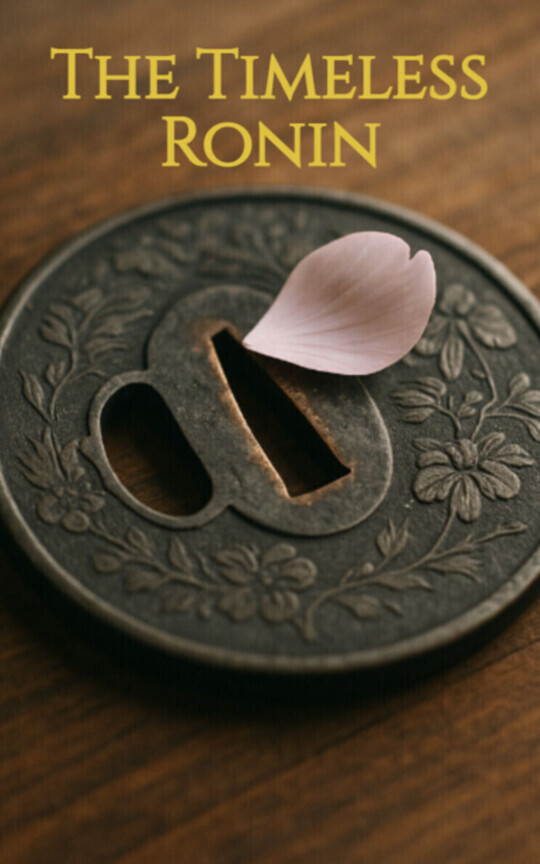
The Timeless Ronin
Compartir con tus amigos
Personalizar legibilidad

The Timeless Ronin

IMNerdy78

Todos los derechos reservados ©

Asistido por IA

Notas de historia

This is a preview of a full-length novel currently in development. I’m sharing the opening chapters to get a sense of reader engagement and clarity.

I’m especially interested in feedback on:

- Pacing (does it feel too slow, too fast, or balanced?)

- Clarity (is anything confusing or hard to follow?)

- Engagement (what made you want to keep reading—or stop?)

This is a more reflective, character-driven story, so I’m also curious how the tone lands.

All feedback is appreciated—honest reactions help the most.

Sinopsis

Mori Kenshin has lived for centuries. Once a samurai, he has walked through the rise and fall of empires, survived wars that erased entire generations, and watched the world reshape itself time and time again. Now, he lives quietly as a university professor, teaching history to students who believe the past exists only in books. But for Mori, history is not something he studies—it is something he remembers. As fragments of his past begin to surface through his lectures, the line between memory and instruction starts to blur. A perceptive student begins to notice the inconsistencies. The questions grow sharper. And Mori is forced to confront a truth he has spent lifetimes avoiding: No matter how carefully he hides, time always reveals what refuses to fade. This is a reflective, character-driven story about memory, identity, and what it means to endure when the world refuses to stand still.

Estado:
Completa
Capítulos:
7
Rating
5.0 (1 reseña)
Clasificación por edades:
16+

A NOTE ON LANGUAGE AND TRANSLATION

The protagonist of this novel, Yamamoto Haru, is a man who has lived across four centuries and many cultures. His native tongue is Japanese — classical Japanese at that — though over the span of his long life he has become fluent in English and other languages.

Throughout this novel, Haru’s internal thoughts, recollections of historical dialogue, and moments of deep emotion arise in Japanese. For the reader’s clarity, these passages appear in English as direct translations — rendered in the voice and cadence you would expect from the character himself, rather than literal word-for-word renderings.

Japanese words and phrases that appear untranslated — such as ronin, uchigatana, or mono no aware — are terms that carry cultural meaning too specific or too layered to reduce to a simple English equivalent. These words are italicized on first use, and a brief glossary is provided at the end of the volume for reference.

Historical names of people and places follow standard Hepburn romanization. Where historical figures spoke or wrote in Japanese, their words have been translated with attention to period context and meaning.

In this way, what you read is not merely a translation of language, but of a life.

Sigue leyendo en la app

Escanea el código para abrir este libro en la app de Inkitt y seguir leyendo en tu móvil.

¡Cuéntale a IMNerdy78 lo que piensas sobre este capítulo!

IMNerdy78

Thank you! I really appreciate that. I’m happy to know the story and characters are landing the way I hoped..

In regards to the visual ideas—that’s something I’ve thought about as well. I’d definitely be open to hearing what you had in mind for some of the scenes.

Thanks again for taking the time to read and comment.
7 meses