The Street
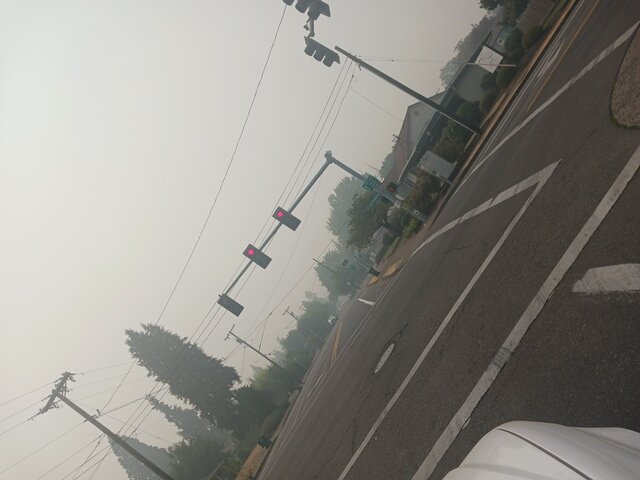
The dust danced to the wind’s mysterious music at the west of town, where lay the crossroads, once the confluence of all directions, before the advent of the interstate. The town’s lone stoplight swayed above the swirling dust, blinking at the dance like a bleary eyed drunk mesmerized by the sight of joy, so strange and alien, beyond the scope of his current reckoning. A plastic bag flitted down the street, and for an instant, I caught sight of its logo, a long whiskered, point nosed red fox grinning broadly at me.
“Be a foxxy shopper,” I said to the empty fuel island I presided over. “Shop Reynolds.”
The plastic bag floated high in the air as the fox flashed a grin at Farm and Home Hardware’s faded yellow and red paint scheme. Then, heeding the call of the crossroad’s reverie, it darted down again, zipping along street level in a mad rush. Twisting and turning, it joined the dust devils. The blind blinking red eye swayed uneasily.
A gust of wind washed over me, sending ripples through my loose hanging overalls. My legs twitched, wanting to leap up, muscles contracted and driving toward the beautiful dance. What a glorious experience, I imagined, to strip off my stained and smelly overalls to my boxers and tee shirt below and jump and spin and gasp for air, the wind pressing at me from all sides, the fox smiling down on me from his plastic cloud.
If I followed the desire pumping within me, the street would see. If I leapt as high as possible trying to touch that red faced smiling fox, tongues would wag, ears would hear. Tales would spread.
The wind strengthened. My hair rumpled. The sign above me advertising the lowest beer and ammo prices in the county groaned against invisible force.
The plastic bag beat a furious rhythm, snapping a crackling in its acrobatics. The fox grinned, winked, beckoned. My stomach felt light, floating, like when my dad used to coast down Cemetery Hill in our old station wagon, windows down, wind whipping, grasshoppers cracking against the fanned red fenders and wide, flat grill. I tingled as my chest and shoulders rose from the back of the folding chair stationed between the customer enterance and open garage bay.
The bag floated alongside the flashing stoplight. It reminded me of a picture of a jellyfish in the World Book of Encyclopedias. The fox gave me a long, upside down smile. Then the bag rumpled and fell to earth as the wind slacked, and the dance at the crossroads became slow and fitful.
I closed my eyes and absorbed the quiet of an Eastern Montana afternoon. For a few breaths of time there was nothing. The lines of a poem began to form in my mind’s eye, fiery words hanging over an eternal horizon. Deeply I inhaled, passing over the pungent scent of gas and oil, tasting instead the fragrance of prairie grass, sagebrush and alfalfa, born into town on the wind’s wings. The words in my mind coupled, becoming thoughts, ideas, phrases.
Snarling and squealing heralded the beast’s coming. My eyes snapped open as the dancers scattered. Possessed by anger and aggression, metal and chrome glinting fiercely in the noontime sun, it roared around the corner, blind to all in its path. I slumped back in my folding chair and glared at it from lowered eyes. Its oversize tires locked up across the street from the Farm and Home as the pickup skidded into a parking spot, one wheel running up onto the curb.
Byron stepped down from the driver side of the metal monster, Scott from the other, dust leaping from their boots. For a moment, my gaze met Byron’s. A smile crossed his face as he said something to Scott. Their laugh felt harsh and sharp in the hot silence. My face flushed and I stared down at my hands. They looked so pale, so soft against the rough grease stained overalls. Without thinking, I pulled down the cuffs, and watched Scott and Byron from the corner of my eyes.
They wore the uniforms of farm boys, tee shirts and jeans, baseball caps advertising a brand of tractor or football team tilting atop sun burnt, unshaven faces. Scott stood tall and muscular, walking with the arrogance of farmer’s scion and past high school glory. We had gotten stoned together last summer, after graduation. He wasn’t a bad guy there, under the stars with a joint in his fingers and warm laughter coming from his lips.
Byron rose to barely Scott’s shoulder, his “No Fear” shirt building against the onslaught of barstool exploits. No farmer’s son was he, no athlete of regional royalty. He pulled open a peeling green door with a slow creek that cut through the still street, Scott disappearing into the oasis of beer and air conditioning, with Byron remaining true to his one talent in life and following behind. The wind shoved the door shut with a bang. Once, the sign above had been bright and happy, before the oil had run out, before the interstate had slit the jugular of the town. Today, the faded sign merely murmured the name Stockman Bar and Grill.
As if one cue, the dust once more leapt into swirling dance at the crossroads. The bag, who had been rustling restlessly in the gutter, leapt up to meet them, but became trapped on the antenna of a dented, rusted Cutlass parked in front of the Mercantile, the only two story building on the street. It strained and struggled against the bounds of reality, where it existed as a mere plastic bag, litter dangling on the antenna of an old car, instead of the graceful, elegant dancer, privy to a music we cannot hear, cannot know. But reality proved to great a jailer, and only by blind chance of the wind or unlooked for aid would the red fox ever smile again.
My instinct pushed me to free the plastic bag, but Jason, my boss and his son Jared, currently discussing head gaskets in the garage behind me, would never let me live it down.
“He just put down his damn book and walked down the street to the Mercantile and damned if he didnt take a plastic bag off Cartoon’s busted down rig and just let the damn bag go flying off in the wind. Now some farmer’s gonna have that damn bag hung up in their fence. Shit, more Reybold’s bags than tumbleweeds out in the tree belts these days. But that boy didn’t think. He got no sense. No damn sense.”
I let out a long sigh against these words infecting my imagination, as if to breathe them away and leaned my head back against the filling station window. In the azure sky, a jet glinted under the baleful gaze of the afternoon’s tyrant. A pang of envy hit my stomach, from which tendrils grew, wrapping around my neck, pulling my head lower. Shame came next, over the feelings of jealousy, desire for what others possessed. These two emotions, powerful beings holding my strings, melded and fought, fed and devoured.
My downwards eyes drifted to the open page on my lap. I examined it from far away, a satellite taking images of an otherworldly landscape. The yellowed page bore the marks of a life well used, with dog eared corners and a deep crease dividing the page in a near perfect 45 degree angle. A fingerprint sized stain, probably from spaghetti sauce, held the impression of a previous visit.
Pulling away from the color and texture of that imprint, I watched it blend with the paragraph, until it became part of the stately, strong structure of the page. I beheld the straight edges of the paragraphs, the indentations and open fields of creating mood and tempo. The writhing tentacles previously engulfing me became an unfelt memory as the letters, some straight backed and proud, others curving and elegant, seductively drawing me into their embrace. I landed in the world held on my lap, to the side of Frodo Baggin and Samwise Gamgee huddled in the pits of Mordor. With a faint pat, a drop of sweat stuck to the page.
The familiar rhythm of Charlie’s bad spark plugs lifted my eyes, back to the fuel island. With a grin I admired his driving technique. He never seemed to use the brakes or gas, somehow maintaining what appeared to be a constant speed, gliding around corners, floating down Main. With the long sharp fins on his big boat, the wind seemed on the verge of picking him up flying over the hills of his home.
He hung a wide left across three lanes of traffic, empty today beneath the August heat, though Charlie seldom allowed oncoming traffic to hinder his turns, and came to a gravel spitting stop at the Cenex Feed Store. With a deep intake of prairie air, I set aside Tolkien and the shade of the fuel island, stepping into the blasting sun upon the parking lot. Charlie’s door whipped open under the winds muscle.
At the far end of the street, Stockmans Bank read 1:30 in the afternoon at ninety-nine degrees. On days I worked the morning shift, I sometimes walked through the Cenex’s red and white barn door, where the old timers, the small farmers and the veterinarian still bought bags of grain or pet food or garden seed. When I walked in, I got a ticket to the past. Pete might talk about the first time he saw an automobile. Over cowboy coffee and roll your own cigarettes, they joked I couldn’t handle a regular cup of joe as I poured in spoonfuls of sugar into the swirling black. Charlie remembered when news came down the line that FDR had died. He still choked up a bit at the telling, his gray blue eyes watery, even as he changed his story to when his battalion met the Russians on the Rhine. You have to hold Russian cigarettes straight up when you smoke them. Otherwise the cherry falls of quicker than a french woman's, he’d laugh with those same watery eyes. How do you tell a Ruski from a Kraute? The burn holes in his uniform. Laughter rang out over bags of feed and seed, receding into silence. What images danced in their minds’ eyes during those moments I knew not, searching inside from my own memories and stories to share.
One hundred degrees at one forty spelled out the yellow dots. Not time to pass through the portal today. As I turned away, a gust of wind sucked away my breath. A Thrifty Nickel newspaper glided past Kwik Wash Laundry. On cue came the gravel voice of either Jason or Jared, amplified by the echo chamber of the garage.
“Hey Julius, these cigarettes ain’t gonna stock themselves.”
Turning my heel to the wind, I nodded to Jared, standing beside the open hood of his son’s vintage mustang.
“I thought maybe the cigarettes might stock themselves today, if only I gave them the chance,” trying to make my voice sound strong across the wind and the fuel island.
While Jared gave a chuckle and ‘well get to it then,’ his son Jason stepped out from behind the metallic blue hood, wiping his meaty hands with an oily rag.
“Seems we got an ungrateful employee here. Reading books, wandering off to hangout with old men. What are we are paying him for?”
The bells on the door of the store jingled as I pulled it open against the wind. And extra push of the wind almost pushed the door closed before me, giving me an extra moment outside to hear Jason’s parting comment.
“What use is he?”
My face flushed in the closed air of the shop’s interior. Jason’s only interest at the shop was his mustang and stealing beer when his dad wasn’t around. He had no time for the details like oil changes, brake jobs, selling shelf space, the things I helped Jared with, usually while quietly insisting I’m not the one stealing beer, but I sure don’t know who the hell is. For as many times as I had gazed up at a distant jet, wishing to be on it, I now looked down at thin arms as I unlocked the cigarette case, pulling out a pack of Marlboro’s, and wishing I was strong enough to kick Jason’s fat ass.
Later that night, as with nearly every night, I’d be riding with my friend Sam, up and down the street, over and over, until time and place lost all meaning. I’d curse Jason then with strong words, to Sam’s laughter at my impotent anger. With a fuck it, we’d blast Metallica on the stereo, and I’d stare out the window of his Chevy Biscayne at the passing signs: The Ranger with its neon cowboy twirling a lariat; the Idle Hour and its blinking martini glass in the window; The Stockman across the street from the Cattle-ac, four bars squatting at the crossroads like dark eyed sentries.
My drifting mind floated away from Jason and who the hell does he think he is calling me useless. Thoughts of my mom and her stinky boyfriend stumbling out of bed to greet the new day with a new can of Milwaukee’s Best would fly out the window with wind and the thundering rhythm of the Master of Puppets. I didn’t wonder where the hell my dad was as the steady pattern of the street at night passed by the window. With each pass of Taco John's another beer drained, and the world beyond the streetlights of main quit prodding at me, prying for me to join it.
The employee’s only door opened to reveal Jared’s bearded face.
“How’s those cigarettes coming?”
The glued tabs of the carton popped as I broke it down.
“Right once again, boss, these cigarettes don’t stock themselves. Think I’d know that by now.”
I ripped open a carton of Marlboro lights and slipped a pack into my pocket. Jared’s eyes, shaded beneath his faded Circle K har, followed my hands.
“You’re paying for them,” he reminded me, the gravel of his voice a bit softer than before.
“I always do,” my voice sounded far away in my own ears.
For a moment, we made eye contact. He gave me a short nod of understanding, which I returned. Then his eyes broke back to the street, where the heat shimmered off the pavement.
“Charlie just came outta Pete’s. I suppose he’ll be stopping for gas.”
With a ‘got it’ I followed his gaze, squinting against the sharp glints of the sun outside the pain glass window, slipping a stack of Lights into the slot above the counter. I locked up the cigarette case and grabbed a quart of thirty weight oil, then, with an 'I got this one, too' I snatched a second bottle off the rack.
“You need some more whipping at cribbage after your shift?” Jared called to me as I approached the door.
Again we made eye contact. From beneath his heavy brow, brown eyes twinkled. I felt mine do the same in answer.
With a slanted smile, I told him, “I will beat you at cribbage. One day, I will win.”
His laughter echoed into the garage.
“That will be the day, Jules, that will be the day.”
The employee only door closed with another greasy palm print left behind as I stepped through the jingly door to the thick, pressing embrace of the summer heat. Instantly, sweat sprang up under my arms, tickling my sides as I watched Charlie’s Mercury float across three lanes with an eerie grace, almost jumping the curb as Big John’s Big Ford Lot, then floating back across the same three lanes, aiming for the fuel pumps where I stood. Bouncing into the lot, kicking up gravel, he skidded his boat to the ground right in front of me. With barely a step I opened his fuel tank and inserted the nozzle, clicking the handle wide pen.
I pushed open the plain of the hood against the wind, propping it open with the two by four Charlies stashed in the tire well. Checking the oil, I decided a quart would be enough this time. The bottle glugged, the contents seeping down into the engine. I peeked under the hood to see Charlie’s ridged, forever tanned face as he watched the rolling numbers on the gas pump.
Most people looked at Charlie and saw just another old man, just as a person might look at the hills of my upbringing and see nothing but emptiness. But look closer. There is a dell where a Mule Deer raises her fawns. There is a wrinkle that deepens when he laughs, and another that droops when he talks about the war, and becomes a canyon. In the canyon is an old oak, who knows where it came from or how it rooted. They aren’t native to our land, but there it grows, singing with birds in the spring.
I removed the empty bottle of oil, checked the dip stick and put the second bottle in my back pocket. The Mercury shifted slightly under the growing weight of its cavernous tank. Charlie stood with his back to me, facing the length of Main Street. I wondered how it appeared in his eyes, if he saw beauty, or a faded, dusty street with empty parking lots and blind windows. Drops of water puffed out of existence as I snapped the squeegee washing the wide windshield of the boat. Charlie turned to me, the fault lines of his face shifting, throwing up mountains and laying down valleys. I returned his smile.
“What do you know there, Julius?” came the same question he’d asked times uncounted.
“Not much. You?” My customary response.
Charlie swayed slightly against a sharp gust of wind.
“Well, my place is gonna dry up and blow away if the weather keeps up like this. Can’t keep enough water in the garden. Damn wind just sucks it right out of the ground.”
His eyes were hidden by the shade of his Ready Mix hat.
“I was thinking I’d hoof it out there on my day off.”
The gas nozzle clicking off punctuated my words. Charlie toed the curb with his heavy work boot.
“That’s quite a hike in this heat.”
“Aw, my mom lives at Crescent Ridge. If a guy cuts across the fields from there, it’s not so bad.”
I scrubbed at a grasshopper baked into the windshield. Charlie watched, I felt his eyes regarding me, pondering me. He opened his mouth to speak, but the gravel voice of Jason interrupted.
“Hey Charlie. Making a supply run today eh?”
One aged blotched hand reached into the breast pocket of his overalls and came out with a tin of Velvet.
“Yea, needed gas and feed. Can feel fall coming. Hip is stiff in the morning.”
Charlie’s hip predicted the change of seasons. His left shoulder predicted thunderstorms while his right knee knew when the fog would roll in and blanket the Yellowstone Valley in a thick wet blanket.
“Suppose there will be frost soon?”
Charlie ran his tongue along the glue of the cigarette paper.
“Nope. Too damn hot during the day. But I suppose it’ll frost soon enough. Be missing the sun before too much longer.”
“Ain’t that always the way.”
“I suppose,” the words came in plumes of smoke.
The squeal of the Stockman’s door announced Scott and Byron’s departure. They guffawed and rough housed now, Byron’s face shining like an apple as tried to hoist Scott over his back. Jared stepped out of the garage and called out to them.
“Are you done with your outfit Jared?” Jason called out to his son’s receding back.
Jared responded with words short and hard, but the wind blew the sounds down the street and away from our ears. Jason looked after him for a moment, then after a deep sigh I wondered if he even heard, he told us he’d better get back to work. With a glance to me, he turned inside the garage. Charlie and I gazed silently into the garage as Jason dropped shut the hood of the mustang.
“How’s Pete doing?” I asked as I topped off the tank of Mercury.
Three doors slammed as Scott’s glinted red pickup, the brightest color on the street, snarled to life, belching clouds of black smoke as it ripped off towards the fields east of town.
“Oh, you know, he’s doing good enough, I suppose. Times passed us by, you know. Everyone’s buying their seed and feed from big stores over in Williston. Pete can't compete with them prices or supply. Little guys like me, we do our best, but my couple pigs and chickens ain’t no stock near enough to keep any feed store going. Hell, old Don Cyko sold his place to some big outfit from Minnesota. Now Pete ain't got no more big customers."
The cherry of his cigarette glowed red.
I topped off Charlie’s gas tank, following his gaze to the crossroads, now quiet and sullen as the wind slacked, the sun dipping lower, casting long shadows across vacant parking lots.
“Times are changing, I suppose, as they always are. I was telling Peter about the time I rode the rails from Wolf Point out to the coast. Before the war, you know. Folks was struggling anyhow, not enough food for all us kids, so I headed out west to find work. Landed in a town called Astoria. Spent ’round a year working the fishing ships and logging. Til the day the Japs bombed Pearl Harbor. I signed up that day. But tell you what, that work out on the coast, my dad always said that’s what got us through the depression. Lots of folks lost their land back then, never heard from again.”
The restless shopping bag flitted against the bent antenna. The dust rose up to dance under the blinking stop light. The Circle K sign shimmered in the heat.
“There’s a lot out there….” I choked off the words.
“I ain’t never seen nothing like that ocean. Different from the plains, you know. Both of them you can see as far as your eyes or the sky will let you but that ocean, she’s always moving. The plains, they sit and watch. That ocean flexes its muscles.”
Past the wavy lines of Circle K stood the Lone Tree Inn, all peaks and angles, its sign forever vacant, always lit. Charlie ambled over to the chair I used for break. My book lay open covered on the seat.
“Return of the King, eh?”
The town grew thinner out there past the Lone Tree, more spread apart. Empty parking lots and boarded up windows spoke of another age, when the Lone Tree’s sign read NO on occasion.
I answered with a detached “yep.”
“I suppose its written by some Englishman. Knew a few of them during the war. Tommies, we called them. Nice women, I’ll say that. They are all about kings and queens over there. Royal this, royal that. I never had much time for them. Or their food. I grew up round sheep, never thought to eat their stomachs,” he finished with a brown toothed grin.
Beyond the Corner Pocket Bar and Grill, the town just ended, a neon eight ball the last milepost before the green fields of the Yellowstone River opened into a verdant highway west.
“Yea…he’s English. Oxford professor.”
I felt Charlie’s eyes on me as my own beheld the sum of my experience, somewhere out there in the river bottom.
“Well, I suppose.”
Charlie clapped me on the back. I started like a man awakened. For a moment, he squeezed my shoulder, his watery blue gray eyes embraced me with soft kindness, a trait rarely seen or felt out there on that wind swept steppe, where tiny people clung to even smaller existences.
“See you Thursday, maybe. I’ll be around. You’re a good hand, Julius. Can always use a good hand.”
“Thanks, Charlie,” I answered.
Our hands clasped, his feeling rough and hard in mine. I locked his gas cap in place as Charlie pushed open the finned door of the Mercury. The boat lurched to life, rolling away from me, slowly rising to gliding speed. As he neared the crossroads, he passed Cartoon’s Cutlass. The updraft from the Mercury lifted the plastic bag from its despised reality. It floated in Charlie’s wake until he hung a left and disappeared behind the Stockman.
The fox rejoiced loudly, flapping and snapping in between twin plumes of swirling dust and bits of paper. The dancers expanded into clouds, rising around the blinking red eye. The fox grinned at me. I turned to the unstocked cigarette rack, my gaze lingering on the road west, where the fox winked.