
FOREWORD & TWs
My dearest reader!
Feel free to skip this chapter, for its intention is - first of all - to THANK YOU for picking up this book and teach you a bit about the history and trigger warnings that you come across in this story!
Secondly, as I was kindly told by another reader, sometimes it feels difficult to keep track of the plethora of characters that reside within this book and for this very reason I decided to cater to every one of you, who has the same issue.
Lo and behold, there is a spoiler-free family tree and a list of notable characters on a picture below, to remind you of the names, visages, titles and certain traits. Anytime in doubt, or you cannot recall who is who, feel free to come back and take a peek. It will probably work better on PC than on mobile though.
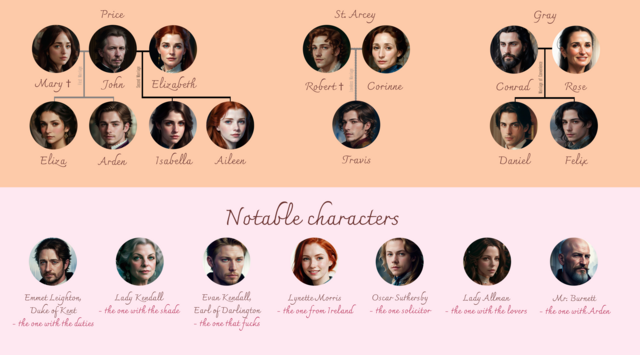


The story (here and in the subsequent books) will uncover the destinies of three families:
Price Family
Our main family! The head of the family is the Duke of Hertfordshire, John Price. The Duke remarried once due to the demise of his first wife of humble background with whom he fathered two children. They reside in London and their magnificent estate is called Mayfair House, located in Mayfair. Then they often visit the summer residence in Hertford. Their source of income comes mainly from leasing their vast lands.
Gray Family
The Grays reside in Newcastle, though Conrad is born and raised Londoner and got minted the title later in life. As there was too much historical commotion with the surname Grey, his ancestors made a small change to distinguish themselves. He, as the head of the family, is Duke of Northumberland. Their estate is located in Fulham, called Thornton Hall. They have a business with wood and make clever investment decisions.
St. Arcey Family
St. Arceys always go with the surname - it’s not a mistake on my part, rather the simplification for the reader, hence there will be always Marquess St. Arcey/Lord St. Arcey, Dowager Marquise St. Arcey/Lady St. Arcey. Late Marquess Robert St. Arcey died when Travis was just a child. The family owns a city home in Kensington - where Travis resides most of the time, and a grand estate in Reading, which is occupied by his mother. Their income source is trading with animals and animal products.
Now, what is this book about?
It belongs to a historical fiction category, and a subcategory of historical romance, as the story spans throughout Georgian era England. Taken from Wikipedia: The Georgian era was a period in British history from 1714 to c. 1830–1837, named after the Hanoverian kings George I, George II, George III and George IV. The definition of the Georgian era is also often extended to include the relatively short reign of William IV, which ended with his death in 1837. The sub-period that is the Regency era is defined by the regency of George IV as Prince of Wales during the illness of his father George III. The transition to the Victorian era was characterised in religion, social values, and the arts by a shift in tone away from rationalism and toward romanticism and mysticism.
If the name Jane Austen conjures images of timeless literary classics like Pride and Prejudice, Sense and Sensibility, and Emma, or if the allure of the Bridgerton series has recently captured your attention, you’re in for a treat. Perhaps you’ve already immersed yourself in the charm of historical romances set in this captivating era, or maybe you’re embarking on a whole new adventure.
In the pages that follow, I invite you to set aside the weight of historical accuracy and join me in a delightful escape into a world where creativity knows no bounds. This book isn’t a lesson in history; it’s a celebration of storytelling, where I’ve dared to take some artistic liberties to spin a tale that I hope will entertain and enchant you.
Now, you might wonder, does this minor departure from historical facts mean abandoning the essence of the era? Absolutely not! As you delve into these pages, rest assured that the spirit of the times remains alive, intertwined with a touch of imagination that seeks to breathe new life into the past. So, dear reader, fasten your seatbelt— or rather, adjust your bonnet— and get ready for a journey where reality meets reverie in the most delightful of ways.
Most importantly, if you expect a story much like Austen’s works where love is expressed in a subtle manner by longing gazes and flowery proclaims, you may be vastly disappointed. Jane Austen was a repressed virgin in her era, which was by no means as prudish as it tends to be portrayed; in fact, Georgians fucked, and they fucked a lot. The stuff they did would cause even our contemporaries to blush rather profoundly! Roughly 40% of brides were knocked up during their wedding ceremony! Hence it is often noted that the Regency and subsequently the Victorian era became more repressive as an answer to the past era’s folly.
Before we embark on this historical journey, it is my responsibility to provide you with some important considerations.
Firstly, a gentle heads-up: within these chapters, you will encounter explicit depictions of intimacy, mature language, and instances of sexual assault. I want to ensure you are aware of these elements, as they play a significant role in the narrative.
In this tale, I’ve chosen not to shy away from the intimate moments between characters, and you’ll find a generous serving of spicy scenes throughout. So, brace yourselves for a vivid exploration of the characters’ relationships.
Additionally, as this narrative unfolds against a historical backdrop, I encourage you to view the depicted situations through the lens of the era in which they are set, not through the contemporary perspective of today. A crucial aspect to consider is the societal landscape of the time, particularly the challenges women faced in relationships due to limited sexual education and contraceptive methods.
In those days, societal expectations placed great emphasis on a woman’s virginity, considering it a confirmation of her marital purity. The lack of sexual education and limited contraception methods often presented challenges, leading to significant consequences if a woman was not a virgin on her wedding night. However, it’s essential to recognise that not all women, even in high society, entered matrimony without any knowledge of intimacy. Contraceptives, though rudimentary, did exist in various forms, including animal intestine or linen condoms, cervical caps fashioned from de-pulped lemon halves, and sponges, though the effectiveness in preventing pregnancy was not foolproof.
One couldn’t overlook the option of the discreet backdoor approach. In those times, this method was not only viewed as a means to reduce the risk of pregnancy but also carried the heavy stigma of criminal conduct, punishable by the ultimate penalty. The individuals who engaged in such practices were often labelled with terms like sodomists, buggers, or mollies, all of which were derogatory references to the gay community.
However, one cannot also ignore the unsanitary conditions of the past, even among the aristocracy who bathed infrequently, perhaps once or twice a week. This lack of hygiene made the unconventional contraceptive method quite challenging, particularly for heterosexual couples. Consequently, the withdrawal method emerged as a more practical choice, despite the inherent risks, given the higher likelihood of unplanned pregnancies—a reality that persists to this day.
In the midst of an unexpected pregnancy, the fate of a woman of esteemed social standing hinged on the identity of the father of her child. Should it be the king himself, her son could still ascend to the ranks of a Duke without raising an eyebrow, even if she happened to be married to another. However, if her heart led her to a charming young footman, the situation took a different turn. In such cases, families spared no effort to conceal the impending arrival and often coerced the woman into relinquishing her child.
Surprisingly, the stigma of illegitimacy did not carry the same weight, especially when viewed through the lens of the male perspective. It was widely acknowledged that some aristocrats maintained mistresses, with some even daring to coexist under the same roof as their wives, legitimate children, and acknowledged bastards. The peculiar dynamics of these family arrangements paint a fascinating, albeit unconventional, picture of aristocratic life and its idiosyncrasies.
In an era where the bonds of marriage were unbreakable and divorce an unthinkable notion, Georgians faced the weighty decision of choosing a life partner with utmost caution. Once the vows were exchanged, there was no turning back – husband and wife were bound until death intervened. Within the aristocracy, the pursuit of a suitable match was driven by considerations beyond mere affection. Love often lingered as a secondary concern, with the primary goal being the acquisition of societal standing and the securing of a family legacy, hence the birth of an heir and a spare was paramount. Many couples, in their pursuit of progeny, experienced the heartache of losing children to the harsh realities of the time. Large families consisting of 14 children weren’t a rare sight, though only a fortunate few offspring reached maturity.
Moreover, the perils of childbirth itself cast a shadow over the joy of parenthood. High mortality rates during pregnancy and childbirth, coupled with the lack of medical standards, meant that the advent of a new life was not always accompanied by the immediate joy of seeing a healthy child. The journey of motherhood was fraught with uncertainty and sorrow, as women grappled with the harsh realities of the time.
In the complex tapestry of Georgian matrimony, some couples chose unconventional paths. Living apart in separate abodes, they navigated the intricacies of fidelity and desire, sometimes indulging in discreet relationships outside the bounds of their official union. However, societal norms dictated that such dalliances, particularly for women, were to be shrouded in secrecy.
While young men were free to pursue their dreams and wants, the education of young women predominantly centred around the realms of household management and the art of nurturing children. Even for those of elevated social status, the privilege of acquiring knowledge in languages and the fine arts was often extended through the guidance of private tutors.
A pivotal milestone in a young woman’s life was marked by her debut into society, typically occurring at the age of 16 or 17. This inaugural season held particular significance, especially for families blessed with multiple daughters. Swiftly following this social debut, the prospect of marriage loomed, a culmination eagerly awaited by both the young woman and her family.
In a society where matrimonial unions were paramount, a woman not wed by her mid-to-late twenties faced the label of a “spinster”. Though not a definitive sentence to a solitary life, spinsters encountered the competitive landscape of fresh-faced debutantes. The allure of youth, coupled with the potential for bearing more offspring, rendered these debutantes more sought after in the matrimonial arena.
So that’s it for a small peek into the history, the characters, and the family backstories - you’re now good to move to the story itself! Let me know what made you smile, laugh or frown - every comment makes my day!
Yours sincerely,
Sylvia Norcroft


















Hey! I just read your story and it honestly left a nice impression on me. The emotions felt grounded and real, which I really appreciated. Best of luck with your writing looking forward to reading more.
Thank you!