
The Landing: Inside the Airport Control Tower
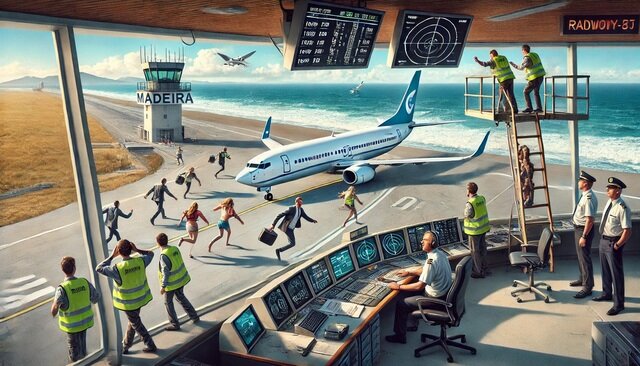


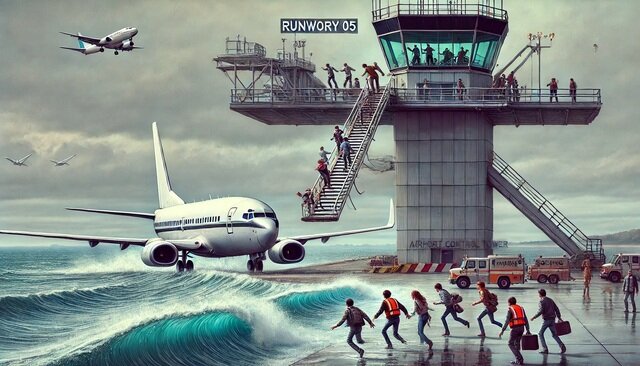
Let me introduce myself... I've been an air traffic controller here for 11 years. I was employed at Madeira Airport back in 1999. At that time, the airport was still often referred to as Santa Catarina Airport, the name it was given when it was built in 1964. In 1977, we had two fatal accidents here. The airport then had only runways that were 1,600 meters long. In November, in bad weather, a Boeing 727 touched down on runway 23 only halfway along its length and couldn't stop in time. It overran the runway edge and fell onto the beach. 131 people died. In December 1977, a much smaller aircraft, a Sud Caravelle 10R, landed on runway 05—which is essentially the same runway but with landing rights in the opposite direction, i.e., west-east. The pilot made a mistake and plunged into the ocean where it's immediately very deep. As you know, in 2000, the runways were extended again to their current respectable length of 9,110 feet, or 2,781 meters. Since then, we can accommodate practically all aircraft. Landing on our runway 05 is more challenging. After flying over the coastal hills and spotting the visible airport, the pilot must quickly reduce altitude to touch down as soon as possible. If they start braking only halfway down, they'll end up in the ocean.
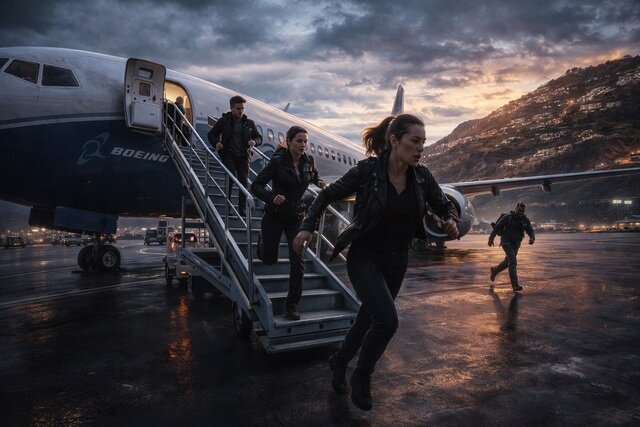
Along with the entire control tower crew, I watched what was happening. The Boeing BBJ, a medium-sized aircraft, touched down at the very start of runway 05 and somehow managed to brake so abruptly that it came to a complete stop with two-thirds of the runway still ahead. Instead of taxiing to a stand along the terminal, someone on board opened the rear door and threw out a folding ladder. Seven young people descended the steps—four women and three men. They were dressed oddly, as if they planned to land in London or Oslo, not Madeira. Each carried a fairly large travel bag.
Then events unfolded in an incomprehensible way. The stairs were pulled back in, the door slammed shut. As the group of passengers was nearing the entrance to the "Arrivals" section of the terminal, the massive Boeing began to take off. It immediately gained significant speed. Two hundred meters before the end of the runway, it lifted into the air. After ten minutes of flight, still at an altitude of about 300 meters, it suddenly nosedived and struck the ocean's surface. Within minutes, there was no trace of it. Only a whirlpool, a stain on the surface, marked where the plane had crashed and sunk.
We were in shock. I frantically thought about whom to notify. Probably not just the International Aircraft Accident Investigation Committee, International Air Navigation Services, and Airspace Management Cell, but also the police and the military.
"Boss, I recall that when the aircraft crew requested permission to land, I asked which airspace they were leaving. They hadn't been visible on radar earlier! Captain Vivian didn't answer my question."
"Captain Vivian? Did you ask for the name and status of the aircraft?"
"Of course. She introduced herself as Captain Vivian Reims. She said that the Boeing BBJ 737-700 had private aircraft status and belonged to a company registered in London called Long Range Space Monitoring Software. She requested permission to land, a half-hour stopover, and then to take off again. They didn't want to refuel, which I found a bit odd. The airport and navigation fees were to be transferred today. Since we don't have much traffic on the apron now, in the afternoon hours, and I had good separation from other incoming flights, I granted landing permission."
"You should have told me! Alright. Lucidio and Onega, call the Airspace Management Cells and controllers of the Faro, Lisbon, and Porto airspaces, and possibly the control towers at Agadir, Gran Canaria Airport in the Canary Islands, and Ponta Delgada Airport in the Azores.
"Where did they come from?" I pondered. "They didn't just fall out of the sky." I can imagine all the visits that await us—the people from International Air Navigation Services and Airspace Management Cell, the police chief in Funchal, that naval colonel I can't stand. Well, there's no choice. Luckily, we have everything recorded by standard monitoring cameras. Lucidio wisely recorded their strange takeoff and short flight with our service's portable camera. I have a feeling that this time, the procedure for investigating the causes of an air accident may be ineffective. Where the plane went down, the ocean floor is probably at a depth of 2,000 meters.

We did it. I think things are going well so far. I'm contemplating the overwhelming events of the day. Oh... I should introduce myself... my name is Tim Lynx. I'm waiting for Vivian. She should arrive from the airport in the next taxi. She prefers that I don't move around the city alone for now because I find everything strange and, according to local customs, apparently behave oddly. I obeyed and came, as she instructed, to the Don Pedro Hotel in Garajau, near the town of Caniço. It's a place located a few kilometers east of Funchal, the capital of this island. The hotel room was booked. I settled in here and waited. From the windows, we have a beautiful view of the ocean, although today the sky is cloudy and the wind is blowing. I'm lying on the bed, trying to sort everything out in my head.
We used a difficult method to reach the surface of this planet. We employed a lander designed to resemble local airplanes. Our engineers on the mother ship built it to look like a Boeing BBJ, an aircraft used here by wealthy individuals or affluent companies. Our lander, from the standpoint of space engineering, is almost just a glider and, of course, wouldn't be able to return to orbit. Here on this planet, they supposedly used such landers called Challengers. Judging by the photos Vivian provided, they were much larger. It wasn't easy to build a lander the size of a Boeing BBJ.
The engineers also had to ensure that this "device"—part lander, part airplane—could take off from the airport where we'd land, then fly automatically, partially controlled by our radio transmitter.
According to Alice's plan, presented in detail during the operational meeting on the ship, we're supposed to stay on this planet for several years. We prefer that the locals remain unaware of this, at least at the beginning of our mission. If you think about it, a more convenient way to land would require much more complex technology. We'd need a device capable of decelerating from high cosmic speeds, capable of landing on a massive planet and soaring back into space, overcoming what's known as the first cosmic velocity. That would require a different, very advanced propulsion system. It would be challenging to store such a device capable of a space launch. As Vivian joked, we'd have to keep it in some barn, which the villagers would notice. Of course, TCP-1 is waiting for us in orbit, but we had to destroy our lander. That's why we chose to land on this island. The local airport is very specific. On both ends, the runway terminates over the ocean waters. If you land on runway 05, right after the end of the runway is the deep ocean. Our plan to sink the lander succeeded, which doesn't mean we've solved all our problems. The local authorities will probably be looking for us.
Vivian insisted on using this airport, even though there are supposedly several similar ones on this planet, for example, on the island of Saba in the Caribbean, part of the Dutch Antilles. Vivian planned that after landing, we'd immediately initiate several actions. With us landed Elias and Beatrice, Alice and Abigail, and Brenda. A total of seven people. There were supposed to be more of us, but at the last moment before departure, we quarreled. The farewell party thrown by the princess, as it turned out, caused various tensions.
The first pair from our group must go as soon as possible to the continent, specifically to Portugal. We attach great importance to an on-site inspection in a certain town. We're looking for evidence of the existence of what we call "intermediate powers," meaning forces much more potent than humans but not identical to the creator of all things.
They are significant for our conceptual model of the world. Elias and Beatrice are heading there. Abigail is to proceed slightly further east, that is, to explore the cradle of the main religions of this planet. Alice, being a determined individualist, said she wouldn't tell us for now where she's going. She promised to get in touch after some time. Alice and Abigail also settled somewhere in Funchal and plan to join the passengers of the giant cruise ship Queen Elizabeth of the Cunard Line, which will depart from here in a few days and return through the Strait of Gibraltar to the Mediterranean Sea. They want to join the two thousand passengers of that behemoth.
I don't know what Brenda will do. We had an argument. She said she's had enough of me for now. She wants to build a life with someone else. I think she's simply bored with me.
During the "descent" operation, Vivian had already determined that a certain Tedeus would be here on Madeira right now, someone she'd heard about during her first stay on this planet. If Vivian hadn't been here before on a mission carried out by TIME-CRAFT-IV, all this wouldn't be so simple. We already have an officially registered enterprise here, or rather an office, which we call Long Range Monitoring Software. The people employed there indeed deal with methods and technologies useful for long-range listening and contact with level "2-II". This company has a bank account. We use so-called satellite cell phones and extensively utilize the local Internet.
I didn't know that here on this planet, besides regular cellular telephony, they also have a communication system based on telecommunication satellites. Initially, they used satellites placed in geostationary orbit for this purpose. They still have the Thuraya system. But that orbit is far away, so the signal was weak. The Thuraya system terminals are heavy. Then they launched the Iridium system, and recently the LEO system based on satellites flying low over the Earth. The transmitting and receiving devices can thus have less power and are similar to regular phones.
Even from the deck of TCP-1, Vivian was determining, with the help of our people from LRMS, where Tedeus was currently located. She considered the fact that he chose to come to Madeira right now as a favorable twist of fate, which she called causal synchronicity. Everything would be fine if not for the awareness that it's not entirely clear how we're supposed to return to orbit and find TCP-1. We only have the optimistic advice of the commander: "You must return using your own means... if you think about it, you'll manage."
When I ask Vivian about it, she answers vaguely. She says, "Oh, we have a few years. Much can change. When the time comes, we'll think of something."







![Fated to My Ex- Best Friend [Moving to Galatea]](https://cdn-gcs.inkitt.com/vertical_storycovers/ipad_49edb1dbf9a28b50b9c4d68d8598359b.jpg)











I’ve never been a fan of sci-fi since I hardly read it but the detail in this first chapter for the first few paragraphs has told me that this is definitely going to be a great book. can’t wait to carry on reading this.