Chapter 1
CHAPTER 1
Somewhere in the Valley east of Damascus, near the Ghouta region...
The desert was scorched, the dunes shifting with the breath of war. The air shimmered with heat, and every gust of wind carried with it the stench of sweat, steel, and searing blood.
Men moved like ghosts in the sun—faces wrapped in cloth not just to shield from the unforgiving heat, but to cloak their identity from death itself. Others bore heavy mail and iron helmets emblazoned with the blackened cross of the Ashen Order, their banners sun-bleached but still defiant, whipping in the dry air like the tongue of a serpent.
Steel clashed. The sound was dull—muffled by the heat—but each strike carved screams from the throats of the dying. Blood hissed when it touched the sand, as if the earth itself rejected it.
The Qabḍat al-‘Ayn al-Ḥamrā’—Grip of the Red Eye—stood their ground beneath the crescent banners of Qamaristan, defiant and unyielding. At their front, atop a dark stallion whose hooves churned sand into dust storms, rode Sultān Azrak ibn Sahl al-Nimari. His eyes, rimmed with the dark paint of tradition and war, scanned the battlefield like a hawk. His armor shimmered with desert gold, his scimitar already crimson from the necks it had found.
This was his land.
His blood soaked this soil long before the invaders did.
And he would see it soaked again—only with theirs.
Across the field, marching beneath black pennants and a sky-piercing iron cross, came the invaders. The Adarath Army, their order forged in northern stone and ice, moved like a cold machine. At its center, astride a white destrier clad in full plate, was King High Marshal Caedric of the Ashen Cross—a man feared for his brutal campaigns and unbending discipline.
This wasn’t just a holy war.
This was personal.
Azrak’s people had lived in the Ghouta valleys for centuries. And now, Caedric had broken the pact—a breach at dawn, with no formal declaration. The Sultān would not forgive it. The desert would not forget it.
The next swing of a sword would not be for conquest.
It would be for vengeance.
King Marshal and Sultan Azrak stood across the battlefield, the scorched earth between them buzzing with silence.
“Azrak,” Marshal called out, his voice sharp and unholy, slicing through the still heat like a blade. “By nightfall, this valley will drink its fill… but I wonder, Sultan—will it be your men’s blood, or mine?”
His words dripped with cruelty—bloodthirsty and smug. A golden canine glinted when he grinned, catching the sunlight like a crown of sin. His hand clenched the hilt of his sword, not to wield it yet—but as if he needed its weight to ground him, to keep from lunging forward too soon.
Across from him, Sultan Azrak did not flinch.
He didn’t sneer. He didn’t blink.
He simply stared, the folds of his royal indigo cloak caught in the wind, his gaze dark and patient like the eye of a brewing storm. There was no passion in his face—only promise.
His voice came like dusk—low, still, in the language of his ancestors:
“مارشال، أنت رجل ميت.” (Marshal, you’re a dead man.)
It wasn’t a threat.
It was a vow.
Marshal’s lips curled into a wide, scarred grin. He drew his sword with a hiss of steel and yanked the reins of his white steed, the beast rearing beneath him in protest. He was eager—too eager. There was desperation in his posture, a hunger to spill blood and prove dominance.
Azrak didn’t move. Not until Marshal closed in.
The moment Marshal raised his blade overhead, Azrak tugged on his own reins, twisting his stallion in a fluid sidestep. His sword flashed free in a blur of silver, slicing toward the Marshal with lightning speed.
Marshal barely dodged, teeth gritted, his blade clashing in time—but as soon as he deflected the first strike, a second was already coming.
Azrak was not just fast. He was relentless.
Marshal’s horse stumbled under the assault, hooves kicking up sand. He snarled and yanked the reins viciously, jerking the animal’s head back. It neighed in agony, bucking wildly.
“Come on, you lousy animal!” he spat, slapping its flank.
But when he looked up—he saw it. That silver arc. Coming fast.
His eyes widened.
He ducked—too late for the horse.
A wet shhhhkk sound followed by a piercing scream. Blood sprayed across the sand as Azrak’s blade cut clean through the horse’s throat. The beast collapsed in a heap of muscle and bone, twitching as its life spilled out beneath the sun.
Marshal tumbled off, coughing and cursing. Dust clung to his armor as he scrambled up, brushing off his chestplate. Rage twisted his face.
“I don’t need horses or armor…” he growled, spitting blood from his lip. “…Let’s fight this like men.”
He tossed his gauntlets aside. One hand clenched his blade. The other trembled slightly.
Azrak said nothing.
He dismounted quietly, his boots touching the sand like judgment. His horse backed away on command, obedient and calm.
Now it was just them. Two men. One war.
The sun blazed overhead. The battlefield had gone quiet, as if even the wind dared not interfere.
Azrak and Marshal circled one another, blades drawn, eyes locked. No words. No war cries. Just the sharp inhale of breath. The hush before thunder.
Marshal struck first.
His blade sang through the air in a wide arc. Azrak met it with a hard parry, the clash of steel ringing out like the toll of a war drum. Sand kicked up around them as they moved—each man pivoting, feinting, retreating, returning.
Their swords danced with violence, neither overreaching, neither faltering. Marshal’s strength came in heavy blows, hammering with brute force. Azrak countered with footwork—precise, ghostlike, turning momentum against him.
A swing to Azrak’s ribs—blocked. A jab to Marshal’s thigh—dodged. Steel spun. Sand flew. Sparks spat.
For every advance, there was a counter. Every blow answered with cold skill. It was not fury they fought with—but calculation. They were not men anymore, but war itself given form.
Marshal pushed forward again, slamming his boot into the ground as he lunged, his sword crashing downward with a roarless wrath. Azrak turned, sliding just enough for the blade to graze his cloak. He twisted his wrist, using Marshal’s weight against him.
They separated. Circling again.
Sweat rolled down Marshal’s temple, blood dotting his lip. Azrak bled too—from a shallow cut across his arm—but neither man flinched. Their silence made the duel feel ancient. Sacred.
Then—moment.
A mistake.
Marshal stepped in too fast, too wide.
Azrak moved like shadow.
Steel gleamed once. A blink.
A clean, diagonal slice across the throat.
Marshal froze.
Blood sprayed from the clean line beneath his chin. His sword dropped with a thud into the sand. His eyes—full of shock and stubborn pride—never left Azrak’s face.
And then—
His head slipped from his shoulders, rolling to the earth.
His body collapsed soon after, crumpling beside his slain horse in the blood-soaked dust.
Azrak stood still.
The wind finally returned.
And with it—it was over.
Azrak stared down at the corpse, his gaze cold and unreadable. Blood soaked the sand around the hollowed frame of the once-feared Marshal, but the Sultān’s face betrayed nothing—no pride, no rage, no satisfaction. Only silence.
He reached down, fingers closing around the dead king’s matted hair, and lifted the severed head without ceremony. The eyes were still wide. The mouth still slightly open, as if the last breath of defiance had frozen inside it.
Azrak mounted his stallion, bloodied blade at his side, and rode back into the chaos of the battlefield. Clashing swords. Screams. The dying cries of men still loyal to a corpse.
He raised the head high for all to see.
“Your king no longer breathes!” he bellowed, his voice cutting through the field like thunder.
Then, with the indifference of a man burying a dog, he hurled the head to the sand before his soldiers.
“Go home. Never return... or find yourselves burning in the hands of my men.”
The words struck harder than swords.
The Adarath soldiers faltered. Some froze. Others slowly lowered their weapons, gazes flicking between the bloodied head and the man who held it aloft only moments before. They had come to conquer. Now, they stood cornered—by the living wrath of Azrak and the unstoppable tide of the Qabḍat al-‘Ayn al-Ḥamrā’.
One by one, their swords hit the ground.
Clang. Clang. Clang.
The battlefield fell quiet.
The war was over.
Sultān Azrak ibn Sahl al-Nimari had won.
for now...
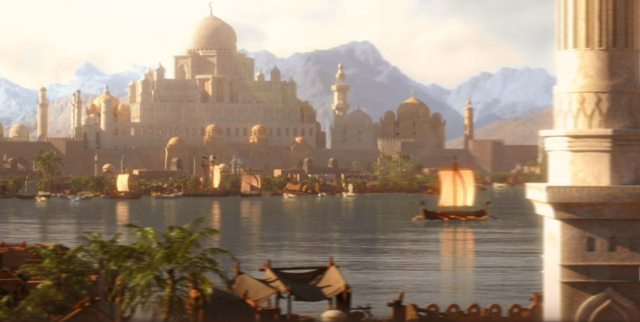
{this is what Qamaristan looks like below}