
Through the Threads of Time
This story was written for a literary contest held in Pazardzhik, Bulgaria, between September 6–8, 2025. The contest theme was
“The bright future we all dream of. How to fight for it?”
The taste of my sandwich matched my mood perfectly. Bitterness filled my mouth—wilted lettuce mixed with the stale aroma of yesterday’s bread and cheap processed meat.
“The taste of the new era…” I thought, as my gaze drifted across the buildings around me. “The Cake,” as we used to call Konstantin Velichkov Square, was full of passersby—hurried people, lost in the routine of modern life. The buildings loomed gray before my eyes. Not the fountains, nor the cafés, nor even the laughter of children could lift my spirits. My hometown of Pazardzhik felt like a cruel stepmother that day.
“He’s gone. I’ll never hear his voice again. Never shake his hand.”
When the phone call came, my whole world turned upside down. Everything spun wildly, time froze, and it felt as if the entire Lion’s Bridge metro station would collapse on top of me. I rushed out of the capital in shock, reeling from the news—Grandpa Sava had died suddenly.
To me, he was a saint. My role model. My living link to roots and memory. He was the one who raised me after my parents died young—yet another tragedy on the roads. It was Grandpa who urged me to move to Sofia, to study, to succeed. He took pride in my work—he called me an enlightener, a keeper of memory.
Never mind that I was just a history teacher in a municipal school. Never mind that I hadn’t really “achieved” much in life. Indifference and apathy surrounded me everywhere. People complained about the system, but no one did anything to change it. My students chased shallow dreams of success, my colleagues were resigned to their dull routines. I went through my days on autopilot, with a tired smile plastered on my face. I doubted I inspired anyone at all. Truthfully, even I lacked inspiration. Sometimes I wished I had chosen a more “practical” career.
But for Grandpa Sava, I mattered. I was everything.
And with his death, my faith in myself had died too.
“The bright future I dreamed of is gone as well.”
As I passed the art gallery, the smell of pizza reached me, and my stomach growled in protest at the memory of the miserable sandwich. But I had no time to think about hunger. I had to arrange the funeral.
The little streets of the town embraced me, reminding me I was home. I turned past the Old Post Office and soon reached our small house—somehow surviving the wave of new construction. I unlocked the door, my hands trembling as I pushed it open. Months had passed since my last visit, but nothing had changed.
Our yard—small but neat—greeted me with the fragrances of spring and blooming flowers. The branches of our old plum tree bent as if to welcome me, and I breathed in deeply, chasing away the heavy scent of grief, if only for a moment. A gentle white butterfly stirred from the branches, hovered briefly in front of me, and then fluttered toward the garden’s flowers—utterly unaware of the pain in my soul.
Climbing the front steps, my phone vibrated. The funeral home was calling—to confirm the details.
“Dobromir, when should we expect you at the office?” The woman’s voice was soft, respectful, but purely professional. I replied that I would come as soon as I dropped off my bags.
I stepped into the dark hallway and shut the door behind me… but my legs refused to move further. The silence and emptiness of the house unleashed my grief with brutal force. Tears streamed down my face. My heart, crushed by sorrow, pounded in my chest.
Losing control, I collapsed to the floor and wept. The smell of Grandpa’s cigarettes, soaked into every corner of the house, only deepened my sobbing. My sorrow poured out like a raging torrent, and I surrendered to it—there was no witness, no one to comfort me. To know you are completely alone in this world is a crushing thought.
At last, when the tears subsided, I dragged myself up and stumbled into Grandpa’s small sitting room. I threw myself on the old sofa and held my head in my hands, trying to calm the throbbing in my skull.
Through my blurred vision, the familiar sight of his world revealed itself. The entire room was a frozen moment from the communist years—his library full of old books, socialist-era paintings, black-and-white photographs, the gramophone with its stack of vinyl records. I knew I would soon have to clear it all away, but I stubbornly refused to accept the thought that he was gone.
A knock on the door pulled me from my thoughts. It was Aunt Violeta, a nearby neighbor. Her eyes spoke of sorrow and compassion.
“Dobromir, my condolences,” she said, wiping a lone tear from her cheek. “I saw you through the window and came right away.”
Her words nearly brought back the tears.
“Thank you, aunt. Please, come inside, don’t stand on the threshold…” I mumbled, extending my hand awkwardly. But she shook her head firmly and stretched out her hand instead. I flinched, thinking she meant to touch me, but she was holding something.
“No, no, I won’t come in now. I’ll visit another time… to see how you’re holding up. I brought you this.” She handed me a yellowed envelope. On it, in the familiar crooked handwriting—Grandpa’s—was written my name.
“What is… this?” I asked, taking it.
“Your grandfather left it for you. He told me to give it to you personally one day—he wasn’t sure you’d find it among his things after he was gone. He made me promise not to delay. And so… here it is.”
I tried to reply, but my throat, tight with grief, produced no sound. She nodded in understanding and left me alone, the envelope trembling in my hands.
Back in the room, I tore it open carefully. Inside was a single sheet, written on a page from one of my old school notebooks. The message was short:
“Son, if you’re reading this, I’m gone. Don’t grieve for me—live your life! But don’t forget what I told you about the Old Post Office. Some things can’t be explained with words. You’ll understand. Time isn’t linear. Look in the attic! Search for the wooden box—in the top drawar of the chest. I tried, but I couldn’t! Now it’s your turn.”
I read it several times, lost in thought. A faint smile crossed my face when I noticed he had spelled the word drawer wrong.
Old memories swept over me—visions of childhood returned. I saw Grandpa again, sitting on the front steps with his eternal cigarette, telling me one of his incredible stories. Incredible, because I never knew which of them to believe.
He loved to boast about his achievements. His rough but quiet voice brimmed with pride as he recounted which important building in Pazardzhik he had helped construct. He said he’d left his sweat and blood in the very stones of the square. He would beam like a child when remembering how he worked on restoring the Old Post Office after the fire in the ’90s. Those were the real stories—the ones I trusted.
But then there were the “legends.” Tales of hidden rooms, symbols in the plaster, secret passages, and “a place where thoughts come true.” Even as a child, I doubted those.
Grandpa claimed that during one renovation, he and his colleagues had stumbled upon a small hidden door, leading to a room not marked on any plans. A strange light spilled out, so bright they had to squint even in daylight. Afraid, none dared to enter. Except one. He went inside briefly and, upon returning, swore that a spirit had granted him a single wish.
Everyone laughed at him. Yet not long after, that man became a city councilor, rising to wealth and influence. Inspired, Grandpa and his coworkers searched for the door again, but it had vanished—as if it had been sketched in pencil and then erased by a child.
The mystery never left Grandpa. More than once, he showed me a hand-drawn map of where he thought the door had been. I ignored him then, too busy chasing after some schoolgirl. Ah, those carefree times…
Without realizing how, I found myself in the dusty attic. Soon the old wooden box was in my hands, locked with a rusty but working clasp. To my surprise, it opened smoothly. It was well kept—Grandpa must have used it often. Inside lay a pocket hourglass, its frame carved with strange symbols intertwined with a socialist star. It was fixed to a beautifully crafted wooden ring, also inscribed with symbols. Beside it, a scroll with a map and Grandpa’s notes.
A beam of afternoon sunlight slipped through the window, illuminating the paper as I read:
“I’m certain the entrance is in the Post Office. At last, I found the way. I found the key. Use the hourglass! Only at night. Beware of yourself!”
I clenched the note in my hand. Somewhere inside me, a tiny flame began to burn again. My heart beat faster. The mystery was real. His words were vague, but that only sharpened my curiosity. That night, I had to go. Something pulled me—something old and important.
I rushed out to settle the business with the funeral home. Though grief still weighed on me, Grandpa’s cryptic words had distracted me.
Maybe that was his plan all along… or maybe not.
He knew my love for mysteries. My fascination with history and archaeology was genuine, unshakable.
I could hardly wait for nightfall. At last, I stepped outside. My footsteps echoed along the empty pavement. I carried nothing but the wooden box. Within five minutes, I was at “the Cake.” The square slept, its lights casting shadows on the rain-slick cobblestones—spring drizzle had fallen earlier.
The Old Post Office loomed silent, its clock tower still counting the seconds of a town that rarely looked upward anymore. I approached from the side shown on the map, scanning the façade. I felt both thrilled and ashamed—like a child breaking curfew to play. I couldn’t believe I was chasing Grandpa’s stories. Maybe this was just my mind’s way of coping with loss.
“Or maybe he was always right, and I never listened.” The thought came with a stab of guilt.
I ran my fingers along the wall, heart pounding wildly. Nothing happened at first. Finally, crouching low, I found a stone in the building’s foundation that shifted under my touch. I leapt back, terrified that I had triggered some alarm. A moment later, the box in my hand began to vibrate.
For a second I thought I’d left my phone inside—but when I opened it, I froze. The little hourglass glowed with pale blue light. Instinctively, I lifted it out, set the box on the ground, and held the hourglass toward the wall, remembering Grandpa’s words.
The blue light seeped from the hourglass like a living thing, slithering down to the stone. It circled, hesitated, and then dove into it. The wall pulsed. Before my eyes, the impossible happened—a small, timeworn wooden door materialized out of nothing.
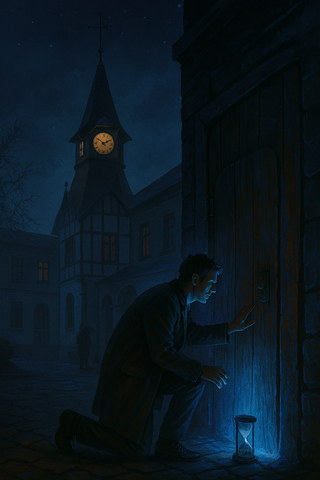


Fear, awe, and disbelief battled in me. I nearly ran. But then a strong grip seized my shoulder. I could swear I heard Grandpa’s voice:
“Son, don’t be afraid!”
I spun around—no one was there. Goosebumps rose all over my skin.
Courage returned. I pushed the door open. For the second time that day, I crossed a threshold—but this one was pulled by a force beyond understanding. A staircase descended into darkness. The air smelled of damp stone, old books, and something unknown. The hourglass began to spin in its ring, its sand flowing one way, then the other. The blue light returned. I watched, hypnotized, as the grains danced.
Then time bent. The world shifted. Reality thickened with forgotten words, lost people, ancient events. My heart skipped a beat.
I was in another time.
The air smelled of homemade bread with cheese, burnt leaves, wild nature. The earth was soft beneath my feet. Around a well, children in simple shirts and leather slippers chased each other. A bagpipe played in the distance. Nearby, a man with graying mustache laughed heartily at the children’s antics. I tried to call out, but I was invisible—a ghost in the past.
“Dad, will you tell us about the haiduks [1] again?” asked one boy. I knew those eyes immediately—they were Grandpa’s.
“That’s why he never stopped telling stories. He taught me to listen. Memory lives through our stories.” I whispered to myself.
The scene dissolved. Time shifted again, like a spiderweb snaring me—a helpless insect in a universe of worlds.
Now I stood in a stone cell, lit by a flickering candle. It smelled of ink, parchment, and incense. A long-haired man bent over a manuscript, writing with a trembling hand. He looked up and his eyes locked onto mine.
“A nation without memory is like a tree without roots,” he said. “But why are you here, boy?”
I opened my mouth: “I’m a teacher! I’m here to teach children respect for the past and faith in the future!” But the words never came. His gaze sharpened with reproach. I tried again, but the web tangled, the image vanished.
The world that emerged was bleak. My home town of Pazardzhik—but lifeless, hostile. People moved like shadows. No children, no birds, no laughter. Everything was clean, sterile. Buildings stood like windowless Lego blocks. Fountains had become digital screens. Trees replaced with strange machines.
I found myself before the Regional Library—the only building that seemed alive. I stepped inside. Darkness. Cold. Blue light. Bookshelves sealed behind glass. The few visitors stared blankly at screens.
“Excuse me, how can I borrow a book?” I asked.
A man looked up, startled. His eyes—my own.
“Violation!” he shouted.
A drone buzzed beside me.
“Reading books is forbidden. This is a museum. Use the digital archive. First and final warning.”
“But these works hold the soul of our people! They are our memory!” I protested.
The drone fell silent. No answer was in its program. The books answered with silence too, trapped behind thick glass.
“Is this our future, if we forget our history? Memory turned museum relic, knowledge locked behind glass—useless to anyone?” I thought, as time stretched again.
At first, I didn’t know where I was. Flags everywhere—strange, with unknown symbols. Signs in a foreign language. Then I realized—I was in my old school.
Shock froze me. A child bumped into me. I grabbed his shoulders.
“Who is Vasil Levski [2]?” I asked, trembling.
Fear rose in my chest. I had to know how far the world had fallen.
“Forbidden term,” the boy replied, eyes empty. “Not allowed for discussion.”
“Who forbade it? Who taught you that?”
“My grandfather—Dobromir Krastev. School principal. Release me. You are violating child-communication protocols.”
I froze. The name… my name. My grandson. He looked at me with eyes stripped of warmth.
His voice echoed, fading… and once again I was swept into the timeless web. Each strand revealed a different world, another existence.
I saw myself—from the outside. Different lives. Different times. Each vision showing me a truth—about the world, about myself.
“Beware of yourself!” Grandpa’s words returned. And I understood. The future is not set. It is a chain of choices. My role wasn’t just to teach lessons—it was to awaken conscience.
To guard our memory.
After countless spirals of time, I found myself once more at the hidden door of the Post Office. The hourglass had dissolved to a pile of sand in my hand. I turned and ran. I did not look back. I had seen enough.
There was no spirit granting wishes in the portal. It was a doorway—to history yet to come. How one used that knowledge… depended only on them.
I had chosen my path—my thread in the web.
“You were never just a teacher.”
Now I knew who I was, and what I was meant to do.
The first rays of dawn touched me as I crossed the threshold of my old school. Grief had given way to resolve. Tears to a smile.
And my soul… was full of gratitude.
“Thank you, Grandpa. For the lesson. For everything.”
And when I lifted my gaze, I saw it—our bright future, arriving noisily as the students streamed in for the first class of the day.
[1] Haiduk is a Balkan outlaw fighting against the Ottoman Empire.
[2] Vasil Levski was a Bulgarian revolutionary leader in the struggle for liberation of Bulgaria from Ottoman rule.


![The Moon's Weapon : the cursed mate [ MOVING TO GALATEA]](https://cdn-gcs.inkitt.com/vertical_storycovers/ipad_123f31099804e79c6de11657975bcaae.jpg)
![Werewolf Hollow [GALATEA DATE TBA]](https://cdn-gcs.inkitt.com/vertical_storycovers/ipad_76bbf380fa2e8dc2f70694197487ab81.jpg)













Your story really hit me, and I wanted to share my experience with you. The way the narrator is thrown between different realities—from a cold, sterile future where reading is forbidden to a past filled with the scent of homemade bread and old stories—is just so powerful. It felt like a mirror of my own life in a way I never expected.As I was reading, I couldn't stop thinking about my dad. We were never close, and he passed away a while back, but reading about the narrator's deep connection to his grandfather's stories really hit me hard. We didn't have that. We didn't share those big family stories or sit down and talk about the past. There was always a kind of wall between us, an unspoken distance. Your writing made me feel the ache of a missed connection so deeply. It made me wish I had those moments, those shared stories that could have bridged the gap between us.The whole concept of the hourglass and how it acts as a gatekeeper to memory is brilliant. The line, "The future is not set. It is a chain of choices," really resonated with me. It’s a beautiful and painful reminder that our present choices, even the seemingly small ones, have a ripple effect. The chapter’s focus on the importance of "guarding our memory" feels like a call to action. It's not just a plot point; it's the core message of the story. Thank you for writing something that’s not just a compelling read, but a powerful reflection on family, memory, and the choices we make. I'm genuinely moved and will be thinking about this for a long time.I hope you won that competition it's a masterpiece ✨
The transition from a warm, reflective moment to a controlled and unsettling world is engaging and it clearly highlights the importance of memory and knowledge. The scene where the protagonist asks for a book stands out as impactful, revealing the rules of this new reality in a natural way ✨This story is intriguing!