
A Waste of Perfectly Stacked Time. - Ch.01.


A moral injury is an injury to an individual’s moral conscience and values resulting from an act of perceived moral transgression on the part of themselves or others. It produces profound feelings of guilt or shame, moral disorientation, and societal alienation. In some cases it may cause a sense of betrayal and anger toward colleagues, commanders, the organization, politics, or society at large.
-Excerpt from Calderra Justice Department training brief: “Moral Injury & Operational Exposure.”
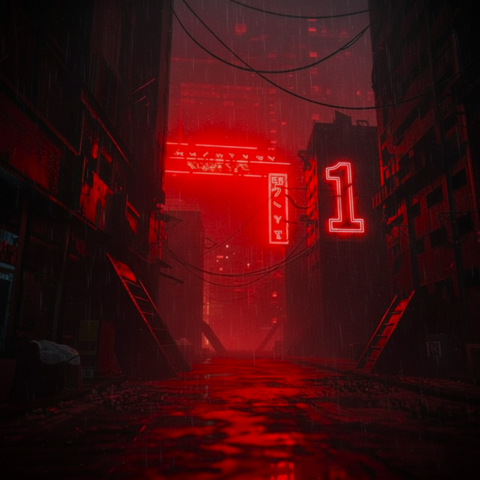
April in Calderra carried a damp bite that never bothered to finish the job. It slipped into metal and stayed there, lived under fingernails, turned every surface into something that held a grudge. The abandoned garage sat behind a row of shuttered storefronts, wedged into the city’s machinery like a bad part nobody replaced, its corrugated door half-lifted, stuck in a permanent flinch. Inside, the air tasted of old oil, dust, dried sweat—metallic with old blood.
Ned lay on the floor with his back jammed against the wall, knees drawn up in a posture that tried to look smaller than his panic allowed. His hands hovered near his ribs, useless, trembling, as if he could keep himself assembled by insisting on it. His face stayed swollen enough to make him look like a stranger wearing his features wrong; his eyes were wide and wet, one cheek blooming in purples and sick yellows. He kept scooting backward, heel dragging through grit, shoulders scraping the stained wall, moving with the stubborn animal logic that always believed a seam existed if you pushed hard enough.
The wall gave him nothing.
Above him stood Tor.
The garage lights had died years ago, so the only illumination came from the street leaking through the half-open door and a cracked window high on the side wall. Neon from somewhere nearby bled a dirty red across the room, turning rusted shelves and scattered tools into cutout silhouettes. Tor looked built for that light. It caught the angles of him and made them look deliberate, as if the city had already decided what he was and kept repainting him to match.
His hair fell in messy dark strands that looked damp even if it wasn’t, the kind of disarray a comb would eventually stop arguing with. A few locks hung over his forehead and threatened his eyes, which stayed sharp under tired lids, the fatigue never softening into mercy. A small hoop earring caught the red glow whenever he shifted his head, flashing like a quiet warning that didn’t need a headline. His shirt hung dark and worn thin at the seams, clinging around his shoulders where the light carved out muscle and tendon like a blueprint. Dirt streaked his arms in uneven smudges, and older marks sat beneath them, faded souvenirs from walls and fists and the kinds of lessons that repeated until you learned.
Ned stared up at him like staring could change the ledger. Like hard enough eye contact could turn Tor into a misunderstanding, a stranger, a problem you could negotiate down to a smaller number.
Tor lowered into a squat in front of him with the smoothness of someone settling down to watch a show he had already seen, elbows resting loosely on his knees, posture relaxed to the point of insult. His boot tapped once against the concrete—soft, impatient, like he was keeping time. He tilted his head a fraction, studying Ned with the detached patience of a man evaluating bad workmanship, as if fear was something you could grade and send back with notes.
“Where were you?” Tor said, voice even, the question delivered like casual conversation in a café instead of an interrogation over a beaten body.
Ned’s throat worked. He swallowed wrong, coughed, tried to wipe his mouth and flinched when his hand brushed swollen skin. “I swear I wasn’t going to run away,” he said, words tumbling over each other, desperate for traction. “I was only with my family.”
Tor’s eyes stayed on him, unblinking. The sarcasm lived in his calm, threaded through the steadiness of his tone like a hidden wire. “For three days?” he said. “I’ve been looking for you for three days, Ned. Do you know what that means? You’re disrupting my perfectly stacked schedule.” He lifted one hand, palm up, as though presenting the concept, like time was something he personally owned and Ned had misfiled. “I had to move slots around just to look for you. Now, where were you?”
Ned’s breathing hitched, loud in the cramped space, each inhale scraped raw by fear. His terror didn’t simply show, it performed, and Tor watched it with the detached appetite of a man who enjoyed a good performance, like Ned’s squirming offered entertainment the city couldn’t stream.
Ned licked his split lip and winced. “It was a trip. My mother—she needed it. We went out by—” He stopped, eyes widening like he’d just heard himself testify. “It doesn’t matter. I wasn’t running.”
Tor leaned closer, closing the distance until the red light caught the ridge of his cheekbone and the shadow beneath his eye, making his face look carved and exhausted by the same knife. He stared at Ned’s pupils, then at his split lip, then back to his eyes, measuring. His head tipped again, slow and curious, like he’d found a detail worth savoring.
“With whose money, Ned?” Tor said.
Ned’s voice cracked. “I swear it wasn’t your money,” he rushed out. “It was my money.”
Tor breathed out through his nose, the nearest thing to a laugh he offered, and it landed without warmth. “Okay,” he said, drawing the word out as if tasting it. “So if you have money, why didn’t you pay us back? Why do you go around taking a trip with your family for three days?”
He shifted his weight slightly in the squat, knees creaking faintly in the quiet, and Ned’s eyes followed that movement with the panic of someone tracking an incoming blow. Tor noticed. It pleased him. His mouth curved, barely, the expression almost affectionate in its contempt.
“Or are you lying to me, Ned?” Tor continued, the question floated gently, like he’d asked if Ned wanted sugar in his coffee. He raised two fingers, clean and deliberate. “Because there are two possibilities now.”
He held them up between them, those two fingers framed by red neon and shadow, as clear and precise as a legal document that didn’t care whether you understood it.
“The first possibility is that you do have money,” Tor said, “and you’re just stringing us along, ruining my schedule, making me come after you every day, asking for the money.”
He paused just long enough for Ned to try to speak, then rolled over him without granting the chance, voice steady, rhythm controlled, like he enjoyed hearing himself reduce a life into options.
“Number two, you don’t have any money,” Tor said, “and you’re lying to me that you weren’t on a trip. You were actually running away from me.”
Tor’s hand remained lifted, fingers still up, calm as a metronome. “Either way, you’re lying, Ned. I don’t like liars. You’re wasting my time, you’re wasting my potential. I have other people to beat.” His gaze slid past Ned as if the garage contained a waiting list. “You’re taking from their time also. So, Ned, for the last time, I’m telling you—where is the money?”
Ned’s chest heaved. Tears sat on his lower lashes and didn’t fall, trapped there by stubbornness or shock. He nodded too many times, a frantic bobbing that made his head look loose on his neck. “I’ll pay you back,” he said. “I’ll pay you back, I swear, I’m not going to take the money and run away.”
Tor clicked his tongue, sharp in the stale air, then sighed with theatrical fatigue, as though Ned’s promise had personally inconvenienced him. “I am so sick and tired of beating you, Ned,” Tor said. “I’m tired. Don’t you get tired? Your face doesn’t take a break from being swollen.” His eyes drifted over Ned’s bruises with something like professional critique, like a man inspecting damage on a vehicle he kept having to repair. “I want to give you a break. I want to give my knuckles a break. I want to give my men a break.” He leaned in a fraction, tone still casual, the cruelty in it clean. “You just don’t seem to comprehend the seriousness of the situation. I’ll have to beat you again.”
Ned’s hands flew up, palms open, shaking so hard his fingers looked boneless. “No, no, no, please,” he said, the word multiplying as if repetition increased its value. “Please, please, please. I’ll get you the money at the end of this week. I swear. I’ll get you the money at the end of this week.”
Tor stayed squatting, head turned slightly as he looked over his shoulder toward the shadows near the entrance where his men waited. Their outlines stayed quiet, patient, practiced, as if they were part of the building. One of them shifted his stance and a boot scraped concrete, a sound that made Ned flinch like it had teeth.
Tor’s gaze landed on Roger. “Write it down, Roger,” Tor said. “End of this week.”
Roger patted his jacket, then his pants, then froze as if his pockets had betrayed him. He finally yanked out a notebook—too hard. Paper fluttered. His flashlight spun, briefly washing the garage in a frantic beam.
Tor didn’t move away. He stared at Roger, expression dead, eyes narrowed in a slow, lethal disappointment that made the air feel thinner.
Roger muttered, “Sorry,” in the smallest voice a grown man could manage, then fumbled for his pen. It refused to work. He scribbled harder. The pen still refused. He shook it, tried again, then finally wrote with the furious concentration of someone defusing a bomb while being judged.
Tor turned back to Ned as if that tiny comedy hadn’t happened, as if nothing in the world ever interrupted him unless he allowed it. “Okay, Ned,” Tor said, voice smooth again. “I’m done here. I guess I’ll see you at the end of this week. Good luck.”
He rose from the squat in one motion, unhurried, shoulders rolling slightly as he stood, the tired lines of his face never shifting into sympathy. Ned tried to follow him with his eyes, terrified that the moment Tor stood meant something worse was coming. His breath stuttered, his body braced, waiting for pain like it was the only predictable thing left in his life.
Tor lifted his leg and drove the side of his boot into Ned’s shin.
It wasn’t a dramatic kick meant to break; it was punctuation, a final reminder delivered with the casual cruelty of someone flicking ash off a cigarette. Ned cried out anyway, voice scraping the concrete, hands clutching at his leg as if he could hold the bone in place through panic alone.
Tor didn’t look back. He walked toward the garage opening, boots crunching over grit, his silhouette briefly slicing through the red spill of neon. His men fell in behind him, a quiet procession leaving a room full of old oil and fresh fear.
Outside, the night sat heavy over Calderra, streetlights reflecting off damp pavement in smeared streaks. Somewhere down the block, a sign buzzed and stuttered between letters, fighting to stay alive. The air carried the city’s late-hour breath—exhaust, rain-soaked concrete, distant fried food—and something faintly briny that Calderra never quite lost, as if the sea kept a hand on its throat even when you couldn’t see the water.
Tor stepped into it like he owned it.
Roger jogged to catch up, still clutching the notebook open like a sacred text, one hand smearing ink across the page as he tried to close it without ruining what he’d written. Another man snorted softly at the sight, then pretended it was a cough when Tor glanced their way.
Tor’s gaze drifted toward his wrist as if he wore a watch, then toward the street as if time lived there in the puddles. “End of the week,” he said, more to himself than anyone, the words sounding like an appointment he actually intended to keep. He slid his hands into his pockets and took three steps, then paused as if listening for something that wasn’t sound.
Behind them, from inside the garage, Ned’s sobbing turned thin and broken, rising and falling between pain and hope. It chased after Tor for a moment, trying to hook into him, trying to make him human.
Tor kept walking.
A parked car waited near the curb, dark paint swallowing the streetlight. One of the men moved ahead to open the rear door, then hesitated when Tor angled his body toward the front instead, like he preferred to sit where he could see everything. The man corrected quickly, moving to the passenger side, and the door opened with a soft click that sounded overly polite for the night they’d just had.
Tor slid into the front seat and leaned back, head resting against the headrest for a second as if letting gravity hold him up. Neon from storefronts painted his face in shifting reds and shadow, catching in the hoop of his earring. He stared out through the windshield, eyes half-lidded, expression distant, like his mind already stacked the next hours into tidy slots.
Roger leaned in slightly from outside, notebook tucked under his arm now, eager to prove he still deserved oxygen. “You want me to send a reminder?” he asked, voice careful.
Tor looked at him, then at the notebook, then back at him. “Roger,” Tor said, “if you ever say ‘reminder’ again, I’m going to pick up a new hobby. It’s called kneecaps.”
Roger blinked, swallowed, and nodded as if that counted as feedback he could apply. “Understood.”
Tor’s mouth twitched—not a smile, just a bored acknowledgment that the world still offered small amusements. He settled deeper into the seat. His eyes drifted shut for a heartbeat, then opened again, sharp as ever, already looking past the curb, past the wet street, toward whatever came next.
SLEEPERCELL
The bar sat on a side street Calderra forgot to polish, the kind of place that never bothered with a sign because the right people already knew where to go. Outside, the night breathed damp concrete and cigarette ash, the city’s neon bleeding into puddles like spilled paint. Inside, it was warm—too warm—reeked of liquor and skin.
Tor pushed the door open with his shoulder and walked in like the room had been waiting to recognize him. His hand stayed tucked in his jacket out of habit, fingers curled around nothing, posture loose and certain, the kind of confidence that didn’t need to announce itself because it already took up space. The bass from the speakers rolled through his ribs, and the light behind the bar flashed across his face in quick pulses, turning his eyes into something unreadable for a second at a time.
His people gathered at their usual spot, a corner booth that always looked like it had been fought over and won. A few heads turned, then turned away again, reassured by familiarity. Tor didn’t slow. He slid between a barstool and someone’s knee with practiced ease, reached across the table, and snatched a glass straight from Blue’s hand.
Blue turned instantly, anger rising fast enough to make his chair scrape. His fist came up, elbow cocked, the first movement of a swing already on its way, knuckles hungry for contact.
Then he saw who it was.
Blue froze mid-motion, fist hovering in the air like a paused threat. In the bar’s cool lighting, he looked carved from the same city-night that raised them. His hair stayed cut close, a dark buzz that made his sharp features look even sharper, forehead clean, brows straight and severe. His eyes carried a pale, icy tone that caught the light and held it, the kind of stare that made strangers rethink their life choices before they even knew why. Silver hoops hugged his ears, and a thick chain rested at his collarbone, bright against his throat. Tattoos flooded his arms in dense, intricate patterns that disappeared under the loose sleeves of his black shirt and reappeared again at his wrists, where bracelets and a watch sat like they belonged there by law. Even sitting, he looked built for violence, broad shoulders sloping into a relaxed posture that never truly relaxed, like his body stayed on alert even when his mouth looked bored.
He exhaled through his nose, then let his fist drop, slow, theatrical, like he was granting Tor mercy as a personal favor.
“Hey, fucker,” Blue said, voice rough with amusement he refused to soften.
Tor took a sip from the stolen glass like he’d been thirsty for Blue’s irritation specifically. He swallowed, let the burn settle, then glanced at Blue with a small, satisfied tilt of his head.
“You were about to swing at me, Blue?” Tor said, tone light, like he’d asked if Blue wanted another round.
Blue leaned back, rolling his shoulder once as if easing out the ghost of the punch. “At anyone who snatches my glass like that,” he said. His gaze slid over Tor’s face, measuring, then he added, “Except for you.”
Tor laughed, the sound brief and real, and handed the glass back as if returning property to its rightful owner. Blue took it without a thank-you, gripping it the way a man gripped something he planned to keep.
Tor’s eyes scanned the booth, then the bar, then the hallway leading deeper into the place. “Where’s Johnny?”
Blue jerked his chin toward the back. “With some girl in the back.”
Tor’s face pulled into pure disgust, immediate and sincere. “Gross.” He dropped into the seat across from Blue, shoulders settling into the booth like it belonged to him. “Okay. I’ll wait then.”
Blue watched him the way people watched weather they couldn’t control. “Where were you tonight?”
“Cash duty,” Tor said, and the word duty sounded like an insult in his mouth.
Blue’s eyes narrowed a fraction, that pale stare sharpening. “Successful?”
Tor let out a breath, slow and unimpressed, then rubbed his thumb along the inside seam of his jacket pocket like he could erase the memory with friction. “No,” he said. “Of course not. It’s fucking Ned.” He shifted forward, elbows resting on his knees, voice turning into that irritated rant he only allowed around people who wouldn’t judge him for it. “I swear he takes money every month, and then we chase him for the next month, and then he gives us the money, and then the month after he takes the money, and then…” He waved his hand in a loose circle like he was drawing Ned’s stupidity in the air. “We need better vetting. I’m sick of chasing the same idiot in monthly episodes.”
Blue snorted, a short, sharp sound that landed somewhere between laughter and disdain. “We’re not the bank,” he said. “We don’t have a credit score, okay? They pay with interest. Of course Johnny keeps lending them money.”
Tor’s jaw tensed, then loosened again. He stared at the tabletop for a beat as if he could see his own schedule sprawled there, neat little slots being stepped on with muddy boots. “That’s such a waste of time,” he muttered, the anger not dramatic, the anger precise. “Time, manpower, gas. My knuckles. Your patience. Everything.”
Blue took a sip of his drink and watched Tor over the rim, eyes gleaming with mischief that matched his cruelty in a quieter way. “If that’s any condolences to you,” he said, “I have a terrible mission on me.”
Tor’s head tilted. “What? The D or the S?”
Blue laughed, shoulders bouncing once, chain shifting against his throat. “The D.”
Tor’s expression brightened, then turned smug. “That’s not bad.”
Blue’s smile flattened. “I don’t like it when that happens,” he said, irritation earned. “I have to accompany the guys bringing up a new load from the desert. Fucking desert. Like the police won’t know we’re smuggling drugs through the desert. Wonderful.”
Tor stared at him for a second, eyes narrowing, then leaned in slightly, voice dropping as if he was about to share wisdom with a toddler who had just discovered knives. “I specifically used just the letter D,” Tor said, “for the purpose of staying hidden, and you just sat here and said the words ‘smuggling drugs’ out loud.”
Blue’s gaze slid around the bar, over familiar faces, over the bartender wiping the same glass for the eighth time, over a couple men laughing too loudly, over the owner’s shadow behind the counter. He lifted his shoulders in a lazy shrug. “The whole bar knows what the fuck we do,” he said. “They’re all our friends here. Family.”
Tor looked unconvinced in the way a man looked unconvinced by gravity. He leaned back, eyes drifting briefly toward a nearby table where someone had paused mid-conversation to pretend they weren’t listening. Tor’s mouth twitched like he’d noticed the performance.
He let it pass anyway, conceding nothing while letting the moment move on, then raised his hand and hooked two fingers in the air, a casual summons.
“Sammy,” Tor called out.
A server wove through the crowd toward them, carrying a tray balanced like a weapon. Sammy moved like she owned the floor and everyone on it, chin high, eyes sharp, ponytail swishing behind her with controlled violence. She stopped by their booth and stared at Tor as if he personally offended her sleep schedule.
Tor smiled at her, polite in a way that sounded suspicious even in silence. “Bring me my usual,” he said.
Sammy didn’t blink. “Shut the fuck up,” she replied, voice flat. “You don’t have a usual drink.”
Blue choked on a laugh and covered it by turning his cough into a sip.
Tor pressed a hand to his chest like he’d been wounded by betrayal. “Okay,” he said, drawing the word out with dramatic resignation. “Whiskey on the rocks.”
Sammy stared at him a second longer, then scribbled on her notepad without looking down. “Look at you,” she said. “So original. The city will write songs about this.”
Tor’s smile widened, pleased. “Make sure the chorus mentions my pain.”
Sammy walked off without giving him the dignity of a response, tray shifting as she disappeared into the crowd.
Blue leaned forward, forearms on the table, tattoos flexing with the movement, eyes bright with that pale, predatory amusement again. “You’re in a mood tonight,” he said.
Tor watched the hallway toward the back where Johnny disappeared, then leaned his head against the booth for a second like he was letting the noise carry him. “I’m always in a mood,” he said. “Ned just picked the one I hate.”
Blue lifted his glass in a small toast, not kind, not gentle, fully sincere in the way only their world allowed sincerity. “To chasing idiots,” he said.
Tor angled his chin up in agreement, gaze still on the back corridor, waiting for Johnny to return with whatever mess he called entertainment. “To idiots,” Tor said, voice low, almost fond in its contempt. “They keep the wheels turning.”
Sammy reappeared a minute later and set Tor’s whiskey down hard enough that ice jumped and clinked like it wanted to escape. Tor took the glass, felt the cold bite into his fingers, and for a breath he let the silence inside him settle into place, the kind that came before plans, before violence, before the next name on the list.
Somewhere deeper in the bar, a door opened, laughter spilled out, and Johnny’s voice carried for half a second.
Tor’s eyes lifted, sharpening.
The night wasn’t over. Not even close.














The opening scene is like the City Light game has joined ‘reality’, love it. And ‘stuck in a permanent flinch’ is an inspired description.