
Chapter 1: The Great Cataclysm
It was the year 2065. The world didn’t end from scarcity. It ended from an excess of pride.
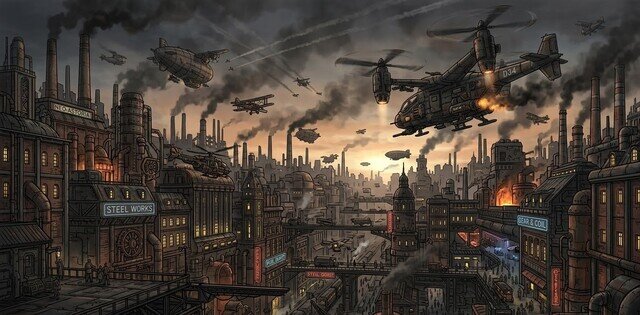


The Iron Union wasn’t just the most powerful nation; it was the standard everyone else followed grudgingly. Diesel engines roaring like chained beasts, steel colossi carving oceans with trails of black smoke, entire economies hanging on the oil they controlled. They dictated progress with an iron fist. The rest of the planet bought their outdated patents, survived in their shadow, and stayed silent.
But paranoia crept in like rust in the seams. They feared the “external chaos” would corrupt their mechanical perfection, that the inferiors would steal their secrets. In 2065, they made the final decision: they sealed their borders. Submarine cables were severed, their own satellites shot down, steel shutters slammed shut. “Without us, they’ll crawl back to the Stone Age,” they proclaimed from marble-and-bronze balconies while refinery smoke darkened their own sky.
They were wrong.
For twenty years of absolute silence, the Union devoted itself to perfecting what it already had: bigger pistons, thicker armor, gravity bombs capable of crushing entire mountains under their own weight. They became masters of a past that refused to die.
Outside, in the darkness of isolation, the unthinkable happened. Without the oil monopoly, the remaining nations were forced to leap into the void. They abandoned steel for ultralight carbon frames, fossil fuel for antimatter contained in quantum spheres, wiring for neural networks linking minds and machines. The world evolved in the shadows.
In 2085, when the Union finally opened its gates to “reclaim” what it considered its own, they didn’t find beggars pleading for coal.
They found a cyberpunk world.
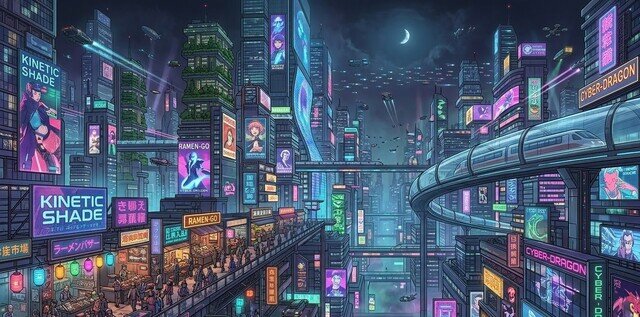
Cities hovering on magnetic pulses, ships humming with clean energy instead of belching smoke, neon drones moving with surgical precision. The Union’s thousand-ton tanks looked like rusted relics against that lethal elegance. Envy turned to hatred in seconds. The High Command couldn’t stomach that the “inferiors” had reached the top without them.
“If it’s not ours, it belongs to no one.”
The war lasted barely a few hours. But its echo would stretch across centuries.
The Union struck first: gravity bombs that bent space itself, sucking entire cities into impossible craters where weight compacted everything—bone, steel, hope—into a dense mass. The ground folded like torn cloth, buildings collapsed toward an invisible center, the air grew thick and oppressive.
The response was immediate and surgical. Pure antimatter pulses: blinding flashes that disintegrated reality at the molecular level. Entire legions vaporized into clouds of glowing particles, neon towers dissolved like sugar in boiling water, the sky burned a perpetual red. The clash between diesel brute force and cyber precision erased the atmosphere itself. Oceans evaporated into radioactive vapor, continents fused into glass, the eternal dust that still veiled the sun.
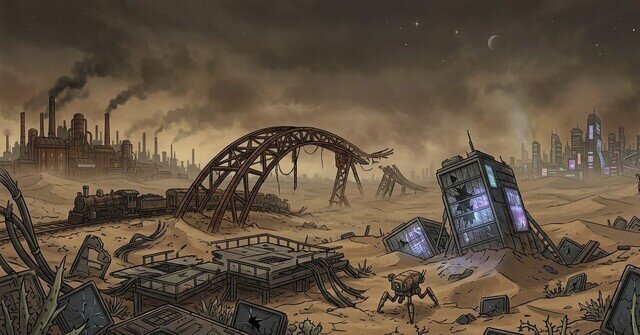
One hundred and fifty years later…
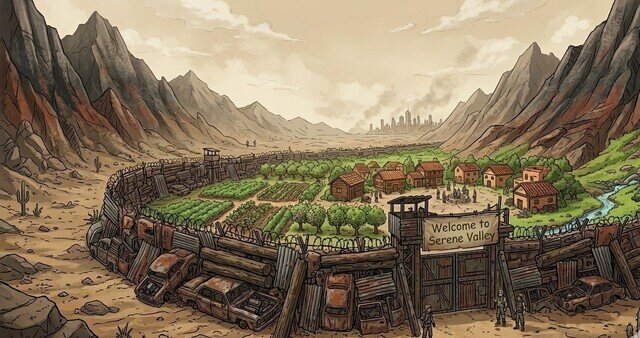
In a narrow valley between jagged mountains, a handful of survivors had built something they simply called “the Village.” The high peaks and tight passes had shielded them from the worst: the radiation clouds that scoured the plains, the mutants prowling open roads, the raiders who plundered without mercy.
The wall was crude but effective: pre-war car bodies stacked high, pine logs felled from the heights, twisted sheet metal and barbed wire salvaged from distant ruins. Inside, wooden and adobe houses huddled around a central square. A faded sign still hung at the entrance: “Welcome to Valle Sereno.” No one remembered who put it there, or why.
The rules were strict. Every five years they elected a new chief from among the most capable: not by blood, but by merit. One improved crops on arid terraces, another reinforced defenses, a third negotiated with wandering scouts. There were disputes, fragile alliances, sometimes duels settled with words or fists. But it worked. Each change brought a breath of progress… or at least kept total stagnation at bay.
Life was hard. Water filters, pieced together from pre-war parts, failed more often; rust ate the membranes, and the water tasted of metal and slow death. Improvised wind generators and salvaged solar panels flickered with weakening light. Knowledge passed mouth to mouth, from yellowed book to yellowed book: rotating crops on sloped hillsides, raising mutated goats that gave milk without poison, repairing a rifle with wire and sheer will.
Guards took shifts on the walls with old rifles and handmade arrows. Scouts—the bravest or the most desperate—left at dawn, never more than a day’s march out. They returned at dusk with useful scrap, hardy herbs, or just stories: strange tracks in the dust, shadows in the distance, echoes of gunfire no one wanted to chase.
Beyond the mountains, no one went. Grandparents’ tales spoke of a wasteland poisoned forever, air that killed slowly, creatures lurking in radioactive fog. Truth or myth? No one knew. No one had returned from a longer journey to confirm… or deny it.
For safety, they stayed close. One day out, one day back. It was the rule no one questioned.
Still, the Village endured. Small, isolated, forgotten… but alive.
For now.













Hey, thank you so much! 😊
You just made my day with this message. I'm really happy to hear that you just started and you're already getting so hooked on the story, the characters, and how everything is building up. I honestly didn't expect it to click with you this much, and that makes me super glad.
Of course! Feel free to share the link with your friends, no problem at all. I'd love for them to give it a try too. If they enjoy it, tell them to come drop their thoughts — I always love reading what people think.
About the comic... man, I wish. I'm not an artist at all, I can't even draw a straight line, but I'd absolutely love to see this story turned into a comic someday. That would be insane in the best way. For now I'm just writing, but who knows what might happen down the road. If it ever does happen, you'll definitely be one of the first to know.
Seriously, thank you for taking the time to write this. Messages like yours are what keep me going when the story gets dark and complicated in the Valley.
Big hug and keep enjoying the ride!
Hope your friends get hooked just like you did