
Chapter 1. Half Past Six
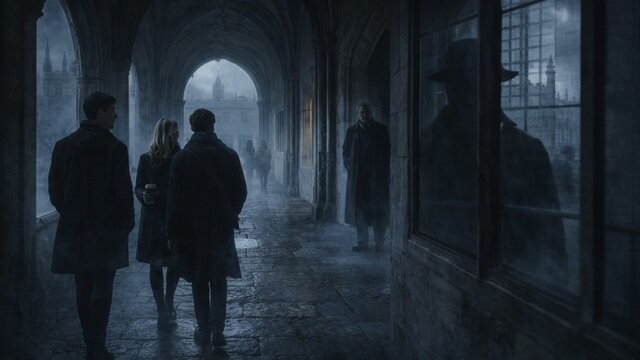
“Trying again to look like a man with a plan?”
The kettle in the shared kitchen of the dormitory gave a hoarse, sputtering cough, as if it had meant to tell the world something of enormous importance and changed its mind halfway through the sentence, settling instead for an ordinary boil. The sound woke Alex Rain a few seconds before his alarm, and for a while he lay staring up at the ceiling, which in their college block had been painted such a determined white that it seemed to have long since grown tired of pretending innocence.
Half past five in Whitby, the town of his childhood, still meant gray air above the rooftops, gulls, and wet wind off the sea. Half past six in Oxford was another density altogether: old stone pressing around invisible inner courts, the thin ring of a bicycle wheel against paving, and the sense that morning did not truly arrive here so much as reenact itself out of centuries of habit.
Alex rolled onto one side; the phone was already blinking on the nightstand.
Jake: “If you forget again today that your birthday is in two days, I’m taking it as betrayal.”
Chloe: “Don’t pull that face of a man already cheated by life. Meet me by the stairs.”
Chloe almost never sent a neutral message. Even when she wrote about the weather, it always felt as if the forecast had smuggled inside it a joke, a warning, and something else Alex would understand too late.
He sat up, dropped his feet to the floor, and tried to find his socks by touch. They were not on the chair. They were not on the floor either. The only thing on the windowsill was the neighbor’s cat, fat and unnervingly certain of its own moral superiority. It regarded Alex with the unblinking gravity of a creature witnessing the breach of a sacred pact.
“If this was your doing,” Alex said, “consider it the beginning of a new phase in our relationship.”
The cat blinked.
Alex sighed, pulled out another pair of socks, less loved and more scratchy, and went to wash up. In the mirror over the sink he found the face of a man who had slept just enough to have energy for irritation. No more than that.
On the way back to his room he noticed the little lighthouse night-lamp on the bedside table. Mrs. Harper, Chloe’s mother, had once given it to him after ten-year-old Alex had somehow managed to drench their garden sprinkler, the neighbor’s cat, and, by all available evidence, nearly half a summer evening. Chloe used to say he never fixed things so much as talked to them until they surrendered out of politeness. And yet it was she who had kept the lighthouse for him when he left to study.
Outside, an early March wind was blowing hard and cold. Alex dressed quickly, shoved a notebook, a book on semiotics, his keys, and the medallion on its fine chain into his bag, then absently put the medallion around his neck. He had worn it for so many years that he barely noticed it anymore. Heavy, warm, its pattern worn smooth around the edge, it looked either like a cheap trinket or like something no one had quite managed to take from him.
The common kitchen was thick with the smell of burnt toast, stale coffee, and other people’s unspoken weariness. A newspaper forgotten by someone lay on the table with a photograph of a minister on the front page. Alex poured himself some tea, took one sip, and understood at once that tea was useless today. On mornings when the world began to shift before breakfast, you needed either real coffee or luck. He had never trusted luck much.
Jake Sullivan was already waiting for him outside the main building.
Jake stood with one shoulder against a column, looking as self-assured as if the column itself had been put on earth solely for the eventual purpose of supporting him in a good mood. He held his own coffee in one hand and a second one for Alex in the other.
“You look like you got mugged by a laundry room,” he said instead of hello.
“My socks were stolen.”
“Worse. Objects are always motivated by spite.”
Alex took the coffee. It was too hot and too bitter, which was exactly what it ought to have been. Jake had a strange talent for bringing a man precisely what he needed five minutes before that man realized it himself.
They had known each other since Whitby, since the fairgrounds and the cheap cinema and those years when the three of them had considered themselves intelligent enough for minor criminal art. Alex and Chloe did tricks. Jake lifted loose change from pockets. Then all three spent the proceeds on sticky popcorn and tickets to the evening show. Later, almost everything that made them close had grown out of those years: the shameful memories they shared, the habit of rescuing one another before explanations began, and the knowledge that laughter sometimes matters more than morality when you are eleven and have not yet learned a better way to survive fear.
Chloe appeared a few minutes later. She was walking fast, the way she always did in the cold, one hand at her scarf. Chloe Harper had the face of someone who had learned too early not to trust beautiful formulations. Even her smile always seemed to reserve the right to withdraw itself.
Alex had known her almost all his life and still sometimes caught himself in the absurd feeling that he was meeting her again at every age. The girl who had run with him along the pier and the young woman climbing the university steps now were the same Chloe, and yet between them lay all the awkward, difficult labor of time.
“Alex Rain,” she said as she came up to them. “Trying again to look like a man with a plan?”
“I have coffee. That’s practically the same thing.”
“That’s Jake, not a plan,” Chloe said, taking his cup and tasting it. “And, as usual, much too strong.”
“I like people to suffer in an orderly fashion,” Jake said.
They headed toward the entrance. Low cloud hung over the court. The stone steps were damp, and the whole university looked as if someone had built it out of materials fundamentally opposed to carelessness. Alex had grown used to the architecture long ago, but on certain mornings he still felt what he had felt in his first term: that he was walking inside somebody else’s memory, trying not to knock an elbow against some ancient thought that did not belong to him.
Emily Price caught up with them.
Emily studied art history and archival work, always carried a folder, and possessed that rare kind of composure that does not make a person dry. She noticed details not because she wanted to impress anyone, but because the world, for her, was made of details and did not deserve careless treatment.
“Waldson twice today,” she said. “Semiotics in the morning, open lecture tonight. And judging by the faculty’s faces, that lecture isn’t entirely meant for us.”
Mason Reed came flying out of a side corridor next. He studied journalism, lived in a perpetual inward chase after news, and even breathed as if the world was about to tell him something important the moment he looked away.
“And,” Mason announced, hardly pausing for breath, “two men in identical coats were seen outside the dean’s office this morning. They did not look like inspectors. They looked like the sort of men who might suddenly remember your surname later.”
“Excellent,” Chloe said. “Exactly what Wednesday morning was missing.”
They laughed as they crossed the gallery, but it was the normal student laughter that exists on the surface without cancelling the other thing beneath it. For the last few weeks all of them had felt something strange. Not an event. Not a threat. More like a slight shift in the angle of vision, as if the familiar world were still behaving as usual, only doing so under strain.
They feared Waldson half-jokingly, the way people fear a storm when they have spent years living under a good roof. Professor Edmund Waldson taught the semiotics of power, the history of symbolic systems, and several other subjects whose names sounded as though students were expected to understand them in advance. He never humiliated anyone openly, never arrived late, never raised his voice. But there was something in him that made everyone gather themselves. He wrote on the board with his left hand in an old-fashioned, beautiful script and could, with one brief phrase, turn the most distracted room into a place where even another person’s breathing suddenly felt significant.
And yet his wife often came to meet him after class. Sometimes the children did too. Alex had noticed the strangeness of it long ago and always felt the same quiet astonishment. It was impossible to reconcile Waldson’s formidable clarity with the warmth of the domestic scene that stood beside him on the steps: a soft-faced woman, a girl with braids, a boy with a rucksack, as if nobody in that family had ever doubted that the strangest man on the faculty knew perfectly well how to be an ordinary father.
Alex got through the first lecture honestly enough, but by the second he had begun to feel a gaze resting on him. It was not the kind of student curiosity that always carries a shade of boredom, nor was it the mild attentiveness of a lecturer. It was something else: the feeling that someone was not looking at him so much as checking him against something.
He turned twice. He saw only backs, hoods, other people’s notebooks, somebody’s bright blue scarf. Nothing.
At the break they went out into the long corridor with windows facing the court. Wind drove wet leaves across the stone with such concentration that they looked like important papers and someone trying to tear the last seals off them.
Chloe slowed.
“Do you feel it?”
“Feel what?”
“Like we aren’t being seen. Like we’re being counted.”
Jake, who was usually the first to turn anxiety into a joke, said nothing. He only lifted his shoulders slightly, as though an old alarm had gone off somewhere inside him.
And at that moment Professor Waldson appeared in the corridor.
He was walking unhurriedly, in a dark coat and a long scarf tied with almost military neatness. The crowd parted before him not because he demanded room, but because people unconsciously yield to anyone carrying too much inner order. He stopped by the window, looked out into the court, and for a fraction of a second tensed. Alex noticed the tiny tension precisely because it did not belong with the rest of the man’s composure.
Then Waldson turned his head.
“Rain. Sullivan. Miss Harper.”
Chloe straightened almost invisibly.
“Good morning, Professor.”
“You will come tonight,” he said.
Not a question. Not an invitation.
Alex saw Waldson’s hand move to the inside pocket of his coat, quick and checking. Too practiced for an absent gesture. It was as if he wanted to make sure something was still there.
And then Alex saw the reflection.
In the glass, laid over the wet court outside, a figure flickered past. Tall. Too straight. As if the man possessed not a natural walk but a learned one. He stood among the students and looked neither at Waldson nor Chloe nor Jake.
At Alex.
The crowd shifted. Somebody’s shoulder blocked the view. The reflection broke apart.
Waldson blinked, as though he too had felt the rupture, and said quietly:
“Be careful with curiosity. Sometimes it is the only door through which a person can be entered.”
He moved on, and for some time Alex kept staring at the window in which there was now nothing but the wet court and his own face, too alert by half.
Waldson was giving an open lecture that evening. But Alex understood with unpleasant clarity that the day had already crossed the line beyond which events stop being independent of one another.
“Thank you for reading! Join Alex, Chloe, and Jake in their search for the truth🧩🗝️ 10 chapters ahead + Original Soundtrack on my Patreon and Instagram [Link in Bio].”







