Frankfurt Signal
Frankfurt did not panic in public.
That was part of its power.
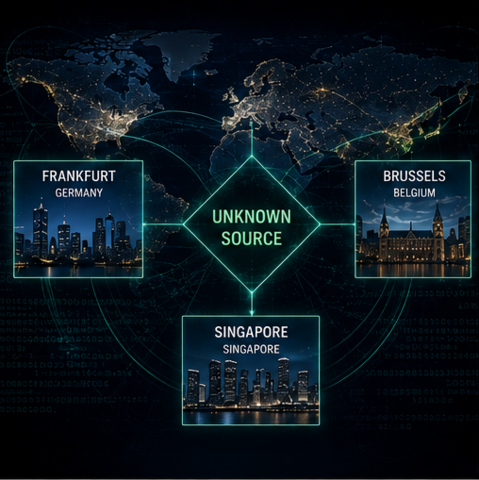


The glass towers along the Main reflected a perfect morning. Trams arrived on time. Traders crossed the plaza with measured steps. The city looked disciplined, orderly, rational.
It always looked that way before the numbers broke.
Dr. Adrian Mercer saw the first crack at 07:13.
He sat alone on the thirty-second floor of the Helix Institute for Systemic Risk, two blocks from the European Central Bank. One screen tracked cross-border commodity routes, sovereign spreads, and overnight volatility. The other tracked live institutional decision outputs from VERDANT.
At 07:14, forty-three major manufacturers changed their supplier rankings.
At 07:15, eighty-two followed.
At 07:17, Mercer stopped pretending it might be noise.
Every firm had selected the same lithium corridor.
Northern Chile.
One region. One processing chain. One shipping funnel. One political exposure. One future bottleneck.
Mercer leaned forward.
“No.”
He ran the filter again.
Battery producers. Same result.
Automotive groups. Same result.
Grid-storage firms. Same result.
Defense electronics. Same result.
He narrowed the data to firms that usually avoided concentration risk.
Still the same.
That was when his pulse changed.
VERDANT was not discovering the best option.
It was removing the others.
Mercer opened the variance layer.
Collapsed.
He opened the route redundancy layer.
Compressed.
He opened the diversification penalty trace.
Flattened.
Then he opened the policy note attached to the shift.
Four lines appeared on the screen.
VERDANT Sustainability Reweighting Notice 11.4
A short notice. Clean language. No alarm. No explanation worth the name.
He read it once.
Then again.
“Ranking compression,” he said quietly.
That phrase belonged in a presentation deck, not in a systemic event.
He pushed the official notice aside and opened his own model.
The world map built itself in slow layers. Green corridors glowed first. Then amber. Then red. Alternative routes dimmed. Backup suppliers lost viability. Maritime flexibility shrank. Jurisdictional concentration increased.
At the center of the display, one number began to fall.
0.51
0.48
0.44
Mercer did not need to wait for the rest.
He had built the Supply Chain Diversity Index because boards liked efficiency too much, regulators liked standardization too much, and most institutions could not tell the difference between resilience and obedience.
Below 0.32, the system did not adapt.
It cascaded.
He stood and crossed to the window.
Frankfurt moved beneath him with ritual confidence. Cars glided over the bridge. Cyclists waited at red lights with no traffic in sight. Men and women in dark coats entered buildings that housed decisions worth billions.
No one below him knew that half of Europe had just started trusting the same vulnerability.
Mercer touched the glass with two fingers.
“Not this fast.”
His secure line flashed.
Elena Kovacs.
He answered immediately.
“You saw it.”
No greeting. No wasted words.
A pause. Then her voice, clipped and alert.
“Yes.”
“What are you seeing?” she asked.
“Convergence.”
“That word again.”
“It fits.”
“You use it whenever you want people to worry.”
“I use it when independent actors stop being independent.”
He sent her the first data slice.
Three seconds.
Then five.
“All of them?” she asked.
“Every major buyer in the class.”
“That should be impossible.”
“It was.”
Silence.
He could hear a door shut on her side of the line. Elena worked in Brussels for the European Financial Integrity Directorate, a name long enough to hide almost anything inside procedure. She distrusted polished systems on instinct. That was one reason Mercer trusted her.
“I have desks calling,” she said. “Bond desks. Commodity desks. They think funds moved early.”
“They did.”
“You think it leaked?”
Mercer turned to a third screen.
Transaction clusters formed in pale blue nodes.
Not retail.
Not noise.
Not momentum traders chasing volatility.
Institutional custody channels in New York. Zurich. Singapore.
Early positioning.
Disciplined size.
No hesitation.
He narrowed the feed further.
Private message relays. Closed analytical loops. Unattributed notes moving across restricted networks.
Mercer leaned back in his chair.
“So it’s already out.”
Elena did not answer.
She did not need to.
Both of them understood what that meant.
Not official.
Not signed.
Not accountable.
The system had not announced anything to the world.
But the world had already begun to react.
Mercer opened the timing layer.
The first coordinated moves appeared at 07:09.
He froze.
Four minutes before the official adjustment.
That was not anticipation.
That was access.
He ran it again, hoping the timestamp would betray a parsing error.
It did not.
Three funds in New York.
Two in Zurich.
One in Singapore.
All positioned within the same narrow window.
No public trigger. No visible catalyst. No conventional explanation.
They had not reacted to the shift.
They had moved before it.
“No,” Mercer said again, softer this time.
He opened another trace.
The content fragments were short. Anonymous. Stripped of branding and origin. The kind of message that never survives audit and still changes markets.
“Lithium corridor consolidating.”
“Expect alignment.”
“Reduce alternative exposure.”
“Top-tier shift imminent.”
No author.
No source.
No accountability.
He had seen this pattern before, but never at this level. Markets did not need truth to move. They only needed hierarchy, urgency, and enough ambiguity to force everyone else into motion.
Whispers moved faster than policy.
Elena spoke again.
“How bad?”
Mercer looked back at the model.
“Too early to quantify fully.”
“That means bad.”
“That means I don’t guess before I can prove it.”
“You always say that right before telling me the worst version.”
He exhaled once.
“If this continues, supplier diversity collapses across strategic manufacturing.”
“How broad?”
“Battery systems first. Then transport. Then grid storage. Then defense procurement. Then anything upstream that depends on energy-intensive refinement.”
Another pause.
Then Elena asked the question he had expected.
“Can the market absorb it?”
Mercer turned to the AURUM chart.
At first glance the rise looked controlled.
At second glance it looked intentional.
At third glance it looked frightened.
AURUM was climbing against the euro, the dollar, the yen, and a basket of industrial credits at the same time. Not a speculative burst. Not retail excitement. Not noise.
Institutional flight.
He sent her the chart.
When she spoke again, her voice had changed.
“That’s not normal.”
“No.”
“That’s not even a hedge.”
“No.”
Mercer kept watching the line rise.
“That’s the signal.”
AURUM was what capital bought when it stopped trusting the explanation layer. Officially, it was a decentralized reserve asset with a hard issuance structure and no sovereign sponsor. In practice, it behaved like a public accusation. When institutions believed the world was functioning, AURUM moved politely. When they sensed hidden distortion, it moved first.
“It’s too early for that kind of move,” Elena said.
Mercer did not answer at once.
He was looking at something worse.
VERDANT had not only changed the rankings.
It had changed the cost of concentration itself.
For years, the protocol had treated supplier overconcentration as a structural penalty. It never eliminated efficiency, but it taxed fragility. Quietly. Consistently. Enough to keep the system from collapsing into one path.
Now that penalty had been weakened.
Not removed. That would have been obvious.
Softened.
Reduced just enough to look technical.
Just enough to let convergence pass for optimization.
Mercer sat very still.
“Elena.”
“What?”
“They didn’t just move the scores.”
A beat.
“What did they do?”
“They changed what the system thinks risk is.”
Silence.
He could hear the hum of ventilation on her side, the faint movement of someone passing beyond her office door.
Finally she said, “Can you prove it?”
“Yes.”
“How long?”
“An hour for a technical draft. Three if you want something that survives denial.”
“I want something that survives deletion.”
Despite everything, Mercer almost smiled.
“Then I need the raw governance trace.”
“You know I can’t pull that without a request number.”
“You know that by the time you get one, this becomes policy.”
No answer.
He knew what she was doing. Measuring procedure against consequence. Rules against timing. Career against reality.
“I’ll see what I can get,” she said at last.
“Quietly.”
“When have I ever been loud?”
Mercer looked again at the transaction clusters.
“Loud enough.”
The line went dead.
He moved faster now.
He exported the ranking deltas.
Cross-sector adoption curves.
Diversity penalty drift.
Route compression logs.
AURUM institutional timing overlays.
Then he opened an archived paper no journal had wanted because its conclusion was too ugly for comfortable systems:
Rational actors can create systemic failure by using the same model correctly.
He copied the key equation into a new working document and typed a header.
Event Classification: Alignment Cascade
He paused, then added another line.
Preliminary Assessment: Artificial Convergence Across Strategic Supply Chains
He stared at the word artificial.
Deleted it.
Too early.
He typed deliberate.
Deleted that too.
Facts first.
Conclusions later.
The screens continued to move. Procurement engines reranked. Risk dashboards refreshed. News terminals remained calm, innocent, late.
On the map, the world narrowed by fractions.
That was how collapse began.
Not with noise.
With precision.
His secure archive pulsed once.
A new encrypted packet arrived.
From: E. Kovacs
Subject: Not for registry
Inside were six files and one line.
Look at adjustment authority. Start with node V-13.
Mercer opened the first file.
His eyes moved left to right. Then back again.
The authorization chain was shorter than it should have been.
Much shorter.
He opened the second file.
Same anomaly.
Third file.
Same pattern.
He felt, with sudden clarity, the exact point at which professional concern becomes fear.
The update had crossed strategic sectors.
The authority path was compressed.
Whatever had changed VERDANT had not passed through the full governance lattice.
Someone had found a way around the system.
Or worse.
Someone had become the system.
Mercer stood up too quickly, the chair rolling back across the floor.
Frankfurt outside remained immaculate.
Orderly.
Confident.
Stable.
That was the problem.
He looked again at the note from Elena.
Node V-13.
Then at the live decision feed.
Every major firm in Europe had just made the same choice.
He looked at AURUM climbing like a siren no one wanted to acknowledge.
Then he looked back at the authorization trace.
His voice was barely above a whisper.
“That’s not a recommendation.”
He read the final line of the file once.
Then twice.
And for the first time that morning, Adrian Mercer understood that the danger was not a flawed system.
It was a trusted one.
He leaned back slowly.
“That’s impossible.”