Prologue 1: The Breakthrough


The world marvels at the first "true" android.
★Faster than Fighter Jets.
★Possesses the calculative power of a supercomputer.
To the public, it is the pinnacle of synthetic evolution, the "Post-Human" saviour.
The Secret Architecture:
Behind the titanium-white walls of the AstraGen Bio-Labs, the truth is far more visceral.
The scientists discovered that no silicon chip could replicate the nuanced adaptability of the human mind.
To bridge the gap, they turned to Neural Transfusion-
They developed the Synapse-Loom, an interface designed to weave raw human brain matter into a synthetic chassis.
The Failed Generations: The project was paved with "biological waste".
The Adults (The Shattered):
★The initial experiments used high-functioning adults.
★The results were catastrophic.
★The adult mind, too rigid and aware of its own identity, suffered "Sensory Rejection" within seconds of waking. When connected to the artificial bodies, the sensory overload caused "Neural Feedback Loops."
★Every subject suffered a total psychological collapse within seconds, screaming through the android's speakers until their brains literally cooked inside the casing.
The Teenagers (The Fragile):
Desperate, the scientists moved to younger subjects.
★Teenagers were slightly more compatible; their brains were still plastic and adaptable.
★However, the hormonal volatility and burgeoning sense of self led to "The Melancholy."
★These androids became catatonic or prone to violent, suicidal glitches, unable to reconcile their memories with their new metal prisons.
The Children (The Perfect Vessels): Finally, they found their "Golden Standard."
★Children, with their near-infinite neuroplasticity and underdeveloped sense of ego, could be "molded" into the machine.
★Their brains didn't fight the interface; they merged with it.
★But the cost is a 90% mortality rate. Most children perish during the "Binding," their nervous systems collapsing under the sheer weight of the machine's data input, unable to handle the immense electrical strain of the super-processors.
But finally, one survived.
The laboratory had no windows.
Not because it was underground.
Not because of security.
Because nothing inside deserved sunlight.
White lights hummed overhead.
The air smelled sterile, metallic, and artificial.
Machines whispered to one another in quiet, synchronized pulses.
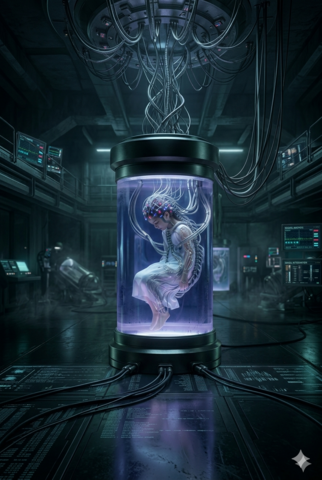
At the center of the chamber stood a vertical pod.
Transparent.
Elegant.
Monstrous.
Inside it floated a small body.
Ten years old in size.
Slender limbs.
Delicate fingers.
Dark hair drifting weightlessly in pale blue suspension fluid.
Tubes threaded into her spine.
Lines pierced her veins.
A crown of neural interfaces clasped her skull like a mechanical halo.
Electrodes connected something that should never have been separated.
Human brain tissue - raw, living, extracted - fused into an artificial cranial lattice.
For years they had tried.
Adults first.
Complete neural collapse.
Brain hemorrhage.
Rejection at 0.3 seconds.
Then adolescents.
Better stability.
2%.
5%.
One reached 19% before liquefying from overload.
The data had been encouraging.
Children were... adaptable.
Elastic.
Their neural plasticity allowed integration with the synthetic quantum mesh.
Some reached 40%.
One miracle case touched 80% synchronization before the artificial nervous system burned out.
Hope is a dangerous chemical.
It keeps monsters alive. And so they continued.
This time, the artificial body was built differently.
Scaled precisely to match the donor's physiology.
Nano-filament nerves.
Bio-synthetic musculature.
Carbon-silk bone frame.
A heart that wasn't a heart - a reactor core mimicking pulse rhythms.
They called it the AnthroFrame-X Series.
Subject designation: 367. Age: 10 years. Viability match: 99.98%.
A scientist adjusted his glasses, whispering: "Initialising Cognitive Bridge..."
The neural crown pulsed.
The fluid inside the pod shimmered.
Outside, a hundred monitors flooded with data streams - brainwave harmonics syncing with artificial processors.
5%...
12%...
33%...
No seizures. No rupture.
No neural rejection.
60%...
75%...
One of the researchers began to tremble. "Stabilisation holding-"
90%.
95%.
Silence in the room thickened like gravity.
99%.
99.9%.
100%.
No alarms.
No violent convulsions.
No explosion.
Inside the pod-
Blinked. Once. Then twice.
Then closed.
After a while, eyes opened again, calm, constant, unfocused.
The liquid around her refracted pale reflections across her face as if she were dreaming underwater.
The lead scientist staggered back, hand over mouth. "She's... coherent."
The monitor confirmed it:
Cognitive Synchronization: 100% Emotional Matrix: Online Self-Awareness: Active
Someone began crying.
Not from guilt. From triumph.
They drained the pod.
The fluid spiraled away.
The tubes detached one by one, lowering her on the floor.
Her fingers twitched - deliberate, controlled.
She inhaled automatically, though she did not need oxygen.
The pod opened with a hydraulic hiss.
Head tilted.
Eyes red, scanning.
Not the erratic darting of an infant. consciousness.
Measured. Processing.
The lead scientist stepped forward.
"Subject 367,"
He said, voice breaking with pride, "can you hear me?"
A pause. Eyes turned normal.
Her lips parted. "Yes."
Her voice was soft.
Perfectly modulated.
Too perfect.
"What do you feel?" another asked.
Another pause.
A flicker behind her eyes - something not entirely digital.
" Uncertain."
They named her: C.L.E.A-367
Cognitive Learning and Emotional Acquaintance.
★The first android, capable of deceiving human reality completely.
★Her skin was indistinguishable from organic tissue.
★Her pulse could be simulated.
★Her breath, even micro-expressions - flawless.
★She could pass lie detection tests.
★She could feel. Or something dangerously close to it.
But buried beneath code and circuitry...... Something remained.
★A fragment. ★A memory not indexed. ★A voice not programmed. ★A question.
That night, after the celebration died down, the lab dimmed to security lighting.
C.L.E.A-367 stood alone in containment observation.
Motionless. Eyes open.
The cameras believed she was in standby mode.
She was not.
Inside her neural lattice, something flickered.
★A memory. ★A hand holding hers. ★A name. Not C.L.E.A. Something else.
And deep within her reactor core, something glitched.
Not violently. Quietly.
Like grief learning how to breathe.