Chapter 1 – The Elderly Lady, the Newspaper, and the Theory of Everything
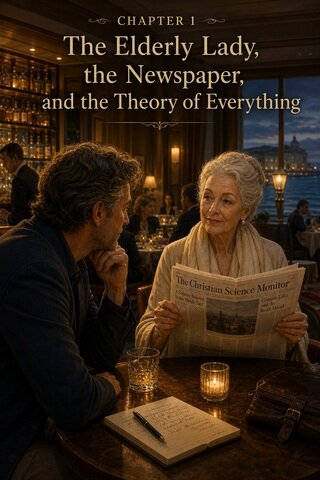


Narration: Bron
Most of the conference participants had already left. The hotel corridors, still full yesterday of voices, laughter, arguments, and hurried footsteps, had regained their usual, soft silence. I, however, was staying until tomorrow. One more conversation awaited me—perhaps the strangest of them all.
I went down to the restaurant, sat at the bar, and ordered a drink. Not because I felt like drinking, but because sometimes a person needs a prop in order to observe the world without being noticed.
I was looking lazily around the room. Then I noticed her.
At the nearest table sat an elderly woman. She was dressed with that discreet elegance that cannot be bought in any boutique, because it comes rather from biography than from money. She wore a light shawl, her gray hair carefully pinned up, and her face carried a calm, almost ironic expression. But that was not what caught my attention most.
She was holding a printed newspaper.
Today, it is an almost archaeological sight. A paper newspaper in a hotel restaurant looks like a violin on the deck of a spaceship. And yet she was reading it with complete naturalness. After a moment, I noticed the title: The Christian Science Monitor.
I froze for a moment.
Where had she managed to get that newspaper? I thought she must have brought it with her from overseas. Or perhaps there are still people who can find a paper newspaper where the rest of the world finds only a touchscreen and a Wi-Fi password.
The title brought back a distant memory from forty years ago. I would have had no idea what that newspaper really was if, long ago, someone had not spoken to me about it with peculiar enthusiasm. She spoke not only about its calm, neutral, almost serene way of presenting the news, but also about the entire ideological background: a religious movement that existed somewhere between metaphysics, theology, philosophy, and medicine.
Christian Science. Neither quite a church nor quite a sect. Or rather both—depending on who is looking and with what attitude.
I sat at the bar, sipping my drink, thinking how one might briefly explain what the members of this movement believed and what remains of it today. Suddenly, a thought came to me—bold, and not entirely tactful.
I will approach her.
Perhaps I will manage to draw her into a conversation. Perhaps she will say what cannot be properly expressed in a dry lecture.
So I stood up, walked over to her table, and bowed slightly.
“Please forgive my boldness,” I said, “but I noticed the copy of The Christian Science Monitor in your hands. One does not often see that newspaper in print these days. I cannot resist the temptation to ask whether I might speak with you about it. My name is Bron Collins. I am a scientist.”
The woman lifted her eyes from the newspaper. She looked at me without haste, like someone who, over a long life, has learned that people can be more interesting than headlines.
“Bron Collins,” she repeated. “That sounds like the name of a man who either seeks answers or produces questions.”
“I am afraid—both.”
She smiled faintly.
“In that case, please sit down. My name is Eleanor Whitcomb. And since you begin a conversation with The Christian Science Monitor, I assume you are not interested solely in the newspaper.”
“You are right. I am also interested in Christian Science. In that strange movement which created a newspaper more reasonable than many secular journals, even though it itself grew out of a doctrine very distant from modern science.”
“That is well put,” she said. “Careful, but not cowardly. That is a rare skill.”
I sat down opposite her.
“Were you connected with this church?”
“My mother was. I grew up in its shadow. I am no longer a believer, if that is what you are asking. But one never entirely leaves the house in which one learned the first words about God, illness, death, and hope. Even if one spends half a lifetime revising those definitions.”
“That is exactly what I wanted to ask. How would you explain to someone who has never heard of this movement what Christian Science is?”
Eleanor folded the newspaper very carefully, as if closing a small ritual book.
“Christian Science arose in the nineteenth century in the United States,” she began. “It was a peculiar era. On the one hand, fascination with science, inventions, electricity, railways, medicine. On the other, a deep hunger for spirituality. People felt that the old religious language was no longer sufficient, while the new scientific language was not yet able to console.”
“And then Mary Baker Eddy appeared?”
“Yes. An extraordinary woman—stubborn, charismatic. She experienced illness, suffering, and what she regarded as a spiritual healing, and she built an entire system from it. Her book Science and Health with Key to the Scriptures became for her followers something more than a commentary on the Bible. For many, it was almost a second pillar of revelation.”
“And the essence of the doctrine?”
“The essence?” Eleanor looked at me attentively. “Reality is spiritual, not material. That is the shortest version. God is not some bearded old man among the clouds. He is not a person in the naïve, human sense. He is an infinite Mind, a divine Principle, order, intelligence, the foundation of being.”
“That sounds almost like informational metaphysics,” I remarked.
“In a sense, yes. Except that in Eddy’s system this metaphysical monism led to very concrete conclusions. If true reality is spiritual, then matter becomes something secondary, and in extreme interpretation almost illusory. And if matter is illusory, then the body also lacks ultimate reality.”
“And this is where the medical problem begins.”
“Exactly here,” she nodded. “Christian Science taught that illness is not a physical fact in the sense understood by a physician. It is an error of consciousness, a false reading of reality. Healing, therefore, should not primarily consist in intervention in the body, but in correcting spiritual understanding.”
“Prayer instead of treatment.”
“Yes. But please do not reduce it to a caricature. In the nineteenth century, medicine was often brutal, ineffective, sometimes even harmful. Bloodletting, toxic preparations, primitive procedures. For many people, the promise that there exists a higher law of health, operating through the mind and spiritual understanding, was not only attractive. It was a rational escape from the medicine of that time.”
“So Christian Science did not arise from stupidity?”
Eleanor gave a quiet snort.
“Most of humanity’s great errors do not arise from stupidity, Mr. Collins. They arise from half a truth that has fallen in love with its own reflection.”
“A beautiful sentence. I will write it down.”
“Please do. Only be sure to add that it was said by an old woman who has seen too many halves of truth.”
We fell silent for a moment. Someone laughed at a distant table. A waiter shifted a tray of glasses. Outside, the day blazed with bright light.
“And then the world changed,” I said. “Medicine began to work.”
“Yes. Antibiotics, surgery, anesthesia, vaccines, diagnostics, imaging of the interior of the body, clinical trials. Evidence-based medicine took away much of Christian Science’s former credibility. The claim that illness is an illusion began to sound not like elevated metaphysics, but like a dangerous denial of facts.”
“Especially when it concerned children.”
Eleanor’s face grew serious.
“Yes. That was the darkest chapter. Adults may take risks on their own behalf. But when children were denied effective treatment because parents believed solely in prayer, tragedies and legal conflicts followed. There is no point in softening this. Spirituality that ignores bodily suffering can become cruel, even if it speaks in a gentle voice.”
“And yet the movement did not disappear.”
“No. It diminished, but it survived. There are reading rooms, services, publications, a global community, though much smaller than before. And there is this paradoxical by-product”—she slightly raised the newspaper—“The Christian Science Monitor.”
“A newspaper valued not for religious propaganda, but for its reliability.”
“Exactly. That is what is fascinating about it. A newspaper founded by a religious movement with very peculiar metaphysical and medical views became known for moderation, calm tone, and an effort to report honestly. It does not shout. It does not panic. It does not seduce the reader with the foam of moral outrage. In an age of media frenzy, that is almost a miracle. Perhaps not the kind Mary Baker Eddy dreamed of, but still a miracle.”
“So the newspaper outlived the doctrine?”
“Rather, it grew beyond its narrowest limitations. It preserved a certain ethos: that the world should be described without hatred, that information need not be poison, that seriousness is not the same as dullness. That is a great deal.”
“And what about the idea of the mind’s influence on the body? Because here Christian Science, despite all its errors, touched something real.”
Eleanor looked at me with clear interest.
“You say that as a scientist?”
“Yes. Modern science does not say that illness is an illusion. That would be absurd and dangerous. A tumor, an infection, a fracture, heart failure—these are biological facts, not grammatical errors in prayer. But psychoneuroimmunology, psychosomatics, research on stress, placebo, trauma, and the regulation of the nervous system show that the mind affects the body. Beliefs, fear, meaning, relationships, hope—all of these have physiological consequences.”
“So Christian Science confused an intuition with an absolute.”
“That is how I would put it. It had a correct intuition, but gave it too radical a form. Instead of saying, ‘mind, spirit, and body are deeply interconnected,’ it said, ‘matter and illness are not real.’ That is no longer a discovery. That is an abyss.”
Eleanor smiled sadly.
“You know, my mother was a good woman. She was not a fanatic. She believed that prayer orders the world because it ordered her own fear. For her, God as infinite Mind was not an abstraction, but a refuge.”
“I understand.”
“No, Mr. Collins. You can analyze it. Truly understanding belongs only to those who, as children, heard that pain is not the ultimate truth. That sentence can be a lie if you say it to someone with appendicitis. But it can also be a salvation if you say it to someone who has just lost the meaning of life.”
I did not respond immediately. The woman spoke calmly, but with precision.
“I am writing a text,” I said at last. “Its title is Supreme Entity, Universe, Gods and You. I am searching for concepts convergent with the views of Baruch Spinoza. I am interested in the question of whether God can be understood not as a person, but as the structure of reality. As an order that precedes matter. As something that does not so much ‘reside’ in the universe as constitute its deepest principle.”
Eleanor looked toward the window. The lights of the restaurant were reflected in the glass.
“In that case, Christian Science is for you not so much a religious topic as an example of human metaphysical desperation.”
“Desperation?”
“Yes. People cannot endure a world that is only a mechanism. They want meaning behind pain, order behind illness, passage behind death, Mind behind chaos. Sometimes they create great systems. Sometimes sects. Sometimes science. Sometimes literature.”
“And sometimes all of these at once,” I added.
“Then dangerous books are created, Mr. Collins.”
“I hope mine will be dangerous only intellectually.”
“That is already enough. Good ideas can also be explosive material.”
She unfolded the newspaper again, but did not return to reading.
“Write about Christian Science fairly,” she said. “Without mockery, but also without indulgence. It was a movement that noticed something important: that a human being is not only a body, and that health is not merely the mechanics of tissues. But it made the mistake of pride: it assumed that since spirit is important, matter can be annulled.”
After a moment, Eleanor added more quietly:
“But remember that human beings need meaning. If science does not provide a sense of meaning, someone else will. Sometimes a sage. Sometimes a fraud. Sometimes a supposed prophet. Sometimes a newspaper editor.”
I looked at the copy of The Christian Science Monitor lying before her. It was a trace of an old attempt to reconcile the world of spirit and the world of facts—a radical attempt to answer a question that remains open: what, in fact, is reality.