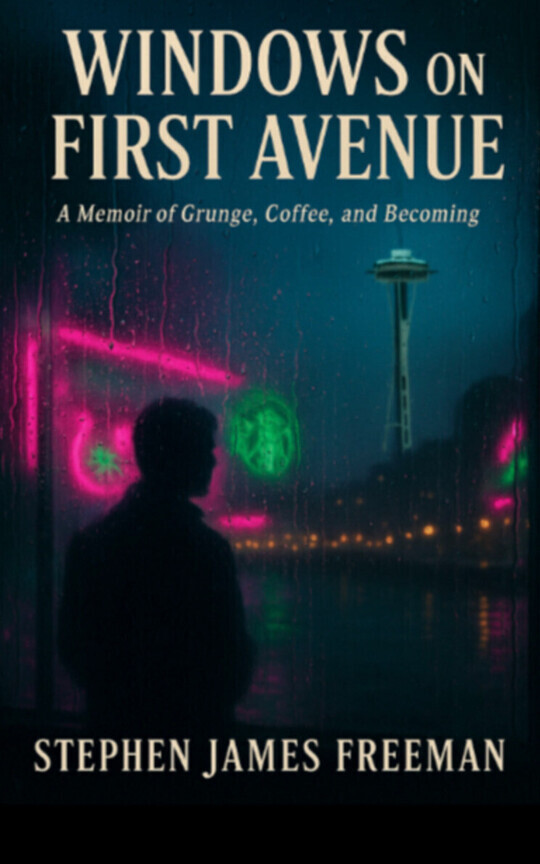

Windows on first Avenue
Windows on First Avenue
It was 1990, and I had just come back from Europe. My suitcase still smelled faintly of airports and foreign cigarettes. I returned with paperwork. Divorce papers. The end of one version of me, and maybe the beginning of another. In those early days back, I told myself I was an accomplished gay man. I said it half jokingly, half defiantly, but really, I was trying to stand in my own truth for the first time without apology.
I took a job in a little salon while I sorted my life out, snipping hair and making small talk. One of my clients turned out to be a girl who would later marry one of the Nordstrom brothers. Funny how even small decisions, picking up a pair of shears or showing up for a shift, can throw you into someone else’s orbit and set in motion a string of events that change everything. Within months, I found myself moving to Seattle.
Seattle in 1990 was a creature waking up. The air buzzed with feedback from basement bands, names that didn’t yet carry the weight they would: Nirvana, Pearl Jam, Soundgarden, Alice in Chains. The city wasn’t polished. It smelled like rain on pavement and the smoke of too many bars. Coffee shops hadn’t yet become temples; they were corners to hide in. And there I was, moving into a tiny apartment on First Avenue, right across the street from the Crocodile Café. At the time, I didn’t understand what that meant.
What I did know was Nordstrom. That department store downtown felt like a cathedral of commerce, and into its gleaming aisles MAC Cosmetics had just arrived like a splash of neon on a gray wall. The brand was electric, unapologetic, alive with pigments that dared you to be seen. I was right there as it blew up in Seattle, standing behind the counter with brushes in hand, watching the city’s musicians and dreamers wander in.
On my breaks, I’d slip outside to the coffee shop by the store. I’d light up a menthol cigarette, sometimes with a blunt hidden neatly inside, and lean against the cool stone of the building. That’s where I learned to love a double soy latte without foam. That bitter, creamy drink became my quiet ritual, my armor before stepping back into the fluorescent light of the counter. Out there, I was anonymous and visible all at once, watching the city swirl past.
The grunge kids came through Nordstrom smelling of sweat, cigarettes, and stale beer. They wore their rebellion like clothing: dresses from thrift stores shredded at the hem, combat boots barely laced, flannel wrapped around skinny hips. Some were nobodies then, anonymous faces that would later hang on magazine covers. Others already carried whispers of legend.
Courtney Love was one of those. I remember her sweeping into Nordstrom like a chaotic storm system, an entourage of fifteen trailing behind her. She always looked like she had just rolled out of bed, wearing a mix of lingerie and street clothes. Her hair was partly dreaded and partly bleached, her face broken out, her eyes sharp. She wore oversized flip flops with fuzzy things glued on, and she bought armloads of overpriced products without a second thought. Once, a beautiful man in drag pushed a baby carriage behind her, dressed like Betsey Johnson’s fever dream, with a wig that looked like it had been found in a costume trunk. That was normal for downtown Seattle then. Surreal, messy, oddly sacred.
I didn’t realize it at the time, but that counter became a kind of portal. Everyone passed through. People who were “nobodies” yet. People who were somebody but didn’t look like it. The MAC counter became a mirror, a place where you could try on a color, a face, a persona, and walk back out into the city a little altered.
One night, a girl I knew handed me some tickets. Her boyfriend, she said, was Peter Buck, guitarist for R.E.M.
“You’re so close,” she told me. “It’s just across the street. Go check it out.”
I didn’t even know who they were at the time. But I went. And there I was, standing in the Crocodile, watching R.E.M. play on a small stage, utterly unaware that I was in the middle of history. It was just another night in Seattle, but one of those nights that leaves an imprint you don’t recognize until much later.
The Akasha has always worked that way in my life. Windows open. Sometimes I walk through them without knowing what’s on the other side. Looking back, I see how many opportunities were laid at my feet when I was too young to understand them. That night at the Crocodile, watching a band I’d never heard of, was one of those windows.
As my confidence grew, I started venturing up to Capitol Hill. That was Seattle’s gay neighborhood, pulsing with neon and possibility. The Brass Connection. Manta Ray. Madison’s. Our Place. The Timberline Thumpers. Each club was its own universe, filled with drag queens with sharp tongues, men in leather, women in tuxedos, and kids my age experimenting with everything from eyeliner to eroticism.
One night, I found myself in a club tucked into an alley. The kind of place where you stood in line outside, heart thudding, until the doorman decided if you were fabulous enough to enter. Inside, the floor reeked of beer and sweat, lasers sliced through smoke, and bodies tangled on the dance floor. Dancing in the nineties wasn’t like it is today. You touched, pressed, breathed into strangers. I was testing out my “gay moves,” as I called them, when my friend tugged at my shirt.
“Stephen, come up to the VIP lounge!”
“VIP lounge?” I laughed. “How the hell did you get in there? I don’t know anybody!”
“You’ll know them when you see them,” she said with a grin.
Upstairs, the room was hazy with smoke. At the center sat a man in his forties, overweight, eyeliner smeared, nails painted metallic, a sequined shirt stretched across his belly. Young twinkish boys orbited him, drinks in hand.
My friend gestured toward me. “This is Stephen. He’s a makeup artist.”
The man leaned forward, eyes sharp. “Do you know who I am?”
“No,” I said, smiling calmly.
He grinned wider. “I’m Casey. Casey and the Sunshine Band.”
And just like that, I was drinking with disco royalty, the Akasha nudging me once again through a door I didn’t know existed.
Daylight had its own surprises. One afternoon, I was bent over the MAC counter, polishing it until it gleamed. Clean counters were our pride. When I looked up, I froze. Standing before me were Ann and Nancy Wilson of Heart.
They were kind. That was the first thing I noticed. Thoughtful. Curious. They asked real questions about the brand and about MAC’s explosion into Seattle. And their style was layered, witchy, bohemian streetwear, grungy but elevated. They weren’t chasing trends; they were inventing them.
I kept my cool and stayed professional, as if they were just friends at the counter. Inside, I was buzzing. I loved their music. But what struck me most was their presence, celebrity stripped away, humanity glowing through. That was another lesson: fame wasn’t the point. Presence was.
Seattle had a way of dropping celebrities into ordinary rooms. One night it was Heart. Another was Sir Mix a Lot in a club, larger than life yet utterly unassuming. Nobody was unreachable in those days. Everyone brushed shoulders in the same bars, the same cafés, the same sweaty dance floors.
And it wasn’t just music. Seattle had a restless independent film scene, and I slid into it almost by accident. Someone heard about the young guy at MAC who could handle makeup and hair, and suddenly I was on sets. That’s how I met Charles Napier, the grizzled Hollywood actor who’d landed in Seattle for a noir project. I was his hairdresser. He loved to drink, and after hours his tongue got loose. He’d lean back, bourbon in hand, spinning stories of old Hollywood, and I’d laugh with him, marveling that I was sitting in smoky rooms after hours with a celebrity while grunge kids stumbled past the windows.
Then there was Chicks with Dicks. It was a spoof on gay and lesbian culture, shot in black and white on Capitol Hill. We filmed for months in basements, apartments above storefronts, and alleys lit only by neon signs. The crew was a patchwork of dreamers and drifters. There was the clothing director with a French accent, light skinned and elegant, his suits sharper than our whole production budget. There were Canadian kids chasing art across the border, and a friend from MAC who would go on to real success. Together we made magic out of scraps, our laughter filling the long nights as much as the smoke.
And then one night, someone screened Faster, Pussycat! Kill! Kill! Russ Meyer himself was in the room. We sat on battered couches, smoke swirling, watching the cult classic in all its black and white glory. And I thought: one week I’m selling lipstick, the next I’m watching Russ Meyer watch his own film with us. Seattle made the improbable feel inevitable.
The film world had its characters. The grip boy was wiry and grungy, his backpack slung over his shoulder like a drugstore. If he showed up, we knew the night would be long. Shrooms, joints, tabs. He always had something to keep the wheels turning. He wasn’t just supplying drugs; he was supplying energy, keeping the current flowing.
Then there was the scout. Plaid shirts, blunt haircut, her van always packed. She was pure nineties lesbian Seattle, showing up with a lover sometimes, or a dog, or just herself. She scouted warehouses, alleys, rooftops. When she said, “This is the spot,” we trusted her.
And the feeders. No matter how broke the production, the food spread was always incredible. Pasta, salads, cookies piled high. Food is love, and those sets were drenched in it.
Outside the sets, I explored Seattle like it was mine. People called it rainy, gray, depressing. I never saw it that way. To me, it was layered. Sometimes misty, sometimes washed in sunlight, always alive. I’d sit on the wharf with a book, ferries slipping in and out, the salty air thick with possibility. Each neighborhood was a classroom.
And it was my first city. My first city as a gay man. There was the handsome salesman at the Chanel counter, selling fragrances with a smile that lingered longer than any cologne. Our flirtations blurred one night into something more, brief but unforgettable. There were encounters that lasted one night and burned hotter for their brevity, arms that held me until the music faded, kisses that stripped shame from my body. There was the first kiss I gave a man without boundaries, without hesitation. That was a revolution. Because when you align with yourself, the world aligns with you.
Even the erotica stores became teachers. Everyone zipped into plastic, the smell of vinyl and sweat heavy in the air. You could drop a dime into a slot, and a little window would slide up, revealing a strip show for seconds. Mechanical, crude, absurd, and yet powerful. It was a mirror, showing me desire unmasked, showing me I wasn’t alone.
Through it all, the city molded me. It taught me to respect my body, to value nourishment, to recognize that windows don’t always announce themselves. Sometimes they look like a blunt hidden in a cigarette. Sometimes they look like a sequined man surrounded by twinks. Sometimes they look like a clean counter that suddenly becomes a stage for Heart. Sometimes they look like a kiss that feels like the first time you’ve ever touched the truth.
And always, above me, the rooftop. My apartment on First Avenue was one floor below a friend of the man who would one day become my partner. Rooftop parties drifted down. Fireworks, countdowns, laughter spilling into the night. We didn’t know then, but the Akasha did. It was staging us, setting the scene, waiting for our cues.
Seattle in 1990 wasn’t just a city. It was a crucible. A threshold. It was lipstick and flannel, eyeliner and sweat, drag and discos, independent films and erotica that cost a dime. It was messy, intoxicating, formative.
What I know now is that those years were about learning to notice. To see that life throws us opportunities, some chaotic, some loud, some hidden. And if you step through, everything rearranges.
That was my Seattle. My First Avenue. My Crocodile. My MAC counter. My Capitol Hill. My nights on film sets. My rooftop echoes.
A city in flannel and eyeliner.
A decade cracking itself open.
And me, caught in the middle, learning how to see.