Prologue-The Calm Before the Storm


O Divine Auria, whose light illuminates the world with its splendid clarity, and you, wise Minerva, guardian of justice and faithful judge of the words that are pronounced here and of the acts perpetrated in the sacred Palegia, it is with deep gratitude that I, Lyssandros, son of Taurus, born and raised in the prosperous city of Athenea, dedicate this message to you.
It is public knowledge that there has been just over a century without armed conflicts among the cities located to the north of the Great Alfeu River, which winds over Palegia cutting it like a blade with the sharpest edge, whether these conflicts are among the northern cities themselves or with cities located further south of Palegia, a conflict to which my eyes and ears have been witnesses.
A contention originating in the city of Apollonia, to the west of Palegia, the polis had its dispute going beyond civil boundaries and becoming physical through two groups that aimed for the city’s supremacy, but seeing himself at a disadvantage the leader of the group called Malus, who had close family ties with the monarch of Ourania at that time, called for his help, which was answered along with the support of the then small Village of Athenea, a great commercial partner and ally of Ourania who joined the conflict in favor of the Malus group seeking gains from the war.
But regardless of the allied efforts of the cities supporting Malus, the group was overpowered and succumbed in the conflict to the ferocity and skill of the Moirans and Rodanians, who together fought like lions, like insane beasts thirsty for carnage while they supported the other group that was fighting for control of the city. Such an episode is a vivid reminder of my childhood when my brother and I ran through the streets of Athenea when it was still just a modest village surrounded by crops and pastures.
However, it is undeniable that there has always been the inevitable effusion of blood in the face of the emerging dangers from the north, such as the one-eyed giants and other creatures that threaten our fields and forests. However, beyond such facts, the peace and calm provided by the absence of conflicts in the north allowed notable cultural advances, as well as in agriculture and economy to be possible for certain cities.
The polis of Malus, for example, was established after the end of the last great war, by centaurs who chose not to return to Apollonia after losing the war when the conflict between the groups that were disputing the city came to an end. The region of Ourania, on the other hand, in the period of peace, developed and expanded its domains and areas of cultivation and mining, becoming the main producer of wheat, oats, and other grains, as well as providing Athenea with large amounts of iron and copper.
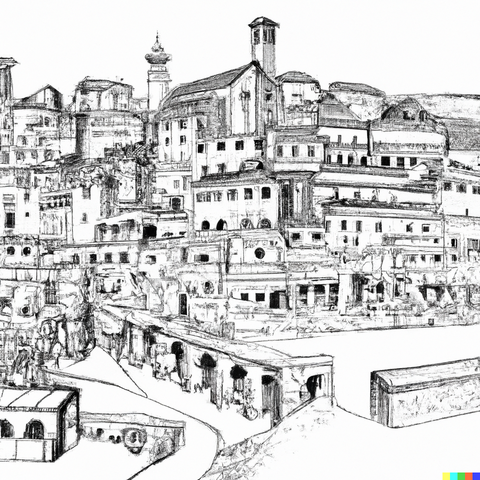
And it’s clear I cannot fail to mention the old village that would grow to become the prosperous city of Athenea. Its growth was catapulted by the reigning peace that allowed for greater cultivation and exploration of land and livestock throughout the north, the extraction of minerals and other natural resources as well, which thus generated an abnormal flourishing of trade and philosophy. This transformed Athenea into the most important urban, cultural, and financial center in the north, with vast plantations, pastures, barracks, temples, civic centers, a true bastion of northern centaur society.
The progress ensured for the northern cities catalyzed an expressive flow of production and trade between them, consequently generating greater wealth for such cities. This development also fostered friendly, albeit incipient, relations with southern cities such as Epano and Argosia. The trade of grains, metals, and other natural resources was intense, as was that of silver, stones, manufactured tools and utensils or copper items produced in Athenea, which fed the economy of these cities, allowing significant advances for the city to the north of Palegia.
At this time, the demand for the products of craftsmen and blacksmiths reached notable growth, as the peace and tranquility of the northern lands offered ideal conditions for the flourishing of these professions. Such circumstances ensured superior quality in their products compared to those of the southern cities, thus raising an emerging rivalry between Athenea, the main bastion of the north, and Moira, the preponderant city of the south of Palegia.
The expansion of Athenea’s economic and political influence in Palegia aroused discontent in Moira, the ancient city of expressive strength both economically and militarily. For many years, Moira exerted a dominant influence over the southern and northern cities, making use of its power. However, over the past 100 years, it has seen its sphere of influence shrink, being limited to the south of Palegia thanks to Athenea and Ourania, which jointly provided notable advances for their respective cities and for the north.
However, Moira persisted as the main producer of copper, cattle, weapons, and armor over these years. Therefore, it was common for Moira to instigate conflicts between southern cities and villages, profiting from the sale of such goods or by hiring Moiran citizens as mercenaries for the resolution of armed conflicts. Thus, Moira’s influence as a military and armament center in Palegia has always been significant and feared by the surrounding cities. I would even dare to say that Moira has always been feared throughout Palegia.
Just like the rhinoceros ready for combat, armed with its armor and sharp horns against the most formidable opponents, or like the eagle that with its claws pierces and with its beak shreds the unsuspecting prey, delivering a lethal attack, without time for reaction. That’s Moira, always ready for the clash, always ready for the inevitable attack.
Therefore, Moira, noticing the gradual decline of its influence over the years, began to harbor a growing aversion to the northerners. Such a feeling intensified as cities like Ourânia and Athenea rose in terms of power, culture, wealth, and population. Factors such as the discovery about 60 years ago of an extensive silver mine north of Athenea, a discovery that catalyzed the city’s expressive growth thanks to the generated wealth and immigration, ended up allowing the construction of a variety of public buildings and investments in the city, these factors that further fostered dissatisfaction on the part of Moira.
This dissatisfaction culminated in more aggressive actions by the influential Moiran city. Increasingly, it sought to force the distancing of the southern cities from those of the north, through threats, assassinations, hostages and, in extreme cases, military occupations of less influential villages, farms or cities. A clear containment strategy and imposition of Moira’s will in a scenario of growing development of the northern cities.
In this covert struggle for dominance, Moira repeatedly imposed itself, restricting the cities south of the Great Alfeu River from trading with Athenea or receiving representatives from any northern city. It became customary to see Moira’s military exercises and patrols in Athenea’s lands, fueling fear and concern among Athenea’s rural inhabitants. Many, fearing aggressive actions from Moira, migrated to the city, abandoning the southern fields to dedicate themselves to the production of varied items such as copper and iron manufactures, tools, limestone and silver exploration, which increased the city’s wealth even more with the increased production of various these utensils thanks to the growing labor force for production and the growing demand for products.
However, no direct battle has occurred between these two powers until the present moment, as such conflict would threaten the very foundation of our society. And so it has been, threatening and transforming everything we know, putting allies of yesteryear on opposite sides of the battlefield. Brotherhood is forgotten, brothers face each other, causing wounds and death for a conflict without reason.
The origin of current events is defined by the actions of Pillus, the stern General Commander of Moira. Characterized by bitterness and disdain, he dedicated his entire life to the military service of Moira, mainly as a mercenary in cities in conflict, rising to the highest leadership position once occupied by his deceased brother, the former General Commander of the city of Moirans. The appearance of Pillus is marked by the gray of time and numerous scars that adorn his slender body, the most prominent extending from the missing left ear to the mouth, a trait increasingly evident as he ages.
Rumors circulate about him, claiming that it was Pillus who, driven by ambition, took the lives of his brother and father to usurp the command of Moira. Since his youth, Pillus harbored contempt for the sister centaur cities, mainly Athenea and Ourânia, being one of the main inciters of the feelings of indifference of the Moirans towards the northerners, maintaining the belief that Moira should exercise superiority over all. He saw Athenea and Ourânia as threats, believing that they were culturally backward and full of deceivers, propagators of unfounded philosophies.
In this way, upon discovering that the city of Nérus, located at the extreme south of Palegia, famous for its temples dedicated to Neptunus, god of the seas, waters, earthquakes, and marine life, recognized for the trade of marine animals, textiles, salt, and wood, was planning to negotiate new trade routes and they would have relations with Athenea, seeking to import ceramics, wine, silver and copper manufactures from the north to expand their markets and offer new products to their people in exchange for the sale of salt, leather, and fish, the General Commander Pillus decided to act to reaffirm his position and keep Athenea away from the south.
Pretending a marriage proposal between Cassandra, the daughter of the leader of Nérus, and Jonos, his own son, in order to strengthen the ties between the cities and the leadership of the south, Pillus planned a visit to Nérus. For this trip, he selected a fourth of his Guard of Enyo to accompany him. The Guard of Enyo is an elite regiment composed of 400 high-ranking and skilled soldiers among the Moirans, who report directly to the General Commander. This detachment was named Guard of Enyo, honoring Enyo, the god of war, fights, battles, and glory - the most venerated god in Moira - for they are considered the most prepared and forged warriors in the city.
Pillus, wishing to be well received and seen in Nerus, so as to gain popular support, arrived bearing many gifts for the people and the rulers. At his command, servants unrolled wine skins, heifers for sacrifice to Neptunus, gold and silver, fat and leather. Moreover, artists were brought to pay tribute to Philip, the Young, priest and leader of the city of Nerus and his daughter. All these gifts coming from Moira were well received and the festivities extended for three days and three nights with great joy for the arrival of the visitors before the Meredivo and for the wedding that is finalized.
At the end of this period of 3 days and 3 nights of festivities, the Meredivo would be celebrated, a sacred day for the Nerusians. On this day, the City’s Leading Priest makes offerings to Neptunus and the new Judges of the Sea are elected. These figures represent the new political and military leaders of the city, assisting and opposing the Leading Priest in the administration of Nerus. In addition, the wedding would take place after the Meredivo, so that Neptunus, upon receiving the offerings, could also bless the marriage and the union between both cities.
Thus, in a political effort to secure support and consolidate ties with Nerus, Pillus brought with him the most beautiful jars from Moira, armors and around 20kg of silver and 10 servants as a wedding gift for the bride’s family and also brought 10 high quality heifers from his own herd, to offer in sacrifice to Neptunus during the Meredivo. The heifers would be slaughtered, cooked and offered at the altar to Neptunus, followed by a feast where neither meat nor wine could be consumed because the meat and wine at this feast would belong only to Neptunus, when the end of the feast arrived, the meat would be cast into the sea for the god to feed.
However, on the night of the banquet, Pillus and his officer Etano gave themselves over to wine even before the beginning of the ceremonies and the feast. Intoxicated, they consumed the meat while it was still on the altar, profaning the offering and the ceremony, thus disrespecting Neptunus and all of Nerus, showing Moira’s lack of interest in Nerus and profound disrespect for the hosts and their god.
After such an act, Philip, the Young, tore his clothes and withdrew for seven days in prayer and pilgrimage in the sacred groves around Nerus, seeking Neptunus’ forgiveness for the profanity and his guidance on what decision to take regarding the Moirans. Upon returning, Philip warned Pillus to leave Nerus, informing him that Neptunus had spared his life and those of all the other guests, and that the marriage was permitted, but not the festivities.
After such events, Pillus, before departing, prayed to Neptunus, but the sky darkened as if night had fallen before them and the sea stirred into strong waves, as fierce as the most beastly kraken. Seeing this, Pillus left and took with him Cassandra, daughter of Philip, his new daughter-in-law, to Moira. Despite resistance from the Judges of the Sea, Philip stated that it was the will of Neptunus, and that he would take care of Nerus.
After the Moirans’ return from the city of Nerus, it is believed that Neptunus, in response to Pillus’s offense and disrespect, sent a severe drought to the entire region south of the Great Alfeu River. The river itself, once copious, saw its waters decrease to the point of becoming a mere stream. Interestingly, Nerus kept its waters and springs unchanged. Faced with the calamity, the Commanding General appealed for Philip, the Young, to intercede with Neptunus for Moira and request the return of the rains and waters. However, no response from Nerus was received and neither did the messengers return.
The drought proved relentless and intense for all cities to the south, forced to watch their fields fade away and their animals succumb to thirst. Some older centaurs perished from lack of water, others suffered severe dehydration in some cities and farms. There were rumors that Nerus was providing water to its allied cities such as the polis of Argosia, but no official confirmation was obtained from Moira. Thus, the water shortage continued to oppress all those in the south.
Suffering severely from the drought, the influential city of Rodian, situated between Nerus and Moira, also faced the difficulties caused by the current moment. The Dunstona River, which supplied the city and irrigated its fields, dried up completely, interrupting the production of grains, one of the main sources of income and food in the region. Desperate, the Rodanians, once bearers of the banner of Moira, went to Moira for help. Pillus, however, claimed they were also without enough resources to share with other cities, that the fields were dry and that they were surviving with reserves from past harvests.
Hearing Moira’s response, and in need of help, the city of Rodian sought help from the coastal city of Nerus, which still had water, food, and drink without any problem during the great drought. However, Philip, the Young, refused to serve anyone, even the mouthpiece city of Moira, because this was the will of Neptunus. So, without any help coming to Rodian from its allies, the city’s king, Laecyos, turned to the northern cities. Observing that the north was not suffering from a lack of water, food, or money, he decided to seek help from the northerners when seeing his people perishing.
Laecyos was a wise and learned man, the elected king among his father’s sons, the former monarch of Rodian. Thanks to his intellect and diplomatic skills, which counterbalanced his small size, weak body, and lack of hair on his body and head that plagued him since his youth, it was his compassion and love for his people who were suffering from lack of water, hunger, and poverty, and his city that had once been prosperous and full of life, that led him to commit the greatest heresy against his main ally, Moira.
Rodian had always been known as the mouthpiece of Moira, and it is even known among the gods that where the sword and shield strike, the raven is at their side to eat the flesh. In this way, Rodian always focused on developing its army and military supplies for Moira. Even though part of its revenues came from small manufacturing and grain cultivation, much of its economy came from the services provided to Moira, which always had to support them in times of crisis. However, in this situation, without the support of their greatest allies, the Rodians found themselves in a no-win situation, because if nothing was done, everyone would fall before the power of Neptunus against those who follow Moira. Thus, at this moment, Laecyos sent a small delegation of 15 centaurs, among them Alekyos, his eldest son and commander of his troops, to Athenea, seeking help with resources and food, but he did so secretly so that Moira would not find out because such a thing would not be well received by the Moiran Fortress.
A few days, about a week after Alekyos and his companions set out for Athenea, Pillus, the Commanding General of Moira, summoned the leaders of each of the cities south of the Great Alfeu River to present themselves in Moira with their families and together find ways to navigate this situation. In response to Pillus’ call, the following cities presented themselves: Tyronia, Rodian, Epano, and Argosia, but the city of Nérus did not attend.
When the guests arrived with their families, the Commanding General ordered that only the leaders be taken to the welcome banquet along with their companions, leaving the children in their rooms, claiming that such matters to be discussed were not suitable for young people or children. And in this way, like a snake slithers in the shadow to hide and ambushes and bites your leg without being noticed, so Pillus acted. Having heard rumors about messengers from one of the southern cities being seen in Valorun heading towards Athenea, he called the leader of each city so that he could warn them.
While they were in the hall feasting to the sound of singers and with plenty of wine to quench their thirst, the warriors of Moira entered the leaders’ chambers and captured one of the sons of each of the leaders present while the banquet was taking place. Thus, after everyone had eaten and were satisfied, Pillus revealed to them that he had taken one son from each of them to keep as permanent guests in Moira, in order to ensure the loyalty of the cities as allies. He also announced that any interaction with the northern cities would be seen as a betrayal to Moira and they would be attacked for it, and that in times of crisis, the southern cities should unite and not become subject to the North.
After the banquet, it was found that the following had been captured:
Caius, the third son of Flavius of Epano
Alex, the first son of Marco of Argosia
Parius, the fourth son of Triacus of Tyronia
Hector, the third son of Laecyos of Rodian
The morning after the banquet, each lord returned to his city, frightened, revolted, and angry for having left their sons in the Moiran fortress, but all were convinced that they would not think of opposing Moira due to its power. However, it is said that as soon as Laecyos arrived in Rodian, he prayed to Onir for 5 days and 5 nights to protect Rodian and his son Alekyos.