Chapter 1
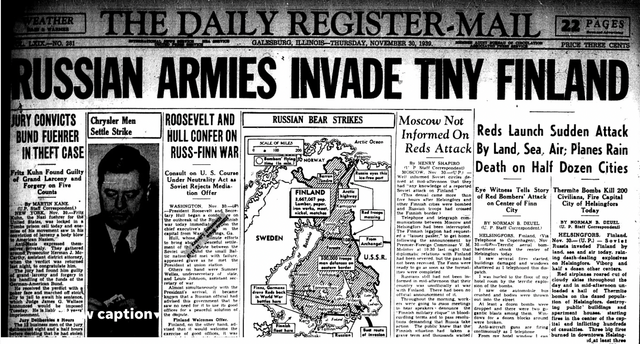


It was the winter of 1942. The war that had first been set in motion when Russia attacked us on November 30th, 1939, was continued after a momentary peace in between. Now, seven months later, it seemed there was no end in sight. The whole world was struggling, most of it anyway, or so it seemed. Millions of average people fought battles of mightier men when most of us only desired peace to continue our lives the way we knew.
I was sixteen years old, turning seventeen by spring. Still too young to join the army, but at the rate things were going, perhaps I would still live to witness the horrors of the battlefield. I lived with my mother and two younger siblings near the new border that the peace treaty had determined in March 1940. My sister Aino was seven, and our little brother only five years old.
Our father.... gone missing in action the summer before, shortly after the war had continued. My mother stubbornly refused to believe he was gone. I knew better. I knew in my heart that he had perished in that battle.If only the peace had lasted, if only the peace treaty hadn’t been so unfair that it could have held.
But what could an average person do but adapt, accept, and do their best to survive?
Those hard times forced me to grow up fast; I was the head of the family, the man of the house now. Looking after my family, like my father had asked me to last time we spoke. And I often wondered if he knew what was ahead.
There was a lot to do just to survive each day to the next. I had to keep the house warm and make sure we had enough to eat. We had bred rabbits, and my father had taught me to skin them and how to prepare them. Sometimes I would go to the nearby lake to fish through the ice. I had stocked the flour, oatmeal, and dry hay for the rabbits we bought last fall from our neighbor. But everything needed to be rationed so we wouldn’t run short.
Little by little, our village, once full of life, had got deserted. We were one of the few families remaining. They had advised us to leave many times, but Mother was reluctant to leave the home she and my father had built for us. I could see how her grief affected her mind, her sense of reality flickering each day that passed, and now she was too sick to be moved on our own. We weren’t sure what was wrong. She was feverish and coughing. Her cough had lasted for months, it seemed, but in the fall she had gotten worse and she needed bed rest.
Each time someone had left, I hoped we could leave as well. The last of our closest neighbors left before winter, shortly before my mother’s condition grew worse. They left after hearing horrific tales of what the partisans could do to people. I did not want to think of it. I had almost gotten my mother to consider leaving as well, but then, as a sign of cruel fate, her condition weakened. And I hesitated to leave her and my siblings alone to get help. The next village was twenty kilometres away.
Life turned into constant fear. Fear I needed to keep hidden from my siblings. Every day I feared they would come and that they would find us. If they would, I had very little chance of surviving, and I knew that. As a sixteen-year-old male, too young to join the army perhaps, but not a child either, I would most likely be shot right on the spot. I kept praying every morning, each night. Maybe the war would end soon?Please, God, let it end soon!The nights when we heard the sounds of a battle were the worst. At the sound of bombing, we would all gather up close together and just hold each other; I would try to sing for them until the terrifying sounds stopped. I did not know just how close they were, but I knew they couldn’t be far. I knew it could be only a matter of days or weeks until we would be discovered.
I tried my best to comfort my siblings, who kept asking,Would we all die? Would our mother die? I didn’t know what to answer them, so I told them what I hoped would be true; we will be fine, we will be safe.
Early on, I heard that there was a possibility of sending small children to Sweden, to families willing to take care of them until the war ended here. I tried suggesting to my mother that we could send Aino and Olavi there, to safety, but she had refused. She wanted us to stay together, not perhaps entirely understanding just how bad the situation was. But Aino would soon need to be sent to school, and right now, every option was too far a distance in either case. I needed to get them to Sweden. I needed to convince my mother when she got well enough to travel...if she ever would.The days went by; I was losing even the little hope that I had. It was hard to see the day when it would all come back to normal. In my heart, I knew that it never could. Too much had already changed.
I tried my best for Aino and Olavi; they needed me. I was only their brother, yet they depended on me as they would on a parent. The war was robbing them of their childhood. All I could do was try my best to offer the little joy that I could.
**^^**^^**^^**
It was the end of January, the coldest time of the year, when I brought my baby sister and baby brother into the sauna. We all needed to get clean. It had been too many days since our last bathing. I hated the unclean feeling.
I remembered happier times, the times when the village was full of laughter and friendly faces. Visitors, weekly bathings in the sauna, and dances that had been held on Saturdays.
I remembered my father and his laughter. I remembered the last time I saw him, the way he smiled before leaving, trying to comfort.We will get our lands backfrom them,you’ll see! But I just hoped they wouldn’t keep taking more, ravaging more.I would rather have kept him with us.I would rather make do with what was left.
I remembered how it had felt to have enough to eat, how the food tasted. We were all getting tired of our narrow food circle that needed rationing. It did no good to remember the way things were before; it was long gone now and life would never return to what it once had been, even after the war.
Aino laughed as she played with water, and her laughter lightened my heart. She was happy now; her smile made me smile, and soon we were all laughing.
I washed their hair; they didn’t like it; children seldom do. I tried to be careful, not to get the shampoo in their eyes. Then I washed myself, my body and my hair. I watched as dirt washed away, revealing the milky tone of my skin. It felt so good to be clean again. The heat of the sauna felt good as well after days of frost.
We walked back inside the house. I brushed Aino’s hair carefully, trying not to pull it, but unfortunately her long hair had many knots and she didn’t much appreciate it. When done, I braided her hair like I had seen my mother do many times before. Fortunately, this procedure she did enjoy, complimenting that I was much gentler than our mother was. Her honest compliment made me chuckle.
Finally, I lifted her up to let her look at herself in the mirror.“Now just look at us; so clean that we could go meet the president,” I told them, and they both laughed. It felt weird to see myself in the mirror; it had been a long time since I had last looked. My blond hair was overgrown and wavy; my skin had a surprisingly healthy color. I would have preferred shorter hair, but who was there to judge my looks? And who was there to cut it?
The sun was setting, and I went out, chopping more wood to keep us warm, while my sibling stayed indoors to play with the few toys they had. It was getting dark fast. I had already gotten a good pile of wood when I heard something from the woods and froze. Voices, growing louder by the minute. Voices inTHEIRlanguage...
Had they seen me?Panic gathered inside, my heart hammering in my chest as I knelt and collected the wood basket to take indoors. I ran inside and locked the door, knowing full well that a simple lock wouldn’t keep them out if they wanted in.
“Elias, what’s wrong?” Aino asked, looking at me with worry in her blue eyes. I was breathing fast, leaning against the door. Sometimes Aino seemed so much older than her seven years, just like now. I walked further in and placed the wood basket down on the floor near the stove.
I looked at her, feeling helpless, at first not knowing what I should do. They had probably seen the smoke; they knew we were here...They were coming... A sense of threat spread within. In my mind, I had played this scenario often enough, but now that it was real, I felt frozen for a moment. All those stories I had heard, not too long ago... Families killed, innocent civilians... women and children, old people. They had no heart. And there my siblings were on the floor with their toys... seven and five, innocent in front of their lives and... I needed to act! I needed to do what I had planned in my mind before.
“Come here, both of you,” I told them, and I tried to smile. I walked into the kitchen, their small hands in mine. “Let’s play a little game; you need to go down here and be as quiet as you can. The one who is quieter wins a prize,” I said, forcing a smile. Olavi looked excited. I opened the door to a small cellar under our kitchen floor. “Now, just remember that whatever you hear, you must stay here and be as quiet as you can.”
“What’s the prize?!” Olavi asked excitedly.
“I have saved a small piece of chocolate. The winner will get that.” I helped Olavi first down there, and then Aino, who had doubt written all over her angelic face.She knew. “Take care of Olavi. I need you to do this, Aino. I trust you.” I whispered to her, sensing that she was about to ask more questions. She looked at me knowingly. Knowledge one so young shouldn’t have, and it pained my heart.
“Be careful, Elias, I love you,” she whispered.
“I love you, too,” I told her and placed a finger on my lips, shushing them. Olavi still looked so excited about the game. For a moment longer, at least, he’d be clueless of the danger I hoped would not reach us. And yet, I knew in my heart that our luck had finally run out. I smiled at them, wondering if it would be the last time they’d see me alive.Please, God, spare them at least!
Once I had closed the door, I hurried into the bedroom where my mother was.
“Mother, wake up. They’re coming. You need to hide.” I shook her arm, and she opened her tired eyes, looking sicker than ever before. She was sweating all over, and her face looked so white; her long, blond hair lay damp against the pillow.
“I can’t... I’m too tired.... Just save yourself, Elias... leave me.... They need you more,” she struggled to speak, taking heavy breaths between her words. But I felt surprised she understood, a moment of clarity between the mist she had been under for days.
“No, Mother, I can not leave you at their mercy!” I cried as I struggled to get her up. But she was heavy and seemed to have already given up. I cried as I kept trying to force her up with me. “Please, Mother, we have to at least try!”
“Elias, just go ... leave me...Armas...Armas is coming for me....” she gasped, repeating my father’s name like a broken chant. Her eyes closed, her breathing heavy. But I couldn’t give up... I couldn’t let them have her. I couldn’t leave my mother at their mercy.
My father had made me promise to take care of her, and I would, even if it cost me my life.
Then I heard it; the front door was forced open, and people came inside. The door slammed shut behind them, leaving the cold winter wind outside.This was it.I would not see a new dawn.
Please God, spear them, spear my siblings at least!“Hello, is anyone here?” The voice asked with a thick Russian accent. I looked at my mother, and she looked back at me, her blue eyes widening in fear. Her burning hand reached for mine as I was about to reveal myself to them.
“I love you,” she whispered.
“I love you, too,” I replied with sadness. I released her feverish hand and walked out of the bedroom. There were three men; one who was quite young and two, twice my age at least. They had brown winter army-jackets on and fur-hats, with the Russian flag on them. They all looked at me, and I didn’t know what to do or say, so I just stood there, looking back at them. Waiting for my death, trying to face it with bravery that would make my father proud. But inside, I was quivering with fear.I didn’t want to die. I wasn’t ready to die.“Well, well. So, there are still people here. Is there anyone else here, boy?” One of the older men asked in awkward Finnish. There was an unpleasant smile on his face. I gritted my teeth, hesitating to answer them. The man neared me and took hold of my shirt collar. “Answer me, boy!” he yelled in anger. One of the other men went into the bedroom and came back, saying something in Russian to the man who was holding me.
“It’s just my mother and me here,” I spoke quickly. The man looked around and saw the toys on the floor. I had forgotten all about them.
“What’s this then? Don’t tell me that you’re still in playing age?” His smile was amused and cruel at the same time.
“My younger sister and brother have just died,” I lied quickly. He was still holding me.
He looked at me from head to toe.
“How old are you?”
“I’m sixteen. Please don’t hurt my mother. She’s sick. She needs me,” I pleaded. He smiled, turned to look at his friends, said something to them, and they laughed. Fear consumed me, but I hoped it didn’t show.
“Is there something to eat here?”
“We don’t have much, but I...I-I can fetch you something. Please, just don’t hurt us,” I asked; he looked at me in a strange way.
“Sergeant Sharkov will come with you,” he said and turned to speak to the younger man. The man in question came to me, pointing his gun at me. “And you better not try anything stupid, boy; Sharkov here has a quick temper,” the man said, amused.
The young soldier followed me into the kitchen. I took some rye bread from the food closet, dried meat and a water can, hoping that Aino and Olavi would keep quiet, and they did. I brought the food to them into the living room; the soldier following me close behind. I didn’t like the look of him, nor did I feel comfortable about the way they were all looking at me.
I placed the food on the table, and then I noticed that the third man was missing; soon enough, I heard my mother’s scream. He dragged her into the living room with him and dropped her onto the couch. She was coughing, tears staining her pale face.
“Please, don’t hurt her. She is sick, for God’s sake!” I cried out. The man turned to look at me, smiling unpleasantly. He came closer and took hold of me. His rough hand touched my face and looked at me carefully. He said something in Russian to the others and smiled in a way I didn’t like. The way he was looking at me and touching me didn’t feel quite right.
“He said that you are pretty, pretty, almost in a way that women are. Your lovely blond hair and bright green eyes...hmm, yes, I quite agree with him.” The one who spoke my language said and laughed.
I swallowed the uncomfortable feeling I had, or tried to, but it refused to set.
“I’m not pretty, I’m a man, and men are not pretty,” I said and once again gritted my teeth. I looked straight at the man who spoke my language, fighting myself to keep his gaze. The man laughed and seemed to tell the others in Russian what I had just said, who then followed his laughter, taunting and cruel. Taking pleasure in the power they possessed over me.
“You’re still a boy, and a very beautiful boy you are,” he said, and those words chilled me to the bone. I did not want to understand the reason they spoke to me like this.
The man dragged me to sit on his lap at the table. His arm was around my waist. I looked over at my mother; her misty eyes looked back at me with equal confusion and fear.
“We wouldn’t hurt a sick woman. Don’t worry, pretty one,” the man said as he took a piece of bread and ate. His eyes never left mine.