
Vermouth
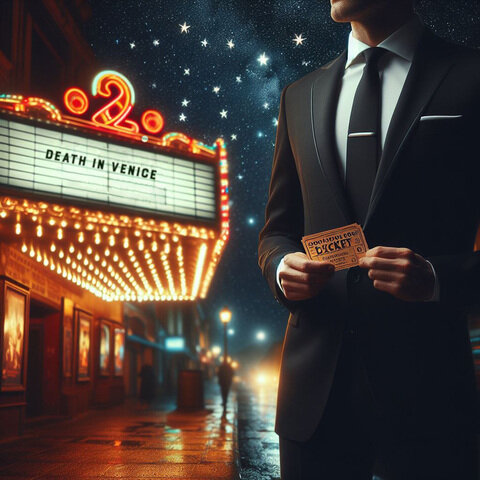


It was dark, but it was the sea. A steamboat and Mahler's music lightened the waves, while the floating silence of the theater hall was pleased to moisten, transmuting itself in fresh and invisible tongues, the columns of the San Martin theater in Colmena Avenue. Six seats away to my right, a muffled murmur spread in the reddish light of a cigarette. The screen, meanwhile, invited me to leave the uncomfortable seat, offering me instead a summer resort of anachronistic beauty. I remember experiencing a huge change in the temperature of my hands. My senses and my appetites had rebelled against my reason, while the artificial brilliance of the ecran claimed my steps. After an insane resistance, I had to break in where I was asked, although without needing to move from the top of the mezzanine.
— I hope you enjoy your stay — a servant wished a man with a dark mustache. — May the room be to your liking, sir.
The guest opened the windows to enjoy the ocean view, which must have cost him a pretty penny. I had paid a few miserable coins in exchange for a little green ticket, but I also enjoyed the same panorama. “Grand Hotel des Bains”, the tents, the burning sand. When he left the room, I touched the walls, caressed the fine wood of the nightstand. I thought about going down to the hotel main hall, from which a smooth, almost clandestine bustle made its way towards the few couples who were observing the scene on their seats —that night the theater carpet had hardly been walked over, and the only things that stained its faded purple tone were the ashes of reddish light cigarrette—. I hesitated also to go down to the main room. I was missing something, maybe. I felt as if a human bridge was necessary to make me present between the columns that welcomed the vacationers. There was no hesitation, however, in entering the fog that lightly embraced Colmena Avenue, bathing it in sadness.
The avenue felt terribly cold to me. There were no stars and the monotonous sounds of traffic lay on the two-way track. My watch insisted on saying it was early. In front of the shadow cast by a rusty street lamp, a woman with dark lips was clutching a gray purse. I talked to her.
—A room full of tables, champagne, hors d'oeuvres…? In the theater? You're nuts —she told me.
I didn't see where or remember exactly when she left me alone. I entered the Bransa bar, consumed half a bottle of sour beer and headed back to the theater hall. I reached into my right pocket, from which I patiently extracted my ticket stub. The feeling of necessary company, after all, had receded until it completely disappeared from my chest.
The hotel main hall was revealed before me in an ample sight. Sitting on an ivory chair, the guest looked insistently at the face of a blond and very neat boy. I turned my gaze and was captivated by an extraordinarily delicate green-eyed woman, with authentically gentle manners, without the feigned refinement suggested by the manuals of etiquette. The rest of the joint seemed to have become hermetic: suddenly it was just her and me, materialized by the sequence of small rainbows in the form of thoughts that traveled through the dark towards the screen. Our affinity seemed to be reflected in both the coincidence of our ages and in the paleness of our faces. I approached her, but when I reached her table I dissolved like an already finished scene. I spent the night on a terrace, assaulted by the sudden singing of some minstrels who stood between the guest and the young blonde. The woman now wore a feather hat and a disinterested look, like almost all the female faces there.
—Will you stay all summer, lady? —I asked her, finally.
—You don't look to have been invited— she replied.
That was enough suggestion for everyone present to look at me with suspicion. Likewise, it caused everyone to disappear except the guest, who looked shocked by the news of an impending plague. I realized that I had to leave the scene immediately and I left, heading towards the street again, looking for something warm to get me through the rest of the night exhibition.
The loneliness was inhospitable and the man, undoubtedly, was dying. I knew it because there was no longer any pause between his sobs, because the sweat that soaked his body had taken over his speech. I headed towards the beach to watch the last scene. Under the surveillance of the persistent sun that accompanied Mahler's notes, the young man's long body, observing the droplets of light that appeared and disappeared intermittently over the ocean, like sequins sewn on a sapphire and mother-of-pearl dress, dissolved between monochrome shadows. As the dying man left his last earthly trace on the very fine gravel of the Baths, the notes of the adagio shaped a beautiful and orderly procession.
At that moment I realized I could no longer return to my theater seat, or anywhere else. I kept my body, but not my memories, and therefore I had also lost my name. I tried to go after the young man in search for answers, but a stranger, whom I was sure I spotted in the night of the minstrels, gently grabbed my shoulder, preventing me from moving forward.
—How beautiful that boy is, right? —he told me, with his eyes on the sea shore —. That Italian director made a perfect choice.
— You… are you also obliged to stay here? — I asked, stunned.
— You could say so — the man responded calmly, letting an unmistakable German accent float in the air. My name is Thomas, and yours?
—I just noticed that I don't have it.
— Don't worry. I will create one for you. And maybe also a story; Tell me, do you like stories about sanatoriums...?
I was about to say no, but when I found myself leaving the flat lands, riding a noisy railway towards the mountains, I realized that there was no turning back.
(Originally published in the peruvian magazine "Caretas", December 2008)
Copyright 2008, 2014 by Fernando Salinas.




![Werewolf Hollow [GALATEA DATE TBA]](https://cdn-gcs.inkitt.com/vertical_storycovers/ipad_76bbf380fa2e8dc2f70694197487ab81.jpg)





![The Moon's Weapon : the cursed mate [ MOVING TO GALATEA]](https://cdn-gcs.inkitt.com/vertical_storycovers/ipad_123f31099804e79c6de11657975bcaae.jpg)







