
Horror Films and Their Impact
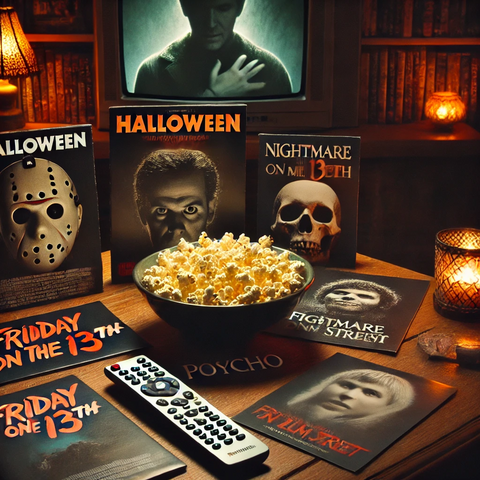


From my earliest memory, I was allowed to watch scary movies. Sitting on the floor just feet away from the TV, my eyes peeping through my fingers trying to shield myself from the terror right in front of me. My parents behind me in their recliners watching intensely, as I was.
I was exposed to horror films at an age when other children were shielded from it. My parents likely saw it as harmless entertainment—just movies, nothing real. But the truth is, those films did more than entertain me. They followed me into my dreams, into the dark corners of my childhood fears, and even into my waking life as I grew older.
Thanks to Psycho, I couldn’t take a shower without peeking behind the curtain. Halloween had me sprinting down my hallway at night, terrified that Michael Myers would be waiting behind me with a knife. My dreams were haunted by Jason and Freddy, always chasing me, always catching me—though I’d wake up just before they finished the job. The horror didn’t stay confined to the screen; it planted itself deep in my mind, shaping the way I thought, acted, and even navigated my own home.
Yet, despite the fear, I kept coming back for more. If a new horror film was on HBO, Showtime, or Cinemax, I was watching it, knowing full well I’d be paying the price for weeks afterward. Why? Because I could. My parents didn’t care.
I felt more grownup over the other kids whose parents forbade them from watching scary movies. I saw it as a badge of honor, a testament to my bravery. It was even a form of family bonding—my parents and me, from behind my fingers my eyes peeking through, sharing in the thrills of The Omen, Dressed to Kill, The Shining, and, at just four years old, Trilogy of Terror. But the scariest part wasn’t the movies themselves. It was what came after they ended:
“Time for bed.”
Those three words spoken from my mother struck more fear in me than any horror film ever could. I’d lie there in bed with my door wide open. Hall light on, staring at the doorway, too afraid to close my eyes, while the bone chilling soundtrack still echoed in my head. It wasn’t just the fear of nightmares—it was the fear of what might be lurking in the dark when I was awake.
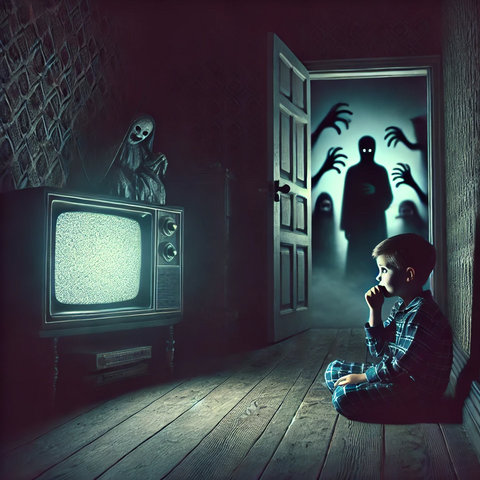
One night, when I was eleven, I sat in my bedroom watching House of Dracula on my small black-and-white television. The light from my small screen flickered in the dim room as I focused on the eerie images in front of me. Then, from the corner of my eye, I saw something.
A black hand—like a shadow—reached around the edge of my door and flipped the light switch off.
In an instant, my room was plunged into total darkness. My TV screen went black. The only sound was the distant murmur of the television from the living room, where my parents were watching their own program.
My voice shook as I called out, “Ha, ha, Dad—very funny.”
Silence.
A chilling realization crept over me: I was in a horror movie. I bolted out of my room, sprinting down the hallway into the living room. My parents, bathed in the warm glow of their TV, looked up in surprise. I frantically told them what had happened, but no matter how much I insisted, they dismissed it as my imagination.
That was the first time I couldn’t explain what I saw. But it wouldn’t be the last.
One afternoon, home alone after school, I experienced something even more unnerving. As I sat in the bathroom, I heard voices—soft, indistinct murmurs—coming from the other side of the door. I froze.
The bathroom had no lock and my pants were around my ankles. I was utterly vulnerable.
I sat motionless, holding my breath, listening intently. The voices continued, then stopped. Were they gone? Or were they waiting for me to open the door? Tears streamed down my face as I remained frozen in place, paralyzed by uncertainty. Then, finally, in what seemed like an hour, I heard the front door open and the familiar jingle of my mother’s keys.
Relief washed over me. I called out, “Mom, is that you?”
A single word confirmed my safety. “Yeah.”
I never told her what had happened to me that day. Maybe it was out of embarrassment or shame. Or maybe it was because I wasn’t quite sure (to this day) if what I heard just beyond that door was real or just my imagination.
As I got older, my fears evolved. The boogeymen of my childhood—Freddy, Jason, Michael Myers—became relics of the past. But what I didn’t realize at the time was that the real monsters were waiting for me out in the real world.
Recently, my home was burglarized twice in three months. I was home both times.
The first time, I woke up to strange noises but convinced myself I was imagining things. The next morning, I discovered my wife’s jewelry had been stolen. The second time, I woke up again—but this time, I didn’t dismiss my instincts. I rushed out of my room, unarmed, and found three thieves rifling through my belongings. I shouted and charged at them, cursing as they turned to flee. One of them raised a gun, aimed it directly at me, then bolted out the door. I didn’t chase after them.
Horror movies had once conditioned me to fear shadows in the dark. But the real terror is the kind that doesn’t fade when the credits roll. The real monsters are the ones who walk among us, the ones we pass on the street, the ones who break into our homes while we sleep. The ones who are pure darkness whom will never succumb to see the light.
Looking back, I believe those parents who shielded their kids from horror films had the right idea. Children’s minds are impressionable, and horror—whether in movies or real life—seeps in more deeply than we realize. Studies have shown that children process fear differently than adults; their brains are still developing, making them more susceptible to lasting psychological effects. Frequent exposure to horror can lead to sleep disturbances, anxiety, and even desensitization to violence.
Did my early exposure to horror movies prepare me for the real-life horrors I would face? Maybe. But was it necessary? No.
Children’s minds should be filled with laughter, education, and love—not scenes of gore and terror. The world will show them true horror soon enough. Until then, it’s our job to protect them, to give them a childhood free from the fears they’ll inevitably have to face later in life.
I’m all grown up now. I no longer fear the dark. I can take a shower without looking behind the curtain. I can sleep peacefully, unbothered by nightmares of Freddy or Jason. Horror movies don’t scare me anymore—maybe because nothing on screen will ever match the real fear I’ve experienced in my adult life.
If you ever have children of your own, I wouldn’t let them sit in front of the TV, or their phones wide-eyed watching shadows creep into their minds. Let them have their innocence a little longer. Because childhood is way too short, and once fear finds them, it never truly lets go.












Great writing! 💯 I didn’t watch those kind of movies when I was super young, but I did watch The Wizard of Oz many many times, and I had so many nightmares about the Wicked Witch of the West! 😰 I really wish that life wasn’t a thing that gets so terrifying sometimes, and I do think that protecting small kids from being exposed to terrifying movies is a good idea. ⚖️
This was fascinating. Children's minds undoubtedly process information differently to the minds of adults, and it makes sense that exposing them to the horror genre creates unnecessary fear. Thank you for sharing your childhood experiences and subsequent analysis with us.
I'm really sorry to hear that you've been broken into, and that your personal space was invaded in such a harrowing way. I hope those responsible were caught.