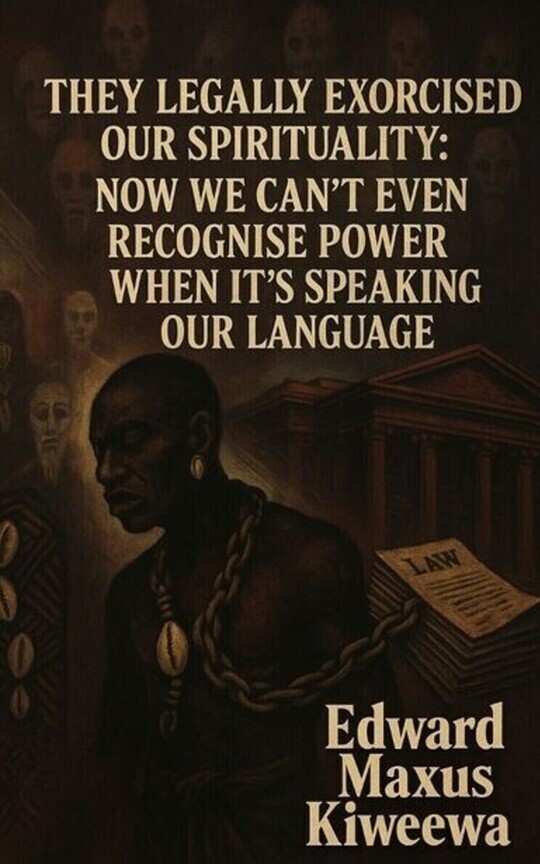
The Legal Exorcism of African Spirituality
Share with your friends
Customize readability

The Legal Exorcism of African Spirituality

All Rights Reserved ©

Summary

They called it "civilisation," but it was really an exorcism. Through colonial laws, missionary zeal, and imported religions, Africa's sacred traditions were demonised, criminalised, and erased. Using Buganda as a mirror for the continent and other marginalised sects, Kiweewa explores how the West legally dismantled African spirituality until we could no longer recognise power when it spoke in our own tongue. A daring meditation on law, history, and faith - challenging us to ask: Are we truly free in worship, or still chained by conquest?

Status
Complete
Chapters
5
Rating
n/a
Age Rating
13+

Prologue

When the missionaries came to Africa, they had the Bible. We had the land. They said, “Let us pray.” We closed our eyes. When we opened them, they had the land and we had the Bible. ¬ Desmond Tutu[1]


What we rarely speak of is that with the Bible came a gradual erasure, not just of territory, but of memory, metaphysics, and the sacred spiritual coding that once made us custodians of the unseen and stewards of mystical authority. That is the true Genesis of African spiritual decline not in the form of a snake in the garden,[2] but in the form of a missionary in a cassock, clasping a Bible in one hand and a statute book in the other, casting out the very soul of a people.[3]

For those with ears trained in scripture and minds soaked in postcolonial thought, the conversation we must now have is not whether African spirituality was valid,[4] but how and why it was buried alive while we watched, praying, fasting, and quoting.[5]

This theme is not a romanticisation of precolonial Africa but employs Buganda as a lens through which wider continental drama patterns unfold. It is a lamentation, a post-mortem of sorts; an analysis of how we lost the very spiritual software that powered our societies. The deliberate branding of African spirituality as “demonic” or “barbaric” which was never a theological argument; a political warfare - disguised as salvation.

[1] West, G., 2015. The Bible in an African Christianity: South African Black Theology. In Routledge Companion to Christianity in Africa (pp. 141-155). Routledge.

[2] Genesis 3:1-15

[3] Smith, J.H., 2006. Snake-driven development: Culture, nature and religious conflict in neoliberal Kenya. Ethnography, 7(4), pp.423-459.

[4] Ter Haar, G., 2009. How God became African: African spirituality and Western secular thought. University of Pennsylvania Press.

[5] Omolewa, M., 2009. Africans, the Bible, and Christianity: pp.87-91.

Let Edward Maxus I. Kiweewa know what you thought about this chapter!

Further Recommendations

The Alpha's Exiled Mate (ON HOLD)

Catherineb83: Story good just would have liked her not to wear a mask

Read Now
The Missing Heir | Billionaire Romance

Inkiminki: Read this twice back to back.... (and read a couple of the chapters several times - phew - hot stuff). Clearly defined characters. Great stuff

Read Now
Bear Shifter Secrets

tatianne Ingrid: Adorei cada capitulo! parabens

Read Now
Nothing Between Us

Elizabeth: It is engaging and entertaining.

Read Now
Bound to the Bear

Mira: Just waw loved every part of tu

Read Now
The Neighbor's Son

Diane: This was an amazing read, I really enjoyed it so much.. thank you for this masterpiece 💞

Read Now
Bloodlines

Read4Free16: Fantastic development of characters and story line

Read Now
Shattered Steel

laraivanic: This is completely stunning book, lots of heat and emotions and finally love with two different people who needs to earn and learn to be as one. Very great indeed!! Thank you for this, sincerely ♥️♥️

Read Now
IVAN

Steve Worden: Very good read and extremely well written!

Read Now