The Wake of Small Lies
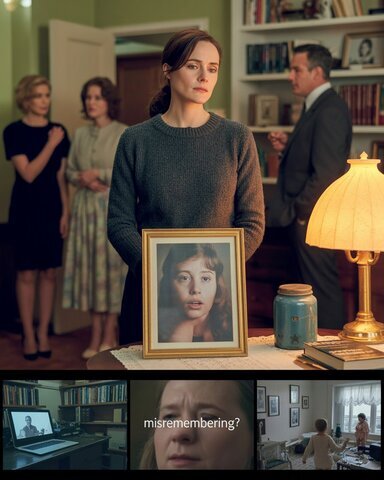


The wake smells like roses and coffee, the way grief in our town always does. Condolences come in cups, refilled by hands that touch my shoulder and arm and elbow like we’re all part of a slow moving conveyor belt that delivers you from “so sorry” to “how are you holding up?” and then deposits you by a plate of cookies you don’t want.
I track the room like an anthropologist: hairlines I remember, hairlines I don’t; cousins whose names detach from their faces and stage a stubborn strike in my mind. There’s Aunt Ruth by the bay window with the north light my mother loved. Ruth holds a napkin and a story: the one about the garden party where Mom tripped and took a hibiscus bush with her, and everyone laughed until they cried, and Adrian picked her up and said, “Now, now, Lila, the plant is more resilient than you think.” It’s the twelfth time I’ve heard it today.
The laughter goes soft as velvet when it comes to my father. People lower their voices when they say his name, like they’ve entered church. Dr. Keene. Adrian. He is in every conversation even when he isn’t in the room. A man says to me, “He spoke at my wife’s book club once. On trauma. Such a gift to the community.”
“Mm,” I say, and try it on my face, that polite smile.
Adrian appears like I conjured him. He’s wearing a navy suit and the tie that broke my mother’s heart in a good way, the one with tiny scissors sprinkled over deep red. He hugs a woman whose son he treated a decade ago. He hugs Ruth, who teases him for not eating enough. He pulls me into his arc like it’s gravity. For a moment, my nose is in his lapel and I am six again, counting stitches to calm down.
“Hey, kiddo,” he whispers. “You holding up?”
“Trying.”
I expect him to smell like aftershave and chalk dust, the scent my childhood assigned to safety. He smells like peppermints and grief, like everyone else.
We move through condolences together the way dancers move through a routine they rehearsed long ago. He does the speaking for both of us, listening with a chin tilt, dropping the right condolences at the right beats. There is an art to this and he has natural rhythm. “We’re grateful you could come.” “Lila loved those hydrangeas you sent.” “That’s kind of you to say.”
He lets people say what they need to say about my mother. Some of them say “fragile,” and he nods with a flicker of pain. Some say “stubborn,” and he laughs, tipping grief toward fondness the way he always does. No one says “angry,” though she was, sometimes, like a match that never learned it could light the room without burning it down.
Aunt Ruth spots me alone by the dessert table and pounces. I love her, but she pounces. “Mara, sweetheart,” she says, pinching my wrist like I’m a lemon that might slip. “Do you remember when you were little and you used to spit out strawberries? The faces you made? Oh, your mother would bribe you with jelly to just keep one in your mouth for a second. You were a stubborn one.”
“That wasn’t me,” I say, automatically. Could be a reflex. Could be truth.
She tilts her head. “It was you. I fed you those strawberries.”
I can feel the knife of it: the way two people stand looking at the same landscape and call it by different names. “I love strawberries,” I say. “Mom and I used to eat them by the sink and let the juice run down our wrists, remember? In the blue jar. The one Mrs. Cho gave her.”
Ruth purses her lips. “Mrs. Cho gave me that jar. Your mother took it, as usual.” Then she softens. “Memory plays tricks during times like these, honey.”
My father is at my shoulder. I don’t hear him arrive; he can be like that, quiet as a cat. “Ruth,” he says, gentle as chamomile. “Let’s not argue with grief. Mara remembers what she remembers.”
Ruth flusters. “Of course. I didn’t mean—”
“She knows,” he says. Then to me, softer: “It’s chilly by the window. Go sit by the fire, kiddo. I’ll bring you tea.”
It’s the same voice he uses in his videos. I watched one on the flight home—“When Memory Hurts.” Fifteen minutes of a careful smile and phrases that feel like cooled stones placed on overheated skin. Memory is a story we tell ourselves. Memory changes, but pain doesn’t lie. Our job is to hold the experience, not the snapshot.
Tea arrives in a white mug with a crack that turns out to be a hair caught in the glaze. It looks like a fracture line on an x-ray. I fish it out, making the crack disappear. Ceramics teachers would say it was never part of the cup to begin with. Now it looks whole.
“Earl Grey,” Adrian says. “Like when you were little.”
“I liked chamomile,” I say, on purpose this time. Then I take a sip. It’s Earl Grey, and it tastes like being tethered to something.
He sits beside me. “People mean well. Your aunt loved your mother very much, in her Ruth way. She’s never been good with facts.”
“I know.”
He studies the fire. It moves like a language I never learned, flickers over and under and coalesces into what you could swear is a shape if you blink at the right moment. “You’re staying here?” he asks. “We can get the house ready. Fresh sheets. Or you can stay with me. I thought, maybe, you’d want… I thought maybe we’d make it easier, for both of us.”
“I’ll stay here.” The word here is a knotted thing. It means the house I grew up in, with its north light and its hollow under the stairs where I told secrets to dust. It means the last place my mother was alive. It means the place where every object weights my pocket with fourteen stories, some heavy and some light, and I can’t tell which is which until later.
“Of course,” he says. “Of course.”
We do the next hour together, and the next. At one point, he kisses the crown of my head in a gesture so beautiful that I have to leave the room as if it burned me.
I go to the study to hide. The study is where Mom paid bills and kept her sewing, where she took calls she didn’t want to take, where she wrote letters she didn’t send. It isn’t the room with the shelves of my father’s books or his plaques or the big framed screen-grab of his TED Talk. It smells like old envelopes and lemon oil and a faint memory of nail polish remover. The desk is clean. It would look staged if not for a pencil shaving curled like a comma in the trash.
There is a stack of condolence cards tied with twine on the chair. There is a small screwdriver in the pen cup. There is a flash drive beside the keyboard, matte black, labeled with a neatly printed piece of masking tape: ECHO.
The word drags its fingernail down my spine. It’s nothing. It can be nothing. Echoes live everywhere. But the tape looks like my mother’s writing. She made all caps like a schoolteacher even though she never taught a day in her life.
I look back toward the hall, hear the sea-sound of people movement. I plug the drive into the computer because I am the kind of person who follows the path that opens under my feet even when my shoes are bad for it.
The drive opens into a folder called ECHO and then into neat subfolders that make my heartbeat a strange animal: Demos. Training. Sessions.
I click Demos. I recognize three thumbnails. My father’s face, fifteen years younger, the lighting cooler. The thumbnails have titles: Memory As Draft. The Safety of Accuracy. When Memory Hurts. He used them lately in his practice, in the trainings he gave to young clinicians who watched him like he was a lighthouse in a storm. I watched them, too. When I felt brave. When I felt like forgiving something that still had hand marks on my skin.
I click Training. The first file is called Roleplay_1_ConsentOK. I double-click.
The screen shows my father in the old office chair with the duck tape scar on the arm. “We’ll model how to gently correct a client’s narrative that’s harming them,” he says into the camera. “This is for training new therapists; the role-play subject is a colleague playing a client, consent obtained.”
A woman enters frame, in her thirties, dark hair, face open and unreadable at once. If it’s a colleague, she’s good. They talk about a car accident that she “remembers” causing; he guides her to consider alternate details that remove her culpability. It’s clean. It’s lovely, in its way. It’s how you save someone from drowning in misplaced blame, maybe. When it ends, he says into the camera: “We introduce corrective reality gently, anchored to sensory memories.”
I click the next video. Roleplay_2.
It’s my mother.
She sits like a marionette trying to be a person, hands clenched in her lap, the way she used to hold them when she was trying not to raise them. She is in her forties and looks forty years old, not forty like movies. Her hair is pinned up with the shell barrette I stole once to see if she’d notice. She did. She laughed and put it back in. The woman in the video appears not to have laughed in a while.
“I keep thinking, I remember it wrong,” she says, eyes skittering away. “I sound crazy.”
“You sound like someone in pain,” my father says. His voice in the video is a blanket, the plush kind that sheds in your nose.
“I wouldn’t have—” She breaks off. “The pond. I wouldn’t have been so careless.”
“Let’s slow down.” He takes the metronome from the shelf. It’s the small black one he refused to upgrade because he liked the click. He sets it on the table. “Focus on the sound.”
The camera quality is bad, or maybe it’s my breath fogging the inside of my head. It clicks, steady. He asks her to picture the afternoon. He suggests that a neighbor call. That she went inside for just a second. The child was playing by the reeds. He says, “You told me you’ve always been careful. This doesn’t fit.”
“I—” She presses her fingers to her eyes like she’s trying to stop a movie. “I remember red.”
“Red?”
“The jacket.” A hitch. “No. No, that wasn’t that day.”
He leans closer, mouth tender like a secret. “It could have been.”
My hands feel too large for my body. I click the next file. Session_1999_06. The file loads like it doesn’t want to. The colors are bruised. The camera is now at a different angle, pointed at the couch.
There’s a child’s voice in the first minute, high and watery. Not words at first, just that snotty throat sound kids make when they’ve cried long enough to become it. Then words. “I didn’t—” A tiny hiccup. “I didn’t mean to.”
The click of the metronome measures the space between every syllable.
I don’t realize I’ve stood up until the chair legs squeal. I don’t realize I’m crying until I taste salt.
The living room laughs at something. Someone drops a fork. Time tips.
In the third minute of the video, the child says the word June. Then the tape fuzzes, and the sound goes dark. I hit rewind with a wild finger. I lean in like an animal sniffing a trap. June. The name slips over the click like a bead on a string.
I save the entire ECHO folder to the desktop, then to a cloud folder I haven’t used in three years, then to a secure drive I pay ten dollars a month for and never canceled out of inertia and a superstition that one day I’d need it. My hands know the passwords that my brain has to search for.
When I slide the flash drive out, my palm remembers the shape of the screwdriver in the pen cup. A thing that opens other things.
Aunt Ruth appears in the doorway with a plate of lemon bars. She breaks one in half and holds it up to my face like communion. “You should eat,” she says, squinting as if she could see grief on my skin. “You’ll feel faint.”
“I’m fine,” I say. My voice sounds like someone lined it with cotton.
“You always say that.” She sets the plate down on the desk, looking at the neatness of the cords, the way my mother would coil them like hair. Her eyes fill in the way people’s eyes fill when they walk into a room that has lost its person. “Oh, Lila,” she says softly. She presses the heel of her hand to the desk; she used to do that to iron out wrinkles in fabric. “Everyone’s asking where Adrian went. He went to get more ice, I think. You know how he is.”
I nod.
“Come,” she says. “Let’s sit. People have questions about what happened. They think they have theories. They don’t.”
“What do they think?”
“That she’d been unhappy. That she…” Ruth looks at the floor like she could read an answer there. She decides not to say the rest. “They forget how stubborn your mother was.”
“Fierce,” I say.
Ruth nods automatically. “Fierce.”
We carry our plates to the living room like peace offerings. We let people say what they need to say. We let grief run like water over the smooth rocks of their affection for Dr. Keene. I watch my father lift his glass to my mother with a toast that makes me clench my fists. He doesn’t spill a drop.
Later, when the house is empty and the quiet is a pressure on my ears, I take my suitcase upstairs and unzip it at the foot of the bed I slept in until I left. The walls are still pale green. The bookshelf is still tilted, held against collapse by an index card jammed under the right foot since I was twelve. My posters are gone. My mother peeled them one by one and folded the tape into little balls she stuck under her nails, which is how she concentrated when she didn’t want to scream.
I lie down on the bedspread that smells faintly of lavender and older than I am. My body plays the tape again. Click. The child. June.
If I get up, I’ll go back to the study and watch until the screen burns two black squares into my vision. If I get up, I will walk into the hallway and down the stairs and into the room where my father sits with his hands folded like a prayer. I won’t do anything that feels good to do.
I get up.
In the study, the computer screen is black. The flash drive sits exactly where I left it. I pick it up and slide it into the pocket of my sweater. The sweater has holes at the wrists where my thumbs have chewed escape routes. I slip my thumb through the left one now.
On my mother’s desk calendar, the last page she wrote on is June. She circled nothing. She crossed out nothing. The little boxes are empty but for numbers. I touch the paper like the month can answer me.
I write a word in the corner where she used to scribble grocery lists.
Strawberries.
Then I go upstairs and sleep like someone has hidden a metronome inside my ribs.