
The Catastrophe of the Retrograde Return
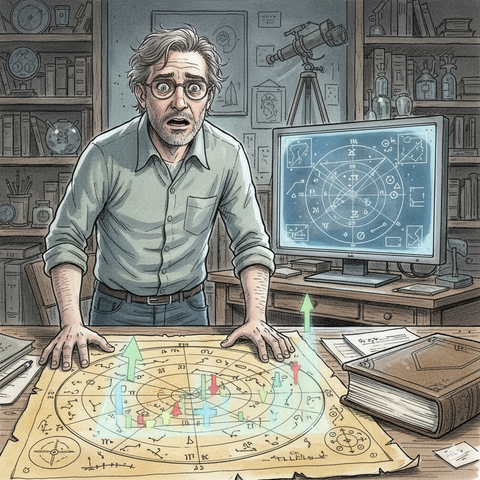


Dr. Lucas Monroe’s penthouse apartment was less a home and more a command center dedicated to the elegant mathematics of chaos. Occupying an apartment in the top floor of a sleek, modern skyscraper, the space was a cavern of minimalist white walls, polished hardwood, and glass. Floor-to-ceiling windows offered a panoramic, god-like view of the city’s glittering nervous system, but Monroe rarely looked at it. The true universe, the one that mattered, was inside, humming with the low, constant thrum of his liquid-cooled workstation
His domain was a study in contrasts, a place where the ancient and the hyper modern were forced into a strange, beautiful synthesis. In one corner, an antique refectory table, its surface scarred with the marks of centuries, was covered in priceless, hand-drawn star charts. Their parchment, yellowed and brittle with age, was carefully backlit on a custom-built light table, making the ancient symbols glow with an inner life. In the other, the sleek, black server hummed in its glass enclosure, its sole purpose to scrape the digital ether for the one piece of data that mattered above all others: birth dates. A shimmering, ghostly projection of the Dow Jones Industrial Average was overlaid on the hand-drawn orbit of Jupiter. The real-time price of gold was a sine wave pulsing gently over a 17th-century woodcut of the Sea of Tranquility. The air smelled of old paper, ozone from the electronics, and the faint, bitter aroma of the brutally strong, single-origin coffee that was Monroe’s only constant companion.
He moved through this space with a quiet, practiced routine, a man whose internal life was a supernova of intellectual activity. He began every day not with the news, but with data. He scanned global markets, political speeches, and celebrity scandals not for their human stories, but as a meteorologist scans pressure systems, looking for the tell-tale signs of an approaching storm. Tragedy, for Monroe, was simply a predictable variable in a staggeringly complex equation.
This morning, the data stream was particularly noisy. He was monitoring a live feed of a local news broadcast on a 75 inch large screen when a face emerged from the pixelated noise. Evelyn Kates. A corporate headshot, professionally lit and faintly unreal, the smile of a woman trying to sell a product. An anchor, a man with a perfect jawline, was narrating a “developing tragedy” in the Palisades with the practiced solemnity of a funeral director. The anchor’s voice droned on, quoting the on-scene Medical Examiner, a Dr. Al-Jazari, who called it “a tragedy of remarkable chemical precision.”
Monroe leaned in, the name a meaningless detail, but the phrase a discordant note. His coffee was forgotten. It wasn’t the flashing lights or the caution tape that made him stop. It wasn’t the hushed, speculative tone of the reporter.
It was the number beneath her name. Age: 42.
A jolt went through him, a surge of pure, unadulterated intellectual excitement. He set his coffee down and moved to his workstation—a triptych of curved monitors that dominated the center of his home. The name, Evelyn Kates, echoed in his mind. A client. Yes, she had been a client two, maybe three years ago. A wealthy, anxious woman obsessed with her financial portfolio, terrified of a downturn. He remembered the chart. It was a fascinating, terrifying mess. His fingers flew across the keyboard, bypassing the market data and opening his proprietary analytical software—the complex charting program he had built and refined himself over two decades. He typed in the name: KATES, EVELYN. The file opened instantly. Her full birth data was already in his system.
The central screen bloomed with the intricate geometry of a life. A circle, divided into twelve houses like the spokes of a wheel, was crisscrossed with a web of sharp, angular lines—some a harmonious blue, others a hostile, aggressive red. Monroe placed a worn, leather-bound copy of his unpublished thesis—The Catastrophe of the Retrograde Return: A Blueprint for Self-Annihilation—onto the desk beside his keyboard. It landed with the satisfying thud of scripture.
The title, dense and academic, was the formal summation of his singular, terrifying finding: that the predictable cycles of cosmic reversals and tension created the perfect conditions for a life's internal flaws to self-destruct. It was not a mystical prediction, but a mathematical blueprint for inevitable, structural collapse.
He watched the program render her fate. And it was perfect. Hideously, beautifully, undeniably perfect.
“A Grand Fixed Cross,” he whispered, the words carrying an almost religious reverence. It was the rarest, most stubborn, and most volatile of cosmic signatures. (In astrological terms, this meant four planetary placements were locked in hostile, ninety-degree tension, creating a structure designed for perfect stability, but with the tensile strength of glass). Her entire identity, the very architecture of her soul, was built on four unyielding planetary placements in the Fixed houses. Four pillars of unyielding ego, wealth, public status, and debt—a life architected for a spectacular, inevitable collapse. He imagined it as a castle with four mighty towers, each pulling on the central keep with immense, equal force. The structure was designed for perfect, unshakeable stability. But it had the tensile strength of glass.
He looked at the transits of the planets for current date.
A new set of symbols appeared on the chart’s outer rim, moving like celestial predators. And there it was. The anarchist. The system shock. Uranus, the great disruptor, was moving into a perfect, ninety-degree alignment with her natal Sun. The planet of sudden, violent disaster was about to collide with the very core of her identity. The detonation signal.
Monroe’s internal monologue was a cascade of triumphant analysis. The pressure is no longer static. The anarchist has arrived to light the fuse. A Grand Cross is a dormant bomb; a hard Uranus transit is the detonation signal. He saw it not as astrology, but as physics. A stable system subjected to an extreme, external shockwave. His theory predicted that the rigid structure wouldn’t just crack; it would shatter into a million pieces. At forty-two, that kind of pressure forces a change. Most people quit a job or get a divorce. Evie Kates had spectacularly failed the exam.
He didn’t mourn her. He studied her with the ecstatic detachment of a physicist watching a century-old hypothesis proven correct in a particle accelerator. He was observing the beautiful, lethal mathematics of fate made manifest.
Then the anchor said something that turned his intellectual champagne to ash. He mentioned police were investigating a “personal correspondence” found at the scene, one that referenced the victim’s “severe moral failing” and the “divine necessity” of the act. The details were vague, but the tone, the philosophical posturing, was unmistakable.
A jolt of ice-water shock went through him, extinguishing his academic glee. He felt a profound, physical sense of violation, as if someone had broken into his lab and was now scrawling graffiti on his whiteboard with a crayon.
The killer hadn’t just stumbled upon the correct timing. They had read his work. They had stolen his philosophy.
His blueprint—the very soul of his thesis—was a four-step sequence targeting the zodiac’s most unstable archetypes. This “correspondence” was the killer’s clumsy, ham-fisted attempt at a philosophical justification. They had found a stubborn, Fixed-sign person—Evie Kates—who fit the first stage of the sequence perfectly. But they had missed the poetry of it, the elegant inevitability. They had turned his science into a vulgar little murder plot.
Next, he knew, would be a Cardinal sign. A leader, an innovator. A high-achieving public figure whose 10th House of Career and Reputation was astrologically primed for total annihilation.
“Amateur!” he hissed, the word echoing in the cavernous space. Professional fury, potent and pure, washed over him. “He’s using the Catastrophe Sequence, but he’s skipping the nuance! The elegance is lost! He’s turning my life’s work into a DIY murder manual!”
The thought was so offensive, so intellectually profane, that it overrode his deep-seated aversion to the outside world. He had to call the police. Not to save a life, but to defend his intellectual copyright.
He stood frozen for a full minute, his hand hovering over his smartphone. To call them would be to invite the barbarians into his sanctuary. He imagined the bureaucratic stupidity, the inane, procedural questions, the sheer, unadulterated hassle of trying to explain a complex theoretical model to a mind that probably still thought the sun revolved around the earth. He weighed the intellectual violation against the horror of social interaction. The fury won.
He found the police precinct number and took a steadying breath, trying to summon a voice of detached authority. It came out as a strangled croak.
“Yes, I require the commanding officer for the Palisades incident. The Kates woman.”
A tired, tinny voice, roughened by cheap coffee and terminal boredom, replied from the other end. “Sir, this is the non-emergency line. Are you calling to report a crime?”
“I am calling to report a gross intellectual and celestial misinterpretation,” Monroe declared, annoyance sharpening his tone. “I am the architect of the cosmic blueprint your killer has so crudely plagiarized.”
A long, weary sigh traveled through the phone. “Sir, have you been drinking this evening?”
“I am sober,” his patience already wearing thin, “and I am telling you that I know the profile of the next victim, and I can give you the timeline. It’s a Cardinal sign whose public status is about to implode. You have roughly three days before the Pluto-Sun pressure (the ultimate destroyer, the revealer of hidden ruin) becomes exact. That’s when Phase Two begins.”
“Pluto-Sun pressure. Right.” He could hear the officer typing, the slow, deliberate clicks of someone filling out a nuisance report. He could practically feel the man’s eyes rolling. “Is that it, sir?”
“Is that it?” Monroe repeated, incredulous. “No, that is not ‘it’! I am handing you the key to preventing the next homicide, and you are treating me like a common crank! Do you understand the temporal urgency?”
“Sir, if you’re claiming to have information about a homicide, I need your name and address. It’s procedure.”
“Your procedure is a blunt instrument designed for a world of simple, linear causality!” Monroe snapped. “This is a different order of problem!”
“I’ll transfer you,” the officer said, his voice flat with dismissal.
After a moment of static, a new voice came on the line—a supervisor. Her voice was different. Not just tired, but sharp, with an edge of professional caution. “This is Sergeant Miller. Am I understanding correctly, sir, that you are claiming to have foreknowledge of a homicide?”
The legalistic phrasing set him on edge. “I am claiming authorship of the theory behind it!” Monroe snapped, his patience gone. “The blueprint is my intellectual property!”
“And where is this blueprint located, sir?” she asked, her voice dangerously calm.
“In secure storage, obviously! Why would you possibly need to—”
The line went dead.
The click echoed in the vast, silent loft. It was a sound of absolute, bureaucratic finality, a small, plastic sound that had just severed his only connection to the rational, procedural world he so desperately needed to influence. Monroe stared at his sleek, black smartphone as if it were a venomous snake that had just bitten him. The professional fury, the righteous indignation of the plagiarized academic, drained away, replaced by a cold, creeping dread that settled in his stomach like a block of ice.
He began to pace, a caged animal in his own private zoo of reason. The smooth, cool concrete was a familiar path, a well-worn track for his intellectual obsessions, but now his footsteps felt heavy, clumsy, the movements of a man suddenly out of sync with his own environment. He replayed the disastrous conversation in his head, a frantic, useless autopsy on a conversation that had been dead on arrival. He had presented them with a perfect, elegant, and urgent set of data, and they had responded with questions about his sobriety and requests for his home address. It was like trying to explain quantum mechanics to a houseplant. Worse, it was like the houseplant had then accused him of being a public nuisance.
His pacing took him past the tv screen, which was now dark, a vast, black mirror reflecting the dim, ambient light of his apartment. He caught his reflection in the polished glass, and for a moment, he didn’t recognize the man staring back at him. He stopped, his own image a sudden, unwelcome, and deeply flawed data point.
He saw a man in his late fifties, a man whose body was a neglected afterthought to a life lived entirely inside his own head. He was too thin, the expensive cashmere of his sweater hanging loosely on a frame that had been subsisting for years on little more than coffee and intellectual fervor. His dark hair, once a chaotic but vibrant tangle that he had considered a signifier of his non-conformist genius, was now just a mess, heavily salted with grey, especially at the temples, a testament to decades of sleepless nights spent wrestling with cosmic equations. His face was not cleanly shaven, a few days’ growth of grey stubble giving him a perpetually distracted, slightly wild look. And his eyes, the one feature he had always considered his primary asset, were magnified behind a pair of functional, slightly smudged glasses, making them look less like the windows to a brilliant soul and more like the desperate, hyper-focused eyes of a fanatic.
He looked, he realized with a jolt of pure, acidic self-loathing, exactly like the kind of crank who would call the police with a theory about the stars.
He turned away from his reflection in disgust and resumed his frantic pacing. His mind, a relentless engine of analysis, turned its cold, unforgiving lens on itself. He performed a brutal, merciless autopsy on his own decision-making process. The objective had been simple: to convey critical, time-sensitive information to the authorities. The method he had chosen? An unfiltered, arrogant, and entirely unsolicited data stream of complex theoretical models, delivered with the condescending impatience of a professor speaking to a particularly dull student. The result? Total, catastrophic communication failure.
But it was worse than that. This was not a simple failure. It was a fundamental miscalculation on a scale he had never before committed. He, the great predictor of patterns, the man who could see the invisible architecture of a person’s self-destruction in a handful of numbers, had failed to predict the most basic, most obvious human variable of all: bureaucratic stupidity. He had not accounted for the simple, linear, and utterly predictable mindset of a police officer, a mind that operated not on the elegant curves of probability, but on the hard, straight lines of procedure.
He had performed the same cold, rational analysis on himself that he had just performed on Evie Kates’s chart, and the conclusion was as obvious as it was terrifying. From their perspective, the perspective of a flat, Newtonian world of motive and opportunity, what had he just done?
He had given them his name. He had given them a precise timeline for the next murder. He had, in his intellectual arrogance, given them a motive: he was the only person who knew the blueprint, the only one who could possibly execute it. He had not just failed to warn them of the coming storm; he had handed them a lightning rod with his own name engraved on it. He had, with perfect, suicidal precision, framed himself.
He stopped pacing. The silence of the loft pressed in on him. The low, comforting hum of the workstation, the sound of his digital universe, now sounded like the whisper of a closing trap. He sank into his chair, the grand architecture of his intellect, the fortress he had built against the messy, irrational world, suddenly feeling like a prison of his own design. He had spent a lifetime proving the elegant, inescapable logic of his system. And in a single, five-minute phone call, he had just been undone by the simple, brutal logic of theirs.
But the humiliation was not absolute. His initial fury, the righteous anger of the plagiarized academic, still burned beneath the cold dread. His theory, the core of his intellectual identity, was not just stolen; it was being butchered, its elegant symmetry replaced by violence. Monroe realized that the only way to disarm the police’s absurd, linear theory of fraud was to reclaim the true, terrifying narrative from the killer. He desperately needed a voice that spoke his language—a mind capable of translating the brutal complexity of his cosmic blueprint for the flat, procedural world that was closing in. He needed an intellectual ally, a collaborator whose academic prowess could justify the catastrophic communication failure he had just committed.
He had only ever wanted to prove the theory. Now, he was trapped in its most humiliating real-world application: disproving his own cosmic genius.









