Chapter 1 The Whispering Sea
Ami Dela Cruz sat at the edge of the pier, her bare feet brushing the tide that licked the wooden posts. The town smelled of salt, wet fish, and the faint sweetness of jasmine drifting from the old houses behind her. Lanterns swayed gently with the morning breeze, their warm glow flickering against cobblestones still damp with the night’s mist. She held her journal tightly against her chest, the leather worn and soft from years of ink-stained hands. Her feathered quill rested delicately between her fingers, poised for the first sentence, the first memory she could offer the town before it forgot itself again.
It had begun before dawn, as it always did after the Fiesta. The town would awaken blank, as if yesterday had never existed.
Shops would open without recollection of their wares, mothers would call children whose faces had already blurred from memory, and even the sea, the steady witness of generations, seemed
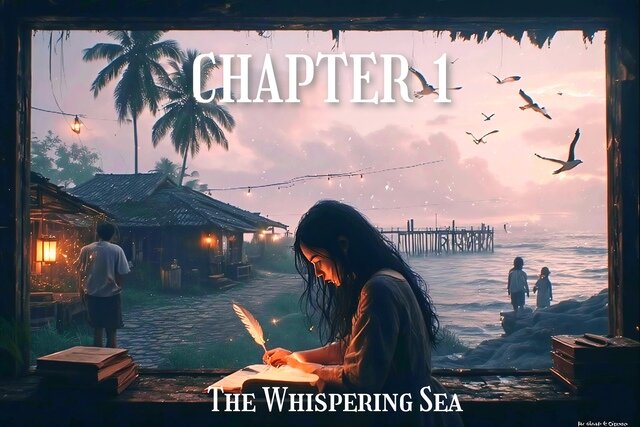


Her necklace, a simple silver chain with a small pendant she never removed, glimmered faintly as the sun lifted its first rays over the horizon. It had been a gift from her grandmother, a babaylan who taught her the old ways—how to honor memory, how to nurture both the human heart and the fragile spirit. Ami had never met her parents. They were part of a world she only glimpsed in dreams and whispered warnings, always half-remembered, always half-hidden. But she had her grandmother’s love and the town’s fading faces. That had to be enough.
A soft splash interrupted her concentration. She glanced toward the water and saw a figure walking the pier: tall, straight-backed, carrying an old canvas bag slung over one shoulder. There was something in the way he moved, the tilt of his head as he gazed at the horizon, that tugged at a memory she could not yet name. The man stopped a few meters away, watching her with cautious curiosity. His eyes, dark and uncertain, flickered with recognition that neither of them fully understood.
“Good morning,” she said, her voice barely more than a whisper.
“Morning,” he replied. His tone was careful, hesitant. He paused, as if testing the air around her, searching for the right words. “Do I… know you?”
Ami tilted her head, a small smile tugging at her lips. “I think you do. I think we knew each other once.”
The man shifted his weight, glancing toward the town behind her. The streets were already coming alive—vendors arranging fruit baskets, children chasing stray dogs, the air heavy with the mingled scent of cooked rice and fish sauce. He exhaled slowly, as if the sight of the town had triggered something deep inside him.
“My name is Ren,” he said finally, as though saying it aloud might anchor him.
“Ami,” she answered, offering her hand, though the gesture felt almost ceremonial. Her quill tapped lightly against the journal, leaving faint ink marks in the margins.
Ren studied her fingers, stained with ink, and the delicate quill poised above the pages. “You… write everything?”
“I try,” she admitted, eyes flicking down at her journal. “It’s the only way the town remembers itself after the Fiesta. If I don’t write it down, it’s gone by sunset.”
Ren’s brows knitted. He bent slightly to peer at the water, the reflection of the rising sun glittering across the waves. “I don’t understand… I remember fragments. Faces, smells, laughter—but it’s like trying to catch sand with my hands. Always slipping away.”
Ami nodded, feeling the weight of unspoken truths settle between them. “That’s why I write. So no one has to feel that emptiness. So we don’t vanish from our own lives.”
From the shadows of the pier, Peter Alonzo leaned against a post, brush in hand and canvas tucked under his arm. His eyes never left Ami. There was love in his gaze, quiet and steady, but there was also jealousy—a subtle, simmering heat reserved only for strangers who could awaken something he could not reach. He had loved Ami since childhood, though she had never noticed the steady rhythm of his heart in her presence. Now, watching Ren, he felt a pang he could not name, as if memory itself had chosen someone else to tether her to.
Ami stood, brushing her hair back from her face, and extended a small, neatly folded letter toward Ren. “This is for you,” she said. “If you remember, read it. If you want… meet me at the lighthouse tonight. We promised once to always find each other, didn’t we?”
Ren took the letter with trembling fingers. The paper felt warm, as though infused with the weight of someone else’s heartbeat. He opened it carefully, scanning the lines written in Ami’s delicate, looping script. The words seemed to pulse with life, pulling at a memory too fragile to hold. “I… I think I do,” he murmured. “I think I remember.”
The tide shifted beneath their feet, drawing a shiver from Ami. The tide shifted beneath their feet, drawing a shiver from Ami. She glanced down at her journal, as if to reassure herself that the world was still intact, still real. The sea whispered along the wooden posts, a voice older than the town, older than anyone in it. It carried secrets she was not yet ready to fully understand—the stories of magindaras hidden beneath the waves, the whispers of Ikran who walked among humans, and the fragile promise of a girl who wore her heritage like a chain of memories around her neck.
Ren looked out at the horizon, the sun rising higher, igniting the waters in a cascade of gold and copper. “I don’t know why… but I feel like I’ve been waiting for this,” he said. “Waiting for you.”
Ami smiled softly, closing her journal and tucking the quill into her bag. The warmth of the morning breeze lifted her hair, brushing against her cheeks, carrying the scent of salt and jasmine. “Then don’t be late,” she whispered, almost to herself. “The lighthouse… at dusk.”
Peter’s brush slipped slightly across the canvas, smearing a streak of color. His jaw tightened. The scene before him—Ami, the stranger, the awakening town—felt both beautiful and unbearable. He dipped the brush back into the paint, trying to capture the moment, trying to hold it still, knowing that memory itself would not wait.
The pier creaked beneath them as Ren stepped closer, their shadows merging briefly with the morning light. Ami’s necklace caught the sun, glimmering faintly. She didn’t speak of what it meant, not yet. There was power in silence, and the town’s own forgetfulness left her words suspended in the air, waiting for the right moment.
As Ren walked toward the town, letter in hand, Ami lingered at the edge of the pier. She watched the waves curl around the posts, whispering her name, teasing at secrets she had yet to uncover. Her grandmother’s teachings reminded her that the sea was patient, that time could be coaxed into memory if one had faith. Ami placed a hand over her journal, feeling the pulse of her own heart echoing across the pages.
The sun climbed higher, brushing the rooftops with light. Birds called from the rafters, and the town began to hum with its tentative awakening. Ami turned, heading toward the market with its colorful stalls, her journal clutched close. Every step was a reminder: she was the keeper of memory, the girl who would not let the town vanish, and perhaps, if the tide and time were gentle, she could also reclaim fragments of herself.
She paused, hand resting on the edge of the first stall, and wrote a single word on the page: Remember.
The sea sighed, and the morning stretched long, endless and luminous, carrying promises yet unspoken, love yet untested, and secrets waiting just beyond the horizon.