Prologue
The man on the bicycle turned left onto the gravel road. The old light-grey bicycle was covered in dried mud and rust stains. It looked as though it had carried many miles, many bodies, many silent journeys. With every pedal stroke it gave off a dull, complaining creak, as if protesting that yet another journey was beginning. The gravel crunched hard beneath the wheels, the sound bouncing briefly between the ditches before fading away.
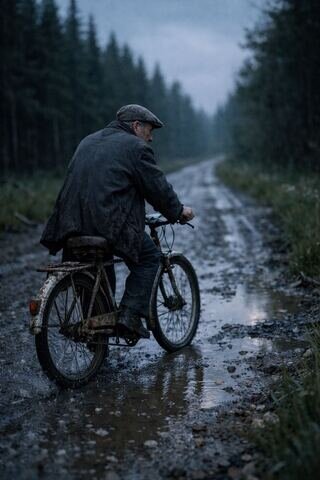


It had rained recently. The road was softened, broken up. Puddles of cloudy, muddy water lay scattered like wounds in the ground, reflecting a pale sky. At times the bicycle tire cut straight through them, leaving behind ripples that slowly spread and disappeared. The man did not slow down. He rode straight through, as if he did not see them or did not care.
He looked tired. His shoulders were hunched forward, his back rounded by years or by burden. His face was stiff, his gaze fixed somewhere ahead of him, unfocused. The bicycle wobbled slightly on the lonely road, as if its balance might give way at any moment. Each pedal stroke was heavy with effort, not only in his legs but in his entire body, as if the movement required more will than strength.
On both sides of the road ran ditches, covered in wet grass and whitening yarrow umbels weighed down by the rain. Where the ditches ended, the forest began. Dense. Dark. The spruces stood close together, straight and tall, their branches pressing in around the trunks and shutting out the light. The forest was strangely silent. No birds, no rush of wind. Only the creak of the bicycle and the crunch of gravel.
The dark spruces rose like a wall, as if they were slowly leaning in toward the road. As if they were reaching for the man, waiting, ready to close in behind him and draw him into their cool, shadowed depths.
The gravel road gradually leveled out. The forest loosened its grip, and the sound of the spruces’ silence was replaced by a strange sense of openness. The man pedaled a few final, heavy turns before the bicycle slowed on its own. Ahead of him rose a gate.
It was large and arched, divided into two sections of black iron. The bars were coarse and cold, with ornaments that had once been decorative but now looked more like wounds in the metal. The iron was mottled with rust. The paint had peeled away, leaving surfaces bare and dull. The two gate leaves were fixed to concrete pillars that had crumbled under time and weather. Cracks ran through the concrete like veins. Small stones lay fallen at their feet.
The man stopped. He set one foot down in the gravel. The bicycle creaked one last time and fell still.
Beyond the gate the road continued, but it was no longer just gravel. It narrowed and was drawn in between an avenue of old oaks. The trees stood close, tall and broad, their crowns closing over the road and casting heavy shadows across the ground. Light filtered down in patches, shifting slowly as the leaves moved in the faint wind.
At the far end of the avenue lay the manor house. Dark. Heavy. It rose out of the shadows as if it had always been there, unmoving and watchful. The windows were hard to make out. The façade swallowed the light rather than reflected it. That was where the gravel road led. Straight ahead. No side paths. No turning back that felt obvious.
The man stood there for a moment. Then he took a deep breath and rolled the bicycle toward the gate. He opened one side of it with a single hand. Its shrill, ungreased cry cut through the forest. And then everything was completely silent again.
He led the bicycle through the gate. He did not bother to close it behind him, as if it were an open, futile escape route for whatever was to come. He took a deep breath and then began the final stretch of the ride toward the manor.
“You are late,” said the Master.
The voice came from the shadows by the steps leading up to the main entrance. It was calm, low, yet carried effortlessly. The man on the bicycle flinched as if the words had struck him physically, like a whip across his back. He braked sharply and rolled the last few inches in silence before stopping.
He dismounted. The movement was quick, almost reflexive. He lowered the bicycle’s kickstand. With one hand he removed his dark grey cap and held it tight against his chest. He bowed slightly, a brief, practiced gesture not deep enough to be servile, but clear enough to show that he knew his place.
The Master on the steps stood one step higher than him. Large. Broad-shouldered. The coat hung heavy on his body, making him seem even more massive. His face lay partly in shadow, but his gaze was clear and fixed. It rested on the man before him without haste, as if time meant nothing to him.
“I’m sorry,” the man with the bicycle said softly. His voice barely carried. He did not dare meet the gaze, letting his eyes settle instead on the edge of the steps, on the worn stone treads leading up to the door.
The Master said nothing more. He remained still, as if weighing something unseen. Letting the silence stretch out. Only when it began to feel heavy in the chest did he slowly turn toward the manor’s dark entrance.
“Come,” he said.
And the man followed.