
The Farmer
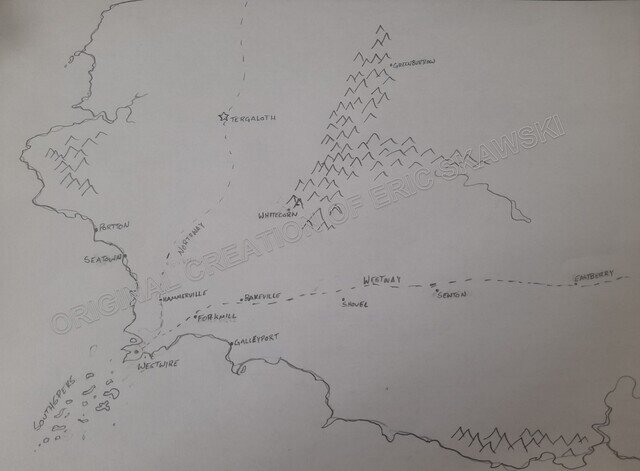


Mertur was a conqueror. That much was plain. In fifteen years, the man had conquered almost the whole continent, forcing the remaining kingdoms to bind together in alliances. The land of Merturia was a land of dark magic, and Mertur was a dark wizard, or so they said.
The war had come to Sewton ten years ago, no matter what ‘they’ said, they all agreed on that. Rumour had it that many darker things dwelt in the forest now, and according to the fathers of the villages, that much was true, too. No man dared venture off the path, lest he be taken by a vampire, a goblin, or worse. Mertur also had a penchant for killing, and they said he had killed off the great giants, the mighty wizards, and the powerful witches. Some also said that in the land of Merturia, lords and captains changed alliances strangely, as if they had always been devoted to him from their first breath.
Whoever they were or whatever they said, it wouldn’t change the truth of Kevin’s life.
Kevin was a poor farmer in the land Merturia, on a farm outside the town of Sewton. Kevin had been a small boy when the soldiers came, only eight. He was eighteen now, and he found it hard to care one way or another who ruled the land and how they came to rule it. He did have to admit, however, that life under Mertur had a certain oppressive quality. From the stories his father told him, men didn’t always have to fear the forest. They didn’t always have to light candles at night or beware what came from the darkness. Wizards and witches, once helpful to the villages, spreading goodwill and helping out even the lowest of serfs, were now distant memories.
Of course, there were other ways of seeing an oppressive regime. Much more of his crop was taken now, to feed the soldiers on other fronts. The lord demanded higher taxes, which meant he had to grow more food, meaning they could not afford to leave the fields to fallow. This meant more work, and harsher soil. And pennies and iron pieces were taken out of circulation in order to salvage the metal, forcing the price of all the goods to go up. Mertur had nearly the whole continent under his control now, save for a small but well-defended kingdom to the east, and lands northwest. There were islands to the south as well that were not completely conquered.
Fortunately, the war had mostly missed the small nearby town of Sewton. It was a short walk along a dirt road, where it sat on the edge of a forest on one side, and in front of fields on the other. The mayor was little more than a peasant himself, the only difference being his house was larger and made of brick, where everyone else had to use wood or cobbles with thatched roofs. The mayor got a last name, too. He was the only person in the town with a last name.
But Kevin was without question a farmer. He would always be a farmer, just as his father was, and his grandfather before him, and so on, for uncounted generations since the beginning of Arrealma. Not always on this farm, perhaps, but on farms just like it. He didn’t consider farming a poor job (though it was), but he had still dreamt about travelling and new experiences. All his life, he’d never left Sewton. Yet, Kevin yearned for adventure! They’d sing songs of his journey! Or at least they would, if he were not so poor.
As a boy, Kevin had often pretended to go on adventures. He would steal princesses, save towns, slay dragons and somehow he’d never run short of food or money. His opponents had been leaves and trees and rats, and whenever he went hunting with his older brother, he’d pretend the rabbit was a fearsome troll. Not that he hit it too often. His brother never seemed to care, though. Jake had once humoured him and pretended to be a dragon, and pretended to lay slain when Kevin poked him.
Adventure was a thing that lowly peasant farmers would never get, though. He couldn’t even read, and they had no money for him to learn. Kevin had learned not to expect adventure from the world the summer after Sewton had been conquered.
His father’s fields had been burned, his crops trampled by the rampage of an army. Kevin didn’t even know whose side they had been on. It didn’t really matter. With Jake’s help, they salvaged enough of the crop that they might have a better harvest next year. The battle was won by Mertur, but either way his family would have lost. A lord came, removed Sewton’s old mayor, and took three-quarters of their already shortened crop! And, when that was done, told them to be grateful he hadn’t taken more!
Jake had died that year. They had very little food, and the winter was a brutal one. Jake was found one night skeletally thin, having starved to death. Kevin had wept all night when he learned. That, he thought, was the night he’d grown up. That was the night he learned what being a peasant truly meant.
Somehow the rest of them made it through the winter, and replanted, but Kevin had learned the hard way not to dream of adventure or glory. There was none for his ilk. Farmers were the ones that died, not the ones that slew dragons or stole the hearts of princesses. They were in the background, fixtures on the landscape, not heroes. The yearning of the world is not quenched easily, however, and though Kevin never again played at swords, deep down, he still had hope that one day he could go on a small adventure.
Perhaps that was why he was leading his family horse into town, riding on a large wagon full of crops. Perhaps if he sold enough at a fair price, he could at least see another town. Middest, to the east, or perhaps Westwire, but that was much further away. He didn’t have to do it – his father could easily have done it, or his sister Anne, and his six-year-old brother Mark needed practice. But Kevin was a good haggler. And they needed a good haggler, because Mertur was looking to make a great many free peasants into serfs. Serfdom was not practiced in the old kingdom that had governed these lands, and Mertur was looking to change it, particularly by forcing the peasants to become so poor they had no choice but to offer their labour, or starve themselves.
He had nearly reached the town, at the edge of a forest next to the long westward road, called the Westway. One good thing about Sewton, it was the only town near the road for days, and there was always at least one traveller eager to share his stories. It was like a small adventure of his own. The ones he’d dreamt about, with dragons and wizards and fairies and trolls, swordfights and potions that turned his enemies into funny animals, and unicorns. He’d always wanted to see a unicorn.
But he could not go on an adventure right now, even if he did have the time or the money. His father was sick and getting sicker, and needed him. His mother and siblings couldn’t do it on their own. It seemed more depressing when he looked down at his ragged clothes and tattered shoes.
Jake was not the first child his family had lost, either. A famine had struck the kingdom when Kevin was two, and he and Jake barely survived. Their oldest child, Kevin’s older sister, was not so lucky. She’d be twenty-two now, if she’d lived. Now it was just Kevin, his parents, his brother Mark, and eleven-year-old Anne. He hoped the tradition of the oldest children dying in their family had ended with Jake. The saddest part was that Kevin couldn’t remember his sister, just as Anne couldn’t remember Jake.
His horse pulled the cart into town. The town depended on foreigners for outside wealth, and so had devoted itself to drawing in as many travellers as possible. The market was almost the entire town, built within a square surrounded by stone buildings, and only one street of homes for the non-farming citizens. Aside from the market, there was a blacksmith, a large inn with a tavern, and the mayor’s house. It sat on the southern side of the road, which was wide open with farmland. North was the wide, private woods of the lord, not that he ever used them.
Normally all their crops were sold to the miller in exchange for bread, or taken by the government, or stored for the winter. But this was early spring, a new round of crops was coming up, and Kevin’s family actually had extra food. On those occasions, they took some of the better crops, and sold them in the local market. That way, they had a good cushion for tax time, and might be able to stave off another famine. Kevin approached his family’s usual stand. The owner of the lot, Duncan, was there waiting for him.
“Hello, Kevin.” he said. “You have the payment?”
Kevin tossed him the last of his family’s money; three copper coins.
“A little light today.” he remarked.
“It’s all we have, and you know it’s worth more than this stand.”
“It’s not the stand’s quality, it’s the location.”
“Which still isn’t worth three coppers. More like three pennies. I’ll give you ten percent of the sales today to make up for it, like usual.”
“Aye, and if you’re as hard on your customers as you are on me, you’ll make me a rich man. Very well. Three coppers, but you’d better make it worth it.”



![Werewolf Hollow [GALATEA DATE TBA]](https://cdn-gcs.inkitt.com/vertical_storycovers/ipad_76bbf380fa2e8dc2f70694197487ab81.jpg)










One way to fix the slow start would be to start the story on chapter 3 and incorporate all the worldbuilding details into the story as Kevin conducts business and starts traveling (basically starting "en medias res"). A lot of the details, like the mayor's house or the coins being taken out of circulation don't seem to be necessary at this point in the story (unless they come up later and I just haven't read enough); I think the anecdote about Jake's death is more than enough to show that these are tough times. Personally the writing style is enough to keep me hooked though (I also really like the dialects in the dialogue).
What a fun way to start, with that poem! I picture it sung by a bard sitting in a hall lit by firelight, getting ready to tell the tale to the waiting audience.
it was an interesting beginning! Now I want to know what happens to Kevin next. He deserves a better life 💖