
APPENDIX: WORLD GUIDE
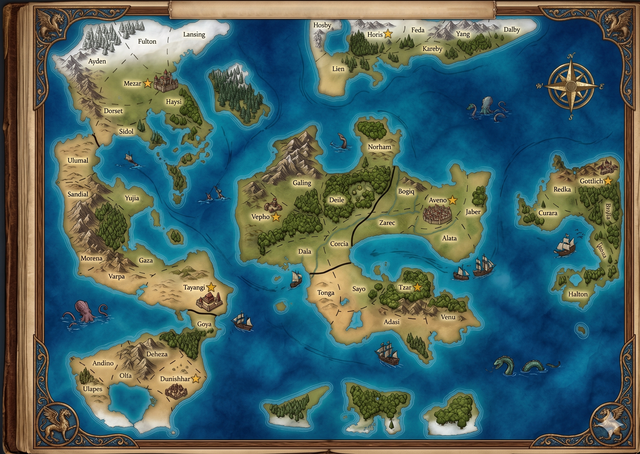


GEOGRAPHY & LOCATIONS
Figmar: One of the central nations of the narrative, ruled from the shadows by a ruthless political body.
Vepho: The capital of Figmar and the seat of power. A city of marble and luxurious gardens built upon fetid dungeons and bloody conspiracies.
The Out-Once: The neglected, rural outskirts of Vepho. Defined by mud, extreme poverty, and hovels, it serves as a home for the forgotten and the fugitives of the realm.
Lake Ithec: Located deep within the Out-Once. A lake of deceptive natural beauty, surrounded by a hostile, damp, and swampy environment.
Samaya: A country battered by constant storms and a merciless, frigid climate. A harsh land where hope and resources are scarce, and death is a constant presence.
Horis: The capital of Samaya. Renowned for its freezing, melancholic architecture, it is the bureaucratic and mystical heart of the country.
The Convent (Horis): A sinister institution where initiates subject themselves to extreme physical trials and near-fatal deprivation in search of enlightenment and visions. It also houses the Ministry of Scribes and its vast Dead Archive.
Huosh: An authoritarian and lethal nation, famous for its oppressive red-brick architecture and the militarized, suffocating control it exerts over its populace.
Tayangi: The capital of Huosh. A metropolis of profound contrasts. Its core consists of districts of excellence, marked by an imposing yet cold and austere wealth. However, this clean order contrasts violently with its industrial peripheries, permanently coated in volcanic dust and inhabited by desperate laborers.
Ignis (“Hell’s Mouth”): The colossal volcano that dominates the peripheral horizon of Tayangi. It operates as both a furnace and a lethal mining excavation, spewing black smoke and sulfurous vapors.
Puruth: A ruthless city-state. Its society is a true, highly militarized “forge of blood,” famous for resisting massive empires and training warriors from childhood.
Toprak Empire: A despotic empire feared across the continent. Its army consists of battalions marching in armor of absolute, matte black, designed to devour light.
LAWS, MAGIC & PHYSIOLOGY
The Golden Rule (Absolute Focus): The irrefutable law governing magic. The human brain cannot process two “miracles” simultaneously. To alter the physical world, the practitioner must focus entirely on a single action.
Magons: The practitioners of magic (often dubbed “The Plague”). Magic is not a benevolent gift; it is extorted from the body at brutal physical costs.
Basal Magic (1st Lineage): The manipulation of pure kinetic force. Allows the creation of invisible force fields or the movement of heavy objects.
Elemental Magic (2nd Lineage): Merges basal capabilities with the visceral control of the elements (fire, earth, wind, water). They are considered the “weapons of mass destruction” of armies.
Molecular Magic (3rd Lineage / The Myth): A terrifying legend even among the Magons themselves. The theoretical ability to ignore the laws of nature and transmute matter at the atomic level.
Bhagya: A passive and highly traumatic prophetic trance. Clairvoyance is only induced by pushing the human body to the absolute brink of biological failure.
Nadarins: Individuals born with physical and biological properties exponentially superior to those of a common human. They possess unbreakable bones, colossal muscular strength, and predatory agility, making them living weapons in hand-to-hand combat.
The “Strange Illness” / The Plague: A lethal pestilence that ravaged Samaya in the past, marking its victims with black veins and suffocating them.
FACTIONS & SOCIETY
The Council of Ministers: The supreme political force that rules the kingdom of Figmar from the shadows.
The Colossi: Figmar’s elite guard. Monstrous men, over two meters tall, clad in heavy, lethal armor.
The Scribes: Scholars and bureaucrats tasked with interpreting ancient scriptures, unearthing dead dialects, and maintaining the official records of the realms.
Puratha: The barbaric ancestors of the Puruth region. Brutal warriors who spoke an ancient dialect, long considered dead by academics.
CHARACTER COMPENDIUM
Ptosi: The legitimate heir to the throne of Figmar, living under the austerity of a self-imposed exile in the swampy lands of the Out-Once.
Ran: A young, stubborn Scribe of the Convent of Horis, willing to sacrifice his own sanity and biology in search of answers about his world’s past.
Brian: A former elite guard stationed in the dungeons of Vepho, accustomed to surviving in the darkest corners of the capital.
Sage: A relentless Elemental Magon. A lethal, pale figure whose abilities defy physics itself.
Neza: A traumatized war veteran who survives however he can in the Gardens of the Vepho Palace.
Master Liam: Once a brilliant healer in the capital of Samaya, now a broken man haunted by memories of the Plague.
Phie: A talented and pragmatic Scribe, responsible for handling restricted documentation in the Ministry in Horis.
Master Chui: An old Scribe who guards access to the dead and heretical archives of Horis.
Theo & Kyros: Miners living in the shadows of Tayangi’s volcanic periphery, crushed by the capital’s industrial machinery.
Chin: A survivor from the outskirts with unusual military training and lethal marksmanship.
Dust: An old, calloused, and loyal dog, a silent companion on the shores of Lake Ithec.







![The Moon's Weapon : the cursed mate [ MOVING TO GALATEA]](https://cdn-gcs.inkitt.com/vertical_storycovers/ipad_123f31099804e79c6de11657975bcaae.jpg)








I really love the map—it adds so much to the world! The glossary is also detailed, but personally I felt it’s a lot of information to take in at once. I think introducing terms step by step in the story could make it easier for readers.( Like in story notes or in chapter )
Presenting the world as a map is a fantastic addition.
The glossary is a great idea too. Although personally, I prefer to discover the terms within the story and feel/experience their meaning. Especially in the online reading community, I’d advise you to only post the map here in the first chapter and refer to the glossary in the very last chapter. But that’s a matter of taste.
What gripped me enough to open the story? The keywords and the cover. Both trigger something in me. Just so you know.