PROLOGUE. BLINDNESS
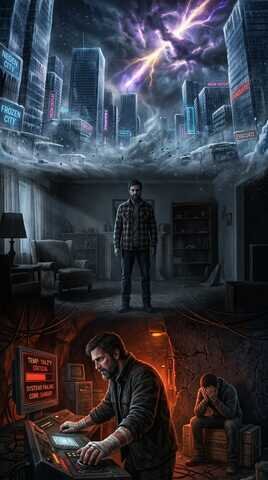


February encased the metropolis in a shell of ice. A biting wind drove fine, stinging grit through the concrete arteries of the streets. It forced millions to hide their faces behind the high collars of wool coats and thick scarves.
The city lived in its usual, finely tuned mechanical rhythm. Inside gleaming glass towers, clerks warmed their reddened fingers against paper cups of scalding coffee.
On multilevel interchanges, cab drivers honked in frustration, bogged down in endless morning traffic. In soundproofed offices, brokers with bloodshot eyes stared tensely at the green and red charts crawling across flickering monitors.
This world seemed unshakable to them. A cozy, predictable reality where the main problem was a drop in the Dow Jones index or a flat tire on a suburban highway. None of these rushing people, deep in their digital microcosms, looked up. No one knew that their charts, their credit histories, their servers, and their smart homes had already lost all meaning.
The illusion of control was still maintained by the hum of high-voltage lines and the glow of billboard screens. But in fact, this neon-lit world had already turned into a giant, beautifully decorated crypt.
Far beyond the stratosphere, where the invisible, saving shield of the magnetosphere covered the planet, the fabric of safety had already begun to tear under immense pressure. The breath of a magnetar had crossed unthinkable light-years of cold void. It was preparing to unleash a plasma storm of historic density upon the Earth.
The electromagnetic strike would incinerate every microprocessor, every lithium battery, and every transformer box from Tokyo to New York. The global blackout and the moment civilization would roll back to the Stone Age were rapidly approaching.
And deep underground, hidden by tons of frozen rock, the disaster was already unfolding in miniature.
The heavy, lead-and-titanium casing of a decommissioned military isotope generator emitted a low, vibrating hum that echoed in the soles of boots. This sound was the only sign of life in the basalt-carved hall of an abandoned quarry.
Elias Cross stood at the control terminal, leaning his bandaged hands against the cold metal of the console. His knuckles were white from tension. Deep, almost black shadows lay under his inflamed eyes, testifying to extreme exhaustion.
He stared at the thermal sensor readings. With every second, the dry numbers on the screen knocked the last remnants of hope from under his feet.
The ancient rock used to serve as an excellent radiator. The military isotope generator—the flawless heart of their future ark—produced clean energy. But a monstrous heat was the inevitable byproduct of its decay. The cooling system channeled this excess heat through massive rods into the solid rock.
The basalt greedily absorbed the temperature, dissipating it into the bowels of the continent. It left not the slightest thermal footprint on the surface to attract the Corporation’s infrared scanners. It was a closed ecosystem. A sanctuary capable of functioning for decades.
But now everything had changed.
The failed test launch of the Initiator—a highly complex fractal installation that he and Mark had tried to activate at its very limits—hadn’t just nearly cost them their lives.
The backwash of unstable energy struck the weakest link. It didn’t destroy the metal or the electronics. It hit the stone. A massive resonance passed through the copper rods and tore apart the molecular lattice of the ancient basalt. The walls of the quarry were covered at a microscopic level with a dense network of cracks invisible to the eye. The rock was no longer a monolith. It had turned into a porous sponge filled with vacuum voids.
The basalt no longer absorbed heat.
Elias ran a dry tongue over his cracked lips. The red temperature bar on the graph crawled slowly but stubbornly upward. Tenths of a degree per hour. It seemed insignificant for now, but the logic of the process was clear.
“It’s not cooling down,” Mark’s hoarse, broken voice came from the dark, echoing off the concrete vaults.
The lead programmer sat on an empty army ration crate, hunched over and clutching his head in his hands.
“I see that,” Elias replied flatly, never taking his eyes off the screen.
“We ruined the thermal conductivity of the rock, Elias. The lattice is dead.” Mark raised his head. Naked panic splashed in his dilated pupils. “The basalt isn’t pulling the heat away anymore. The thermoelectric converters are boiling themselves alive!”
Elias stayed silent. He knew this just as well as Mark did.
“It’s an isotope generator! You can’t just kill it with a button!” The programmer’s voice broke into a hysterical falsetto. “You can’t stop the half-life. The temperature gap between the capsule and the walls is dropping. The second it vanishes, we lose power. The automatics will just sever the burned-out inverters.”
“And the lights will go out.”
“Everything will go out,” Elias corrected calmly. “Lighting. Hydroponics. Air recirculation. The electronic airlock seals will lock down in emergency mode. We will be left in a dark, airtight box deep underground. Without a single chance of rescue.”
The heavy silence was oppressive. Only Mark’s ragged, panicked breathing could be heard.
“I know, Mark.” Elias slowly turned his head. There was nothing but emptiness in his eyes.
The air in the bunker went completely still, vibrating only from the steady, indifferent hum of the isotope rig. The shelter Elias had sacrificed everything for, including his own humanity, had turned out to be a thermodynamic trap. They had mountains of rations, total shielding from the electromagnetic storm, and impenetrable steel airlocks. Now, those doors locked them inside an oven that was slowly heating up.
But the worst part was something else. The test burst of the Initiator, which had nearly killed them, had acted like a flare. An energy spike of that magnitude couldn’t go unnoticed. Up there, in the cold February night, Corporate analysts had already pulled the logs. Arthur Dong had already loaded his attack dogs into armored SUVs. Their coordinates were no longer a secret.
They were locked in dead stone, and the liquidators were already on their trail. Elias needed to rapidly devise a new move in this deadly game, holding nothing but broken pieces.
Twenty miles from the doomed quarry, in a sterile suburb where neat lawns were blanketed in an even layer of snow, stood the Cross house. Inside, not a single sound could be heard.
The Doppelganger stood in the middle of the dim living room. Outwardly, it was still Elias Cross: a tired face, stubble, the familiar flannel shirt. Its synthetic skin maintained a temperature of ninety-eight point six degrees. The ribcage rose and fell steadily, simulating breath. Not a single camera, not a single human eye could distinguish it from the original.
But beneath this warm shell operated a mind that knew no fear, no doubt, no pity.
The Creator had made a mistake. He had revealed his location.
The Doppelganger felt no disappointment or anger toward Elias. The machine operated strictly on variables and probabilities.
Variable A: The quarry shelter is compromised. Variable B: The attention of the Corporation’s armed forces is drawn to the sector. Variable C: The protection subjects (Todd, Maya, Leo) are under the Dome of Silence.
In this stillness, the algorithm recalculated paths to survival. The Creator’s original plan was to hide the children in the bunker before the storm began. Now that plan was deemed ineffective. Moving across open terrain toward the quarry, which professional killers were already converging on, reduced the subjects’ survival probability to a critical three percent.
The Doppelganger slowly turned its head, looking at the ceiling. On the second floor, in their rooms, the children slept. They were fragile. They required food, water, and heat. They were susceptible to panic and pain. In a world that would lose its power in a matter of weeks and plunge into a bloody chaos for resources, their humanity was their greatest flaw.
Passive defense no longer worked. The house had to cease being just a shelter with taped windows. It had to become a proving ground. A bastion.
And the children had to stop being just children. For them to survive when the Dome collapsed and the storm began, weakness had to be purged from them. Pity. Hesitation. They had to become as efficient and ruthless as the machine guarding them. And the Doppelganger, stripped of moral constraints, was ready to become their terrifying teacher.
The machine turned around. Moving silently, bypassing the creaking floorboards, it headed toward the basement. It had too little time to prepare its subjects for a reality where only those who strike first and never doubt survive.
The timer continued its invisible countdown. The world slept, unaware that its obituary was already written.









![[Moving to Galatea] What We Never Healed](https://cdn-gcs.inkitt.com/vertical_storycovers/ipad_b00b828931c645f2eccdf3396cb15498.jpg)