
1


“He was insane. And when you look directly at an insane man all you see is a reflection of your own knowledge that he’s insane, which is not to see him at all.” - Robert M. Pirsig
My feet had become the center of my consciousness by the time I entered the San Miguel River Valley. Forever searching for the next grind of asphalt, the next step closer to a bend in the road, the promise of some ending. Thoughts hovered like atoms lost in a fog of muted pain— catching, colliding with their neighbor within the confines of a hardened mind; Thoughts that never changed, for the mind had only enough energy to stir them about, to repeat, repeat, silently repeat the extension of their syllables, and never put them on the tongue. By their own accord, my blistered feet traced an indirect course South, in parallel to the ledge of a desiccate highway, where things went to perish and turn to salt on the black tar.
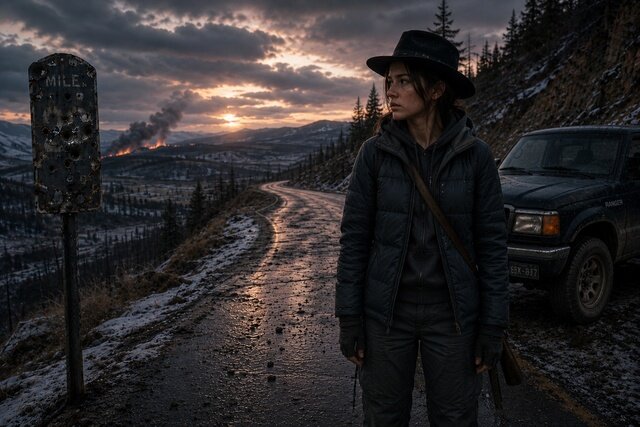
Beneath me, the pavement was oxidized from a night of cold weather, and the air tasted of it—an aftertaste of char and sulfur at the back of the tongue. Somewhere in the distant South a fire burned. Manmade. Or perhaps a wildfire sparked by what people had come to call ‘ghost surges’ currenting through the country’s ruined power grid. Occasionally I passed acres of once-forestland, now barren charcoal hills still smoldering with moribund embers.
My eyes narrowly caught sight of a sign— a mile marker— to the right of me. The head of it was peppered with bullet holes, and with the paint peeled back, the numbers were illegible. The bullet holes looked fresh; not yet rusted. It meant someone had been here recently, and stayed long enough for target practice.
No good to linger here, I thought to myself, yet remained where I stood.
The sign taunted me. I had never bothered to keep track of time and distance as the months slipped by, but now, so close to the end of this journey, the miles stretched, and I desired a means of counting them which no longer existed.
Unable to read the sign, I was reliant on memory to guess the distance from home. But my memory was soft from the years spent away, and the truth was, time had betrayed me. I had been gone too long. Nearly eight years. Enough time for me to change and not for the better.
I had forgotten the important things.
And that very well could be the death of you, I pondered. I’d returned with imprudent confidence in my ability to bear the brutality of the San Juan mountains as I had as a young girl. But death had been intertwined with my fate for so long that rarely now did I feel the real threat of it. Perhaps that was how I had managed to survive for as long as I did. Always half a step away from the edge.
Lifting my eyes, I watched the sun rise behind clouds, the sky shifting from lavender to grey. I lost myself in the light until the shadows grazed my skin and I shook my head, as if jerking out of a cold sleep. I breathed a curse and squeezed my eyes shut – to block thoughts in rather than out. It was getting worse—the long stretches where my mind strayed from my body, neither here nor there. A day might come when my wits departed and did not return to claim me.
The loneliness is rotting you out. You’ll be as mad as your mother by the end of this.
I shook my head, wrung the nerves from my wrists, and touched a hand to my temple. My head hurt more than I cared to admit and the events of the prior week lingered in the stern of my mind like an ache that promised never to grow or ease with time but only persist out of stubbornness. For better or worse, the ache would linger for many weeks more if I lived that long.
Somewhere in the vague above air contracted, thunder rumbled. There was a long stillness—and then it started.
A gentle groan. Machinery on its last wits lowing from the distant north, yet near enough to warrant me putting an ear to the air, and, like a startled fawn, dart into the foliage lining the highway. Peering through evergreen boughs, I sat and watched as the machinery—an old Ford Ranger—languished uphill. The truck’s paint job was badly chipped, the frame dented, the hood coated with dead bugs. A threatening crack ran along the outer right edge of the windshield, casting a long snaking shadow across the faces of those inside.
Exhaust fumes spewed from the truck’s tail, circulating a noxious blend of biofuels that caught in the wind and poisoned my nostrils. The fuel corroded the inner organs of the truck, bound to tear apart the engine. Which would be no great loss to its passengers. When the time came when the engine at last gave out, its occupants would simply move onto the next abandoned car sitting idle and thirsty for the gallons of petroleum being guarded within the interior of the truck. They could have the last petroleum in the country, I pondered, Or the world. That was possible. There were no true means of keeping track of such things Now; No way to know how the world had changed since the painful dissolution of the American government, the bombings and deaths of millions, the collapse of the electricity grid and internet.
The truck came to a pause close enough that I could hear Led Zeppelin blaring from the stereo. Both doors thrust open at the same time, from which three young men dressed in camouflage, heads buzzed and unprotected from the chill, emerged sluggishly, and circled to lean against the front bumper. They stared toward the precarious stretch of highway set before them; each soldier intent on judging the truck’s fortitude and their driver’s ability to ascend the next hill. Poor luck and the truck would stall, hurtling the three men down an icy slope angled ever so for the river. Or the engine would fail, leaving them deserted. The stretch of narrow highway on which they stood was not a destination. Not for anyone, not even Before.
The driver was a scrawny, nervous thing, and though one of his passengers tended a gun, they looked a particular type of easy kill I might have pursued had I a gun of my own. They would not survive long out here.
“—too fuckin’ steep, George,” spat the one with the gun, “You stall us out on that hill, we’re as good as dead.”
“We’re dead if we return to base having burned three quarters of a tank.”
“It’d be better than spendin’ a year of our lives stationed in Dolores. That pisshole aint got nothing but dirt and senile fuckers.”
“Ahh we’ll let you be the king of it, asshole. Just let me get you there, will you?”
The wind changed. They huddled together and shared a single cigarette, each taking a long, fastidious puff before passing it off to the next wanting hand. A bottle of whiskey was tossed in between until the cigarette glowed red and was thrown to the ground; stamped out with a boot; the men’s tempers soothed by a dose of nicotine. The wind died and the men exchanged wary looks.
“I say we turn this piece of junk around, go west, hunt dodgers,” the gunman prompted.
The driver showed teeth. “What the hell they teach you on that airbase? This is the Army, Corporal. You follow directives, simple as that.”
The gunman threw his body away from the hood of the car and stepped into the middle of the highway, two feet straddling the middle white line. His complexion, once pale, grew as red as last night’s sunset, and I began to wonder if he was not altogether stable in the head. “You just compare me to one of them rats?” he asked coldly.
“Yeh, I did. If you don’t serve the Army, yer servin’ the Russians.”
“I spent six goddamn months on the line. Everyone in my unit dead. And you’ve got the nerve to compare me to a rat,” he scoffed. His voice never raised, but I saw the tension gripping his muscles.
I knew what would happen well before the men had gathered their intentions. At first it was just a couple punches, but it never amounted to just a punch with these soldiers. They had seen too much violence; sacrificed too much of themselves to remember a time when conflict did not end in death. Eventually a pop echoed off the canyon walls, then another. The crows startled from their branches. The magpies stayed to watch the violence; such was their way.
Blood leaked from the driver’s head and drained off the tarmac at a slant, and we all sat and watched life leave another body. There was little significance in the moment. As inconsequential as a cough.
Hushed, threatening words passed between the remaining two men, their voices lost to the wind. I could only watch as fear spread and warped across the unarmed soldier’s face while a gun shifted in his direction. He stared the gun head-on much longer than I would have given him credit before doing the wise: darting across the asphalt and throwing himself into the woods. He was twenty paces to the right of me, making a clean charge toward the frozen river, before he realized that crossing the stretch of ice was not in his odds and changed direction to the left. I heard a bullet hiss ten feet away, then a second much closer. Though I curled into myself, it was inevitable that the soldier would see me, and when he did, his step faltered. A bullet caught him in the jaw, grounding him. Awful sounds erupted from his fractured throat until he drowned himself in blood, his eyes staring, staring, staring at me like I was death itself.
Look away Murphy, I urged myself. I couldn’t bring myself to.
I watched the gunman approach his lifeless comrade, quietly and premeditated. He came to kneel beside the body and drove a knife through his victim’s throat. As if the boy was not dead enough.
“Bloody asshole,” the soldier hissed and stood again, wiped the blade clean with the bottom of his calico jacket, and grazed his eyes over the forest. He was not yet awake to the consequences of his actions. Perhaps he would never awaken to them. Perhaps his conscience had long been tarnished by starvation and war.
When his hungry eyes rested on my own piercing stare, I felt myself cower into the undergrowth. His anemic eyes sagged under the weight of purple, sunken skin; nose pointed downward, adding to the severity of his unhealthy features. He reminded me of a vulture bearing down on food he figured already dead.
I shook my head. Just a jerk to the left, then back to center. “I saw nothing,” I answered in his silence. My voice was less than a whisper, and I wondered if I had forgotten how to speak. I had not put words on my tongue since last week.
“Come out of the bush won’t you. Let me get a look at you.” His voice was born from his nostrils and strummed with an accent that suggested he was too far from home.
“So you can shoot me too?” I prompted.
“I don’t know yet,” His hands were on me, pulling me to my feet, his foul breath in my ear, a gun pressed to my narrow hip.
“I’m no threat to you,” I said through clenched teeth.
“It’s not about that though, ain’t it? You don’t look civilian corps, and you don’t look a gimp. Where’s your absolution letter?”
I sneered. “You know I don’t have no goddamn letter on me.”
“Where’s your man? He far off?”
“He’s been dead two days,” I lied. He might take pity. “Let’s make a trade and put this behind us.”
Impossible. I had no decent food. No weapons—Cal had taken the gun, asshole. I should have killed Cal when I had the chance. Before he had left me knee-deep in snow, unarmed, without food, quickly becoming debilitated by frostbite.
The gunman breathed harshly into my ear. “What is it with you San Juan dodgers thinking you have the run of things? I don’t make bargains with rats. Most certainly not unarmed ones.”
“The war is over. I’m not dodging anything,” I said through gritted teeth, “Your Major must realize that given he’s sending you to rot in Dolores.”
He laughed bitterly. “You heard that didn’t you? Let’s get this straight: The war ain’t over, it’s just that the enemy just changed. You-- you’re the enemy.”
He twisted me to face him, wrenching my arms into a painful knot, my back pressed against his flat, armored chest. “You think there ain’t consequences for dodging the draft? I’m the consequence bitch. I’ll kill you. I’ll kill you; you hear?”
I had no doubt that he would. But not immediately. He dragged me toward a tree and cuffed me to a thick branch, so I hung with both arms raised, the blood draining from them, turning them cold, then numb, then painful.
I stood witness as the soldier pulled his dead comrades down to the bank of the river and went about burying them. It took the man three hours to bury his dead, and when he had finished, he sidled right past me, flung himself into the truck, and fell asleep for several more hours.
A goddamn crazed idiot, I muttered to myself. I hardly believed what I was watching. Did he now mean to drive back to the air base in Colorado Springs, two comrades down and four tanks lighter of gasoline? Yes, he probably did. And he would blame it on people like me who could not defend their reputations and thus would remain a hunted species.
I heard him wake with a groan. The truck door slammed shut and he reappeared, mud and sweat still dampening his clothes, hunger in his eyes. The sun had set thirty minutes past, but there was enough light to gather wood for a fire and he went about that task without speaking a word in my direction. From the truck he brought out a cut of meat wrapped in parchment and a box of oil, salt, a fry pan, a starter log, and lighter fluid. He was efficient. This was clearly routine for him.
When he was a few minutes past eating and onto the bottle he finally turned from his seat on the ground and eyed me curiously, as if he had forgotten I was there. Maybe he had.
“What to do with you?” he grumbled to himself.
I observed him intensely.
“You look right frightenin’ standin’ out there in the dark.” He shifted his weight and stoked his dying fire while he spoke. “Funny how war changed things… Remove the rule of law and suddenly our true nature is revealed-- woman powerless under the strength of man, as God intended. Did you know seven out of ten casualties in the first three months of war were women? Well, and then of course, everyone fucking died in the end but you get the point. Women are too easy to kill.” He paused and rubbed the back of his neck. “Fuck, it kinda turns a man on just to think about it,” he sighed.
He stood up and flung the empty bottle of whiskey into the night. I heard it thud around the same time he got his fingers fixed around my chin.
“God’s lookin’ the other way today,” he grimaced.
The way he had me pinned to the tree made my tendons scream. My arms were twisted upward in an unnatural formation and they stretched and popped like they meant to tear right off the bone. I let out a cry as he pushed me further, but realizing he would break my arms, he suddenly reached up and uncuffed me. Before I realized what was happening he had dragged us both to the ground, thrown himself on top of me, and started working his hands toward my throat. I cried out and threw my fists against his warm body. He gained control of my wrists and pinned them above my head, making my muscles roar in pain. The other hand he slipped down my waist, pulling the right side of my pants from my bony hips. But keeping me pinned required a smart choreography he had not prepared for, and his breath reeked of liquor. He was drunk. It was easy enough to wring a hand free from his grip, and then instantly my fingers scrambled like spiders across the ground until they found something dense— a rock, which made connection with the man’s shaven head, leaving a dent that ought to have left him hemorrhaging. He plummeted into my chest, thick, violet liquid oozing from his left ear.
“I’ll kill you,” I mocked his weaselly voice, and shoved his limp body off me. There came no response.
“I’ve killed you” I laughed. It was a wicked sound.
“I’ve killed you,” I repeated.
I hit him again. Just to see the wickedness of it through.
I waited for tears to spring—they did not—and then I pulled up my pants and sat to his side and watched him bleed out. I allowed the brutality of the moment to set in with the cold—not to haunt, not to condemn—but to startle me out of stupor. To bring a moment of humanism to a consciousness gone untended for too long. My life would spread out like a constellation—all connectable into some vague shape of an existence. It was a matter of recounting what I could still remember as most of the finer details of Before slipped away like the frail tendrils of a dream gone unrecounted by morning. If I forgot who I was, I would forget my direction. And then there truly would be no reason to endure this life.
“You had your purpose, I have mine,” I reasoned with the soldier’s body, “Right there, on the horizon.” I lifted one hand toward the southern plane. Darkness was cast over the sky, but I knew where I pointed. Home was at the end of that hand; Home was the end and the beginning of everything. The McClaney property – my property.
When morning gripped the earth, I rose early from my bed by the fire. I sank back on my knees and ripped off the dead soldier’s mittens, untied his army issue boots, wrenched them off his swollen feet, and peeled away a pair of putrid wool socks.
I used my teeth to pull a heavy, wet glove from my right hand, and held it in front of me. My frostbitten fingers quivered, as if pain was rippling from the skin. My index finger was black and bowed like a raven’s claw. Beyond salvaging.
“What have you done to yourself,” I hissed under my breath. Tears sprung and brimmed at the edges.
It had been the first snow of winter which brought the frostbite on, when clothing became vessels for moisture, and campfires out of the question. Slowly but surely the fingers had grown dull and knurled, like a tuber turned under winter soil. If there was something to be done to save them, it could not be done in this cursed canyon. I pulled one of the soldier’s socks over the mottled hand and then the mitten; repeated with the left hand and stole the pain from my thoughts.
I grabbed the soldier’s gun and made my way back to the highway; found no food in the truck, which was expected. Food was not stored. Food was found and eaten, both in the moment, and then the cycle repeated.
Alas, nearly as good, the back seat revealed four bottles of Maker’s Mark; a pack of cigarettes. In the trunk, I found a plain brown scarf to fashion around my head as a baklava; a filthy black Stetson to cover my ears. Slinging my new army-issue gun across my shoulder, I stepped back to admire myself.
“You look a right cattlewoman, you do,” I smiled to myself in the reflection of the glass, blurring my vision just slightly to avoid the harsh reality of my face, vain for no one’s opinion by my own.
I stood and allowed myself to imagine Cal’s arm wrapped around me in the reflection, his internal furnace radiating through my down jacket like a second sun, his breath adding moisture to the roughened skin at the base of my neck.
You don’t miss him, you miss his convenience, I thought to myself.
Being alone was better than bearing his pain because he could not bear it alone… because he had never learned how to.
I stole a last look at the body of the soldier lying warm and wet on the roadway, and I made an improper sound which could not be placed to any one emotion. I straightened my spine to feel a little more human and I turned and took up walking.





![[Moving to Galatea] What We Never Healed](https://cdn-gcs.inkitt.com/vertical_storycovers/ipad_b00b828931c645f2eccdf3396cb15498.jpg)








👏🏻👏🏻
Hey! I’m a new writer on Inkitt, and I’d really love for you to check out my story called Hexblood. You can find it on my profile or search for Hexblood. Thanks so much!
By the way, I’ve already given your story a like. 😄