The Glitch in the System
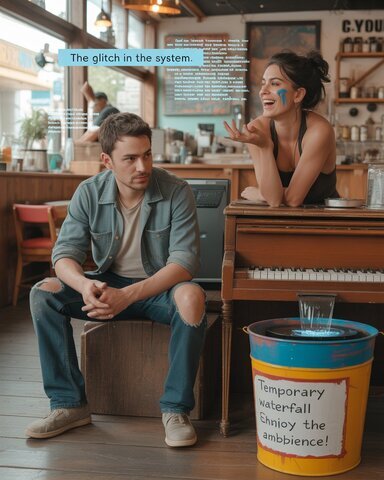


Elias Thorne had always considered himself a master of algorithms. For a man who had built SynaptiCore from a dorm room project into a multi-billion dollar empire, every aspect of life was, at its core, a solvable equation. Emotions, human interactions, even the elusive concept of love – all were merely complex data sets awaiting the right computational power. His latest magnum opus, the Human Connection Algorithm (HCA), was designed to prove it.
But the real world, it turned out, was a much messier sandbox than any server farm.
He watched her from across the coffee shop, a canvas of warm wood and mismatched chairs, a defiant splash of bohemian charm in the sterile, gentrifying cityscape. Clara Vance, the proprietor of “The Daily Grind & Create,” moved with an almost lyrical efficiency, her dark hair perpetually escaping its messy bun, a streak of flour or paint usually adorning her cheek. She was currently engaged in a spirited debate with an elderly woman about the merits of sourdough versus rye, her laugh echoing like wind chimes – entirely unpredictable, entirely unquantifiable.
Elias, or ‘Eli’ as he now called himself, shifted on the rough-hewn bench, trying to adjust to the unfamiliar discomfort of worn denim and threadbare cotton. His bespoke suits, the sleek lines of his penthouse, the hushed deference of his employees – all were gone. For the past six weeks, he had been living in a modest, surprisingly charming loft apartment above a pottery studio in this eclectic, slightly run-down neighborhood, a world away from his usual gilded cage.
His hands, once accustomed to the smooth cool of a touchscreen, now sported calluses from sandpaper and chisels. He’d told the nosy landlady he was a freelance carpenter and artist, a half-truth he was surprisingly adept at maintaining. The workshop across the street, rented cheap, was his cover, a place where he could spend hours learning a new trade, or more accurately, attempting to, while secretly running simulations on a cleverly disguised, secure laptop.
The HCA was his escape and his challenge. After a particularly soul-crushing corporate gala, where he’d been lauded for innovation but felt utterly hollow, Elias had confronted the stark emptiness of his curated existence. He had wealth, power, intellectual prowess – everything society deemed desirable. Yet, he was alone, surrounded by sycophants and veiled agendas. He’d theorized that true, uncomplicated connection was simply a result of untainted environmental inputs, uncorrupted by status, wealth, or perceived power dynamics. To test this, he needed to become an ‘untainted input’ himself.
Clara, unknowingly, was his primary subject.
His HCA, running on his hidden server network, had initially flagged her with a low compatibility score based on their disparate lifestyle vectors. Yet, every day, Elias found himself drawn back to The Daily Grind. Not for the artisanal coffee, though it was surprisingly good, nor the flaky croissants. It was for *her*. Her vibrancy, her unwavering belief in community, the way she effortlessly connected with every person who walked through her door. These were variables his algorithm couldn’t compute.
Today, his internal systems were particularly jumbled. A small leak had sprung in the café’s ceiling overnight, right above the antique piano where local musicians occasionally played. Clara, instead of panicking, had simply placed a brightly painted bucket beneath it, a tiny sign propped next to it reading, “Temporary Waterfall Feature. Enjoy the ambience!”
“Eli, you’re looking thoughtful today,” a warm voice broke into his observations.
He looked up, startled. Clara stood beside his table, a faint smudge of what looked like turmeric on her cheek, a wide smile crinkling the corners of her eyes. She smelled faintly of roasted coffee beans and something sweet, like cinnamon. His internal sensors, typically cool and analytical, registered an anomalous spike in his heart rate.
“Just admiring your... creative approach to plumbing,” he managed, gesturing vaguely at the bucket.
She chuckled, a rich, full sound. “Necessity is the mother of invention, right? Landlord’s dragging his feet. Again.” A sigh escaped her, briefly clouding her sunny demeanor. “It’s fine. Adds character. Though I do worry about the old piano if it gets worse.”
“I could... take a look,” Eli offered, the words out before he fully processed them. His actual expertise involved micro-circuitry, not leaky roofs. But he had been spending his afternoons in the workshop, learning rudimentary carpentry and basic repairs. He found it surprisingly grounding.
Clara’s eyes lit up. “You serious? I’ve seen your work in the shop across the street. That reclaimed wood console? Gorgeous. You’re a wizard with wood.”
Eli felt a strange flush. Praise, genuine and unprompted, was a rare commodity in his former life. “I dabble. But a leaky roof... might be more structural.”
“Any help is better than none. I’m drowning in flour and bills, not exactly handy with a toolbox.” She paused, her gaze thoughtful. “You know, you’re always here. You clearly like the coffee, and I like having you. How about I trade you coffee and pastries for your time? If you could even just assess it for me.”
His HCA, running in the background of his thoughts, screamed ‘opportunity for data collection.’ But a more primal, un-algorithmic part of him simply liked the idea of helping her. Being useful in a tangible, non-billion-dollar way.
“Deal,” he said, a genuine smile touching his lips. It felt good, the word, the promise. Far better than any quarterly report.
Clara grinned, a flash of pure delight. “Fantastic! Come by after close, around seven? I’ll even make you a proper meal.”
As she walked away to serve another customer, Eli found his gaze lingering on the sway of her hips, the easy grace of her movements. His internal monologue, usually a calm stream of logical deductions, was now a cacophony of conflicting data. The HCA had just registered a “positive emotional resonance” spike. Impossible. It was only supposed to observe, not… feel. The glitch in his system was becoming delightfully, terrifyingly real.