Cold Open: 'Cut To Kiss'
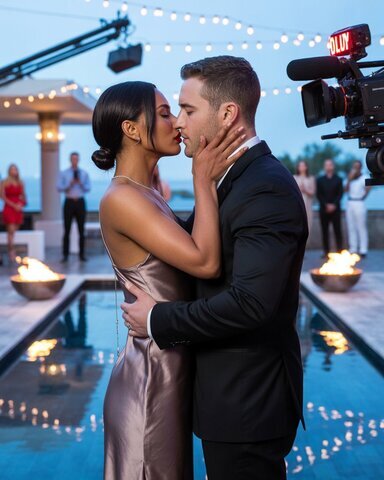


The red tally light winked on, and the backyard of the villa turned into a theater made of glass.
String lights draped like constellations over the terrace. The pool was a sheet of ink, reflecting everything the cameras wanted the story to be: perfect bodies, perfect lighting, perfect decisions made in thirty-second packages and set to the percussion of a snare drum.
Elimination night smelled like hairspray and gardenias. A steadicam operator eased along a dolly track, his black shirt clinging to his shoulders in the heat; a second AC whispered frame lines, the swish of the matte box as evocative as breath. Beyond the arches of the colonnade, generators hummed. Somewhere, a champagne flute rolled off a side table and shattered, but the sound was smoothed out under a music cue piped through the monitors.
“On my count,” the host said, not quite smiling. Ronan Hale made everything sound like a late-night confession and a dare. He stood on his mark between the fire bowls, cue cards fanned in his hand. Tall, tanned, in a suit the color of midnight, he looked like a promise that life wouldn’t be boring if you let it swallow you whole.
The contestants—silver sequins, velvet jacket shoulders, linen in ocean-bright hues—clustered around the rose arbor as if it could provide absolution. Nobody leaned too close to anyone they weren’t assigned to lean against.
Dylan Cross had learned how to stand during elimination nights: shoulders slightly back, chin forward, eyes aware but not hunting the lens. He had the kind of face that magazines used to call chiseled before they remembered it was a cliche. Dark hair cut short at the sides, just long enough to thread a hand through at the crown. A mouth that looked like it knew how to smile and how to hurt someone without meaning to. Fans said he looked like trust. Everyone agreed he looked like ratings.
The mic on his back itched through his collar; the tux jacket they’d fitted on him that afternoon had been steamed so many times it radiated heat like its own body. He shifted his weight and felt the floor tape under his polished shoe: a fluorescent X that told him exactly where to be when the camera pushed in past his ear for the reaction shot.
“Now,” Ronan said for the benefit of viewers who loved the word the way chefs loved salt. “Now, you all know how this night goes. It’s been a week of love and heartbreak in the villa, and we are down to ten.” He let it hang there, as if the math could bloat itself into fear.
In the first row, Sloane Kincaid—bronze skin, lashes like a gospel choir—tilted her neck toward the best-lit angle and squeezed the hand of her partner of the week. Of the hour, really. Marley Bhatt stood stone-pale under the lights, their eyes fixed on nothing. A production assistant—black jumpsuit, discreet earpiece—withdrew a step farther into the hedges with a clipboard pressed to their chest, mouth tight with a message they couldn’t say out loud. Not with the red light on.
“Two of you will leave us tonight,” Ronan continued. “But this season is about more than leaving or staying. It’s about the unexpected.” He smiled the way you smile before a magic trick.
Behind the French doors, past a gold stanchion rope where crew congregated with sloshing coffee cups, a TV display looped a pre-roll of slow-motion laughter and the kinds of kisses you could clap along to: percussive, choreographed excess. Producers—a dozen of them and somehow none of them ever visible when fans pointed fingers—clustered around two folding tables covered in laptops and laminated schedules. The showrunner, Marina Quinn, held a headset loose against her jaw as if it bored her, though nothing bored Marina except predictability.
“She’s ready for drop,” said Luca, the segment producer with a cross tattooed behind his ear and a soft spot for mess that made him dangerous. He flicked his gaze to the timecode. “If we cut to Face Two on Ronan’s beat, we can take the car to camera in… thirty.”
“Thirty-seven,” said Nori from the line of monitors. “We’re holding for cry. I need one, or we don’t sell the stakes.”
“We’ll get better than a cry,” Marina said. “We’ll get a comeback.”
She lifted one manicured finger. In the driveway, a black SUV idled like a decision.
The rear door opened with a sigh.
Skye Rivera touched her heels to the gravel one after the other, like stepping stones only she could see. Under the security light, her dress glowed like a drop of mercury. She was a flicker of movement, fresh and finished all at once: espresso hair pulled into a low knot, a mouth painted in a shade named something like Oxblood but looking like courage. A delicate chain at her throat caught and held the camera’s eye the way a magician steals a watch.
On her wrist, a ribboned bracelet matched those worn by the other contestants. It had been tied there a minute ago by a PA named Quinn with trembling fingers, because last-minute meant last-minute, even for miracles.
Skye paused, just there, in the space where one could still turn around.
The villa smelled like someone else’s summer. She exhaled it through her nose and felt the way her ribs expanded; the dress resisted. She pressed down on the slicker side of her heel—steel tip, comfortable enough to run on if she had to. Over the past month, she’d practiced moving in all kinds of dresses. The trick was to let them drag like water and still cut a straight line through them.
“Rivera,” Luca said, low as a secret in a church. It could have been a greeting or a warning. “We’re on you in five. Smile like you mean it and not at all like you mean it. You know.”
Skye’s smile arrived with perfect timing. She rested her palm against the SUV door and waved to someone who had screamed her name from the darkness. There was no one there. She knew, of course. They did it sometimes: feed energy into a space to see if you’d fill it with a performance. It wasn’t any more manipulative than saying please and thank you to a camera: just a different grammar of politeness.
“I’m ready,” she said.
Everyone moved like someone else had planned for them to move. Ronan cut his trailer cadence, pivoted with grace to face the French doors. Camera B tracked sideways, the lens shifting in one satisfied breath. The red tally light winked again as if it knew everything.
“And now,” Ronan said, “what you didn’t see coming.”
The French doors opened, and Skye stepped onto the terrace like a secret.
Gasps. Real, edited, who could know later. Sloane’s painted mouth parted and then turned up at the corners, the grin a shade too sharp. Marley blinked and straightened like a body jarred in the passenger seat. Gia pressed fingers against the hollow of her throat, one of her rings turned inward to hide the gaudy logo that might get them fined. Micah cursed, softly enough to dodge Standards and Practices.
Dylan didn’t move. It would have been too much to move. He was aware of how the camera nested on his right: 85mm, the one Alex preferred for his face; the one that caught his lashes in crisp lines. He had time, somehow, to be grateful that he had cut the stray hair above his ear, to remind himself that his job tonight was to look like both a man and a brand.
The lens skimmed past him, an orbiting planet, and fell immovably onto Skye.
“Contestants,” Ronan said, “please welcome your wildcard.”
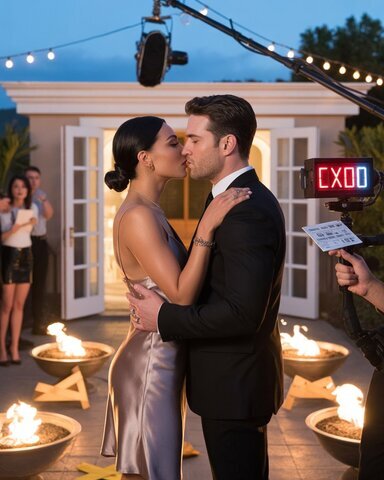
The word hung there like a tossed coin. Skye stood in the center of the terrace and let the second camera drink her in: her straight spine, the tilt of her jaw, the small scar inside her left eyebrow that wasn’t airbrushed out because it gave DPs something to fall in love with. She lifted her chin to Ronan and then allowed her gaze to sweep. Not too fast. You couldn’t look greedy on your first night. It was a tell they could fix in post, but only if they cared.
Her eyes found Dylan on the beat the editors would later cut to. A measurable moment, right where music swelled. Not held too long.
Electric. Alert. It was only a look. He didn’t know what it meant. She did.
“Skye,” Ronan said, tasting the name as if it were a dessert on the menu. “Tell us why you’re here.”
Skye’s laugh was the most honest thing about her that evening. It was small and bright and didn’t ask anyone to applaud it.
“I flew here because I’m a terrible packer and because I have terrible timing,” she said. “Both seem appropriate.”
Laughter, invited and immediate, rippled like a breeze under the hedges. Ronan smiled and lowered a card.
“Welcome to the villa,” he said. “We do things a little differently here. You’ve come on elimination night—most people would call that pressure. We call it opportunity.”
Behind the monitors, Marina laced her fingers and heard the grind and slide of gears as the show moved into a configuration she loved best. Fruit under a knife.
“We have a twist,” Ronan said, like a magician pulling a rabbit with a crown out of a hat. “Not only is Skye safe tonight, she is going to shake this villa at its foundation. Skye, step forward.”
Skye took a breath she didn’t need and stepped to the taped mark. The light there was a half-stop hotter. It found the high curves of her cheeks and the line of her collarbone, and she felt the heat as keenly as if she had placed her body under a lamp.
“You,” Ronan continued, turning to the group, “are about to witness the season’s first instant couple. No dates to test chemistry, no rose to beg for—”
No choice, Sloane mouthed, and smiled.
“—tonight, the producers have decided that Skye will pair up with one of you.” Ronan held the pause as if he could measure time by the taste of it. “And that pairing comes with two weeks of immunity.”
The words fell like a chandelier.
Dylan heard someone swear again, louder. He didn’t look to see who. He had spent enough time in his first week learning not to look when the story wasn’t for him, when the lens wanted something else. He kept the corners of his mouth engaged but only lightly. His heart didn’t kick. Maybe that was adrenaline telling the truth from a safe distance.
“Skye,” Ronan said, “the man you’ll be joining as an instant couple—one our audience knows and loves—”
The camera shifted. Dylan felt its ravenous turn before he saw it. He had been loved before in rooms where he couldn’t see the faces. It felt like an invisible hand, fingers interlaced with his.
“—is… Dylan.”
His name was an invitation and a verdict.
Dylan let himself startle half a beat late, the way he’d been coached. It made him interesting. He turned toward Skye with a smile that was practiced but not practiced. The crowd reacted—Sloane’s laughter like the clink of a glass; Marley’s jaw clenching technicolor; Gia murmuring “wow” like a prayer—and Dylan moved forward to meet Skye in the light.
“Dylan,” Ronan said, tone the color of honey, “come say hello.”
He stepped to the mark. The tape underfoot told him where to let his eyes go; the faint gleam of the lens told him the height of his smile. He landed an arm’s length away from Skye and felt the tiny static of their shared space.
“Hi,” he said, too private for the mics and perfect for the score they’d lay underneath later. “I’m Dylan.”
“Skye,” she said. He expected her hand. She didn’t offer it. The control in that killed him a little. She made him wait the space of a breath longer than was comfortable and then slid her palm up his forearm until her fingers limned the inside of his elbow. Claim. He heard a camera operator curse softly, satisfied.
“Tell me a secret,” she said, her mouth not matching the words so no one would ever notice on the playback.
He looked at her then, like you look at a person you’re not sure wants the same kind of trouble. Skye’s eyes were darker than the night had any right to be, and her pupils didn’t blow with the light. She threw it back.
“How about this?” Dylan murmured. “I smile when I’m scared.”
“Convenient,” she said, and flashed her own. It had a trick in it: the left corner lifted a fraction sooner than the right. He wanted to know if it did the same in the dark.
“Now,” Ronan said, the voice of God if God wore cufflinks, “an instant couple needs an instant vow. And here on Hearts on Air—”
Hearts on Air. The name had been built by a team in a room with a window facing a wall, and yet, out here, it sounded like a wish.
“—that means a first kiss.”
A beat of silence. Not because they were shocked, but because everyone knew the beat, and sticking to it made the shot smoother.
Skye’s fingers tightened the slightest amount on Dylan’s elbow. He could have missed it if he were a different man.
“Okay,” she said, to no one and to all three cameras and to the part of herself that cared about what two weeks of immunity bought.
“Cut to the kiss,” Marina murmured, and three different operators smiled without meaning to, because sometimes the old directions were still candy.
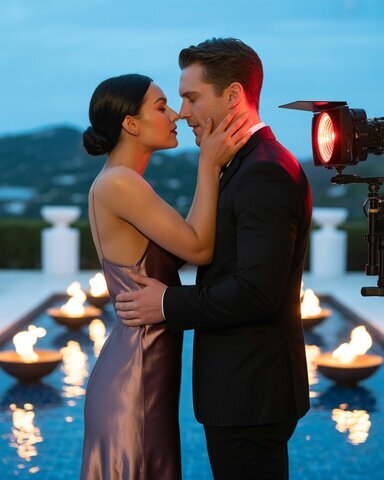
The orchestra stinger swelled in the monitors, a chord with cheeks flushed pink. Dylan shifted into Skye’s space. She lifted her chin by degrees: fifteen, ten, five. Their noses didn’t bump. He couldn’t tell if that was skill or coincidence. And then their mouths met with the kind of careful pressure that said we are telling a story, and the harder version of I am here too.
Dylan smelled sugar on her breath with something bitter under it—coffee, maybe, or a lie. Skye felt his lower lip curve against her own like a promise that could be kept even if it wasn’t meant. She pitched the kiss just hard enough to sell the illusion of lust without inviting a hand to her waist. Control, control, control. He let his palm hover behind her shoulder blades, not touching the spine but making a map of it with the heat of his skin.
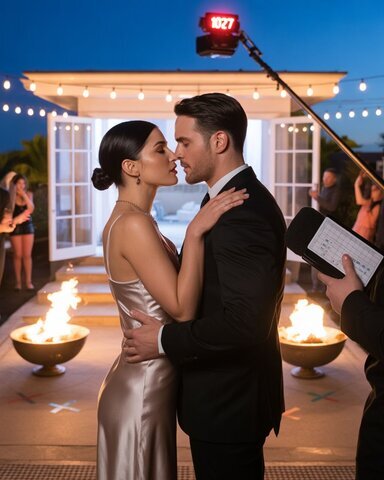
Flashbulb in a world that didn’t use flash. The sound of a clap shut off halfway through. Someone made a noise under their breath that they couldn’t use after ten p.m.
They parted on a collective exhale. Skye lowered her chin, eyes up. Dylan let his smile slip and then amended it, like a man who had just remembered his own delight.
Behind them, Sloane clapped, slow enough to be cruel. “Well,” she said, bright as a blade. “If they’re not a headline.”
The host took them back, the way lifeguards pull swimmers from a current. “Skye and Dylan, our instant couple. You are safe for the next two eliminations.” He turned, the camera following him like a falcon’s gaze. “Which means two of you still leave tonight.”
They went through the motions: Ronan reading names in a cadence that punched up the last syllable, bodies lifting and falling as if currently attached to invisible strings. Marley left, eyes pale embers, hand squeezing a ring that wasn’t theirs anymore; someone else whose name would trend for forty-five minutes fell against a shoulder they’d only meant to rent. Some hugs would be memed, and tears that would be set to pop. The fountain behind the chairs continued to pour water over stones in the ways only fountains know how to be consistent.
Skye stood at Dylan’s side and felt the hard press of his arm near hers while she concentrated on her face. When the camera cut away, the muscles at his jaw went soft as dough and then tensed again, and he did it without moving anything else. She filed it under useful. He filed the scent of her lotion—something with citrus and a little salt—under the same.
Then: “Cut.” A different voice than the one that runs through your life like blood. And everything that had been fixed began to breathe again.
The red tally light went off, and the world slid half a shade gray.
The house didn’t collapse; it was held together by rules stronger than glue. But everyone’s perspective shifted with the electricity. The crew took a collective step forward. PAs materialized with bottled water and sugar mints. A makeup artist hovered three feet from Skye’s face and blinked, grabbed an oil blotter, and orchestrated a perfect dapple instead of a shine.
“Perfect,” Marina said into her headset. She wasn’t lying. “Reset. Confessionals. Ronan, cross to the lounge. Sloane, you’re up after Micah. Dylan, Skye, we need both of you on camera three in five. Can we keep them separated until we get the fresh takes?”
“We can try,” Luca said, with the good humor of someone who existed to fail elegantly so the show could win.
Skye’s handler had told her once that the trick to surviving in a pressure system was to be the person who looked like they were meant to be there. She had practiced the way girls practiced pencil eyeliner in ninth grade: in the mirror, in the rearview, in windows at night. You breathed with your shoulders low and your sternum forward, as if the oxygen that filled you was free.
She had studied the way contestants stood when they were dizzy. She could put the right kind of pink in her cheeks without blushing. She could accept a glass of champagne without drinking any of it and make you feel like you were rude for not toasting her with more heart.
She was good at this. That was the problem.
“Hey,” Dylan said, in the tone of a decent guy who had to hit his beats. He had a face close to her shoulder; he laughed, ready in case she didn’t like men standing so near. “You did great.”
“You too,” she said, and meant it in the way you could mean something at multiple altitudes. Up here, on the surface: you were poised; you didn’t sweat; the kiss didn’t make it weird. Underneath: you were better than she’d expected at pretending, and that made him right for the part he’d been cast in without being asked.
He tilted his head, his eyes scrunched to protect himself in the brightness. “You okay?” he asked softly, like it was a real question. Like the word okay meant anything in the part of your life that got scored.
“I have no idea,” she said, and it would test as self-deprecating later, it would make the lower thirds swoon for her, and it would be true.
“Skye.” Luca’s voice found her like a ping. “Confessional.”
Dylan’s name got yanked in the other direction: “Dylan, quick OTF, then we need you on B-cam for reaction after Micah melts down.”
“Micah’s melting down?” Dylan said, but Luca was a man who smiled as a verb without meaning it. Of course, Micah was melting down. It was elimination night.
Skye felt, momentarily, the impulse to touch Dylan’s wrist. Something about the way he’d looked at her when he didn’t think the camera was on him—like he was still making room in his body for a decision—did something unplanned in her midsection. She had met men who could drown themselves in two inches of water because they liked the way the light looked under the surface. Dylan looked like he knew how to hold his breath and come up in the right place without thrashing. That was the kind who could keep you alive if you were strapped to him.
“Good luck,” she said, and moved away before her hands did anything her brain would have to unlearn.
They placed her in a chair designed to make you look like you were being honest. Low seat, so your chin tilted down a fraction, background simple, a strip of fairy lights blurred into warm coins behind her left ear. They hadn’t named this room yet on the show; fans would call it something stupid and indelible, and the producers would adopt it because they knew which ships to let sail.
The confessional camera was close enough to make her pupils widen with the pretense of intimacy. A light gray card leaned on a stand next to the lens: Look here. Smile. Tell me something real.
“Skye,” said the AP assigned to get something from her without making her run from the room. Janine wore pink lip balm and a look that made you sure she had never cried at work. “Name, occupation, why you’re here, one fun fact. Try to give me the story you’ll want your grandkids to see first. And we’ll do an alternate later for the fans who want to ruin your life.”
Skye allowed herself a laugh. It read sweet, but it had edges. She shifted her dress just enough to make the fabric sigh, cross and re-cross her legs. The mic pack at her spine pressed into the chair; she adjusted her arch so it sat more comfortably against her lower back. She could feel each of the eight pieces she carried on her person: the transponder, the lipstick she didn’t need that was exactly three grams heavier than it should be, the bobby pin that was mostly a bobby pin, the tiny adhesive patch at the inside of her left arm that itched when she thought too much about it.
“Let’s start with the easy thing,” Janine said. “Tell me your name.”
“Skye Rivera.” She smiled. “It’s spelled like the color over your head when you’ve been in one place too long.”
Janine laughed like a bonus. “And what do you do?”
“I am in brand partnerships,” Skye lied with the ease of someone telling a story they’d rehearsed hard enough to make into muscle memory. “Which is code for I tell people pretty stories about products they didn’t know they needed, and if the stories are good enough, they buy into the dream instead of the thing.”
“That was… very poetic,” Janine said, blinking. “Okay. So why are you here? In the villa? On Hearts on Air?”
Because I’m not here for you to ask me that question. Because I need to pull the string on the piñata and see who bleeds.
“I’m here because I’m bad at timing,” Skye said again, easy and light. “And because I wanted to find out if chemistry feels different when you have an audience. Also, because if I had to go on one more date in the real world where a guy lied about liking jazz, I was going to write a manifesto.”
“What does your perfect partner look like?” Janine asked.
“Like someone who knows how to cry without making a mess,” Skye said. “And who texts back?”
“What’s your biggest fear?” Janine’s voice gentled like a hand brushing a cheek. Some of this was always real.
“Getting edited into a woman I wouldn’t like.” Skye’s smile didn’t break. “Or lipstick on my teeth.”
Janine snorted. The camera did not react. It was a god that ate everything and burped highlights.
“We’ll do more later. Give me a first impression of Dylan. First words that come to mind.”
“Sharp,” Skye said before she could pick something safer. She thought of a kitchen knife, of the way Dylan had loaded the air around that forced kiss with a heat that had nothing to do with the lights. “Annoying. I mean… annoyingly pleasant.” She let something like a blush hit the apples of her cheeks and then fade, because she had practiced that too. “His mouth was warmer than I expected.”
“Okay, mama,” Janine muttered, not really under her breath. “Give me a last line. Your… crap, Marina likes it when they do it. Tag.”
“My tag?” Skye thought of a line that could live under a clip on a feed it was weird to think about her mother seeing. “Love doesn’t need permission. It just needs… room.”
“Perfect,” Janine said, and meant efficient. “We’re good.”
“Thanks.” Skye kept the smile on her face as the cameraman lifted his head. He was sweating under the weight of the small rig; she could smell salt and something like cedars. He nodded at her like she was doing him a favor by sitting there being good at this. That was the first thing the camera did to you. The second was to make every nod feel like a receipt you had to sign.
“Skye.” Luca’s voice from the doorway, the only person in the building who could use a contestant’s name like a middle name. “Producers want a passerelle with you and Dylan. We’ll give you thirty for water if you need. Don’t drink too much. We’re tight.”
“I’m fine,” she said, and stood. The dress obeyed.
Her handler had told her to deliver nothing important to a camera she didn’t control. That had meant months of practice looking and sounding cohesive while breaking sentences in places that made any edit into a scavenger hunt. It had meant learning what bits of honesty slipped through like fish through a net.
Be charming. Be forgettable. When it’s time to be unforgettable, you’ll know.
She left the confessional and stepped into a hallway that smelled like fresh paint over old secrets. The villa was a shell: plaster and echoes, rooms designed for a camera’s eye and only accidentally comfortable for the bodies who lived in them. You learned where to place your feet so your heels didn’t call out to sound. You learned the difference between a shadow that made you look human and a shadow that made you look haunted. A good show made you both.
A PA pressed a bottle of water into her hand with the cap already cracked. “Room temp,” they whispered, as if it mattered to her throat or to the story. “Mic check in two.”
“Thanks,” Skye said. She had counted nineteen. Nineteen names in one night, nineteen faces she would have to care about just enough to look like a person. She wouldn’t remember all of them. It would make her feel like a thief.
The passerelle was a narrow balcony overlooking the pool, one of those pieces of set design the camera adored because it made spacing into a kind of theater. Dylan leaned on the railing, his profile cut like Renaissance advice: strong jaw, thoughtful brow, the kind of nose you could anchor a life to. He turned at the sound of her shoes and then didn’t look at her dress, which made her like him against her will.
“You survived,” he said softly.
“You survived,” she retorted. “They didn’t make you cry. I hear that’s lucky.”
“They’re saving it for sweeps.”
Skye snorted. It came out as a half-laugh. The relief she felt scalded her in parts she hadn’t intended to be tender yet.
Dylan shifted, placing his body so the camera could have him. He did it with the ease of a man who didn’t need to be told anymore where the lens loved him. He didn’t seem to enjoy it, but he knew what it paid. “Is this your first wildcard?” he asked. “It’s mine.”
“I’ve always been more of an uppity regular,” she said. “First time as a surprise.”
He glanced down at the pool, at the lights that made it look like the idea of water. “You did great out there.”
“For a first kiss you didn’t want,” she said, and it could have been a joke. It was a test.
He looked at her fully then. “I didn’t say I didn’t want it.”
She felt it in her sternum, a little shock. The night stretched its neck to hear.
“Okay, Romeo,” Skye said, because she needed her hands. She pointed at the camera tucked behind a fern as if to be sure it knew she knew it was there and then looked back at him like he was the only one in the room. The script said you had to feed both.
“Romeo dies.”
“I know,” she said. “But the speech was great.”
“Skye,” Luca called, soft enough to be a secret. “Can we walk? One slow lap around the pool, talk about how surprising this all is, stop by the fire pit, and pretend you’re cold? Later, you can be cold.”
They walked. Their steps fell into a rhythm because the floor tape and the grip marks made it almost impossible not to. Skye told the cameras what they wanted to hear: that she hadn’t expected to feel… anything. That she was overwhelmed but in a good way, like standing in a new kitchen and knowing the drawer with the spoons is on the left after two days of feeling lost. Dylan told them she made him nervous in a way he liked. They laughed a little into the smoke when it blew toward their faces. Their shoulders bumped once and then did not bump again.
When the cameras let them go, the dissolution of attention felt like a physical thing. The air. The lights. The look.
“You smoke?” Dylan asked, and it sounded like a bad pickup line from the eighties. He frowned. “Sorry, that’s… not what I meant.”
“It’s okay.” She leaned back against a low wall and tipped her head to look at the ladder of lights along the villa’s roofline. “I don’t. Not cigarettes. Do you?”
“No.” He hesitated, then grimaced. “I chew ice when I’m nervous.”
“Your dentist hates you.”
“He’s resigned.” Dylan folded his hands around nothing. The ring light caught at his knuckles, making them into small topographies. “You don’t have to—” He stopped, as if someone had tugged his earpiece that didn’t exist, but there were things so ingrained by now that his brain did them without being told. He reset the sentence. “If you need anything, I’m around. Even if it’s just a water run. I think the kitchen is a dimension. You go in and you come out older.”
“Good to know,” Skye said. The part of her that was braced for something strange and sharp relaxed a fraction. It made her reckless enough to show the slip of something true. “Thanks.”
He nodded, as if she had handed him something he’d take care of.
“Back in five!” Janine’s voice, from the direction of the confessionals. “Skye! We want one more quick bite! Dylan! You owe me ten seconds looking like you just saw a flock of baby goats!”
“What does that look like?” Dylan whispered.
“Your fan edit will show you,” she said.
He smiled, and this time it didn’t look like anything but a man smiling at a woman because the night had done something to his blood that made it lighter. It would be a shot they would overuse in the mid-season trailer, and no one would blame them.
Skye went back to the chair that made you honest. She sat like a queen and a criminal and felt the camera’s interest wrap around her in a warm circle. Janine frowned for sympathy she had practiced, then leaned forward and widened her eyes like a friend.
“Okay,” Janine said. “Sorry, just a button. How do you feel?”
“What kind of answer would make you cry?” Skye quipped.
“Funny,” Janine said, flat with affection. She held Skye’s gaze, inviting something heavier. She was good at this, too. “What do your parents think of you being here?”
“My mother thinks the only reality television worth watching is the weather,” Skye said, and let herself smile like she meant it. “My dad thinks I look good in a dress.”
“Good,” Janine said, checking the time again. “And what’s your strategy?”
“I don’t have one,” Skye said. She breathed. Let herself fill. Let the lights trace her. “Which is a strategy.”
She looked at the lens then. Looked into it like a person who knew it could take something from her and had decided what to give instead.
She could taste the moment opening. The first night had been painted so thick you could have scratched your name in it. But the real work had started days, weeks, months ago—in rooms with lower ceilings and worse coffee, in conversations that had used her name like a knife to cut open definitions like truth and entertainment and malice.
“Skye?” Janine said softly. “Anything else you want to say?”
Skye felt her handler in her bones like a second heartbeat. Felt the assignment humming under her skin, thin and bright. Felt the competing obligations—be interesting enough to keep them interested in you, be safe enough to survive, be dangerous enough to matter—twine like ivy around her ribs.
She wasn’t going to give them the whole story. Not here. Not to their camera. Not when she could be cut to music and scored like a sinner or a saint, depending on which clip paired better with an ad for sugar-free seltzer.
But she needed to plant a seed. She needed a place to root a vine that would later bear a fruit she could recognize as her own.
“I think,” Skye said, and her voice slipped a fraction deeper, the way it did when she meant a thing a little too much, “that we’re all better when we know what we’re agreeing to.”
Janine blinked, interested because she was human and learned to keep it from her mouth because she was good at this. “On a date?”
“On a show,” Skye said. “In a life.”
She laughed a little. Made it look like she was a woman who had once taken a philosophy class and now regretted it. But she didn’t blink in the wrong places. And when she leaned forward, her face glowed warm and soft like the inside of a wrist.
“I’ll tell you something,” she said, and this was where a better producer would have leaned in or signaled for another camera to catch the look. Janine didn’t, which made Skye like her and also want to throw up. “I hate being lied to. I hate it more than splinters and coconut water and sweater-dress weather. So I guess… I came here to see if I could still tell the difference.”
Janine didn’t breathe for a full second. “Between what and what?”
“Between the story you write for an audience…” Skye’s mouth slipped: the left corner first, then the right. “And the one you tell yourself while you’re brushing your teeth.”
“That’s… weirdly profound,” Janine said. Her voice was amused, her eyes were hungry.
“Cut,” Marina said in her ear, even though Janine wasn’t on a headset. Sometimes, command was a contagion.
Skye left the confessional with her heart doing a rabbit pattern she knew how to settle. She slipped down a hallway toward the bathrooms and stopped in the corridor when the noise from the main room got big enough to cover anything. She pressed her back against the cool wall and let her head rest for a count of five. It was only then that she slipped her fingers under the edge of the mechanical flower sewn onto the side of her dress and levered it just enough to feel the thumb-drive-slim compartment sewn into the lining. It was empty. It was supposed to be. Tonight wasn’t that night. But the weight of the idea of it was heavy enough to remind her why her throat had stayed dry despite the bubbles.
A door opened. Skye let her head come up smoothly.
Sloane stood in the frame, a cup of water balanced like a crown. Her eyes were a line of coins. “So,” she said, in the tone women developed when life had trained them to braid curiosity and cruelty. “Instant couple. Lucky girl.”
“Lucky guy,” Skye said. The smile she chose for Sloane was a cousin of the one for the camera, brassier, with a knuckle in it. “We’ll try not to bore anyone.”
“I don’t get bored. I get psychoanalyzed.” Sloane lifted her shoulder and let it fall. The light caught her collarbone and looked like it wanted to live there. “Congrats. Or condolences. Those taste the same in this house.”
“You’re not wrong,” Skye said, and meant it, and knew the other woman knew she meant it, and liked her better for not pretending otherwise.
Sloane’s mouth slipped into a smile that had lived in her since middle school. “Anyway, watch your back. The kitchen is haunted, and so is Dylan.”
“By what?” Skye asked.
“Things that make people want to put him in their pockets,” Sloane said. Then her face changed, not softened but altered like clay under a wet palm. A camera operator passed down the hall; Sloane rotated three degrees, and the new angle made her lashes into fluttering curtains. “See you at breakfast, sweetheart.”
“Can’t wait,” Skye said. She could. She could wait forever. It didn’t matter. Morning would come like a production slate.
She stepped into a bathroom, finally let herself be alone for the count of thirty. She set the water on warm and let it run. She didn’t cry. It would have wasted makeup, and she didn’t have time to wash her face. But she looked at herself the way you look at someone on the other side of a window.
“Hi,” she told her reflection, softly enough that only the faucet would rat her out. “Welcome to the villa.”
When she stepped back out, Dylan was leaning against the wall down the corridor, hands in pockets, posture casual enough to pass a lie detector test. He raised his eyebrows like a question mark that had been well calibrated.
“Bathroom success?” he asked.
“Five out of five stars,” she said. “Would pee again.”
He laughed, surprised into it, which made it real. She was dangerous when laughter did that. To him or to her, she couldn’t tell.
“Wanna go get yelled at about breaking the coffee machine?” he asked. “I mean, we didn’t, but I like to be included.”
“Lead the way.”
They moved as a unit back toward the pulse of the living room. The house was empty of some people now, and you could feel the absence. Sometimes absence had weight, like a coat hung on a chair you expected to be bare.
There were more confessionals, more notes, more gently applied pressure disguised as choices. The night stretched, elongated, bent around the arcs of the arcs. By the time someone yelled that they’d made their night, the sky was pinking at the edges like a bruise healing.
Crew bled away like a tide. The cameras kept their distance like a dog that knows it will be called back with a whistle when the good bit happens anyway. A sliver of silence arrived, and then startled when everyone looked at it too openly.
Skye found her assigned room: white linen, too much glass, a plant that would die without better people than any of them around. She closed the door and locked it, because the lock was for her and not for the show. The tiny noise it made was private.
She peeled off her dress as if she were unwrapping someone else’s gift. She hung it on the padded hanger they’d provided, smoothing the fabric with both hands like a penitent. She sat on the edge of the bed with her feet on the rug, toes curling into its threads, and let the adrenaline drain into her heel bones.
Her burner—no brand label, sticker residue on the back where someone had peeled off a barcode—lived inside the hollowed-out spine of a paperback in her suitcase. A PA had delivered the suitcase to her room with the show’s courtesy, and Skye had controlled the luggage in the ways that mattered.
She opened the book in the right place like a magician flipping to a force card, pressing the edge of the paper with her thumb as if reading. She slid the phone free and held it low in her lap. Three messages had arrived in the half hour since she’d turned the phone back on in the time it took to pee and cry and not cry.
LIN: You live. Status.
JULY: They made you kiss him. Effing predictable. But hot. Don’t @ me.
LIN: Did you get eyes?
Skye typed, her thumb making small sounds on the silent screen.
SKYE: I live. They crowned me. Two-week immunity, paired with their golden boy. He kisses like he’s trying to be polite with fire. I have OTFs. The story bible is in the control room. I saw it. Green cover. Dock left. Luca keeps a black drive on a lanyard in his back pocket. Schedules on the wall. Cameras on the east stair don’t reach the outside gate.
She hesitated. She typed again.
SKYE: He’s worse than you warned me about.
JULY: Who? Dylan?
LIN: Focus.
SKYE: Dylan. He’s careful. He makes me want to be stupid. That’s worse.
There was a pause long enough to make Skye think about the fact that the show wasn’t the only place you could be watched.
LIN: Your job isn’t to be wise. It’s to be precise.
SKYE: I know.
LIN: You have eighteen days until a safe pull for the exposé. You have forty-eight hours until they get too comfortable to double-lock the doors. You have twelve hours to get me their production schedule. Your handler is in Treasury. The drop is on Tuesdays. If you feel your face doing anything but what you mean it to do, touch your necklace and get out.
SKYE: I’m not new.
JULY: He’s hot though??
SKYE: Die, July.
JULY: I will never die. Send screenshots.
LIN: Don’t send screenshots. Draw a map on your skin. Wash it off. Then draw it again. Make mistakes now so you don’t later.
SKYE: Copy.
LIN: The piece isn’t about him. It’s about them.
SKYE: I know.
She looked at the word know like it could turn its head and mean something else. She put the burner back in the book and closed it. She pulled on the sleep shorts they’d given her—soft enough to buy compliance—and a T-shirt that had a logo she refused to read. She lay down and stared at the ceiling like it could explain what the sky looked like when you were too tired to pretend it was romantic.
In the villa’s quiet, a voice threaded the air: the sound of a confession happening one room over into a camera that wasn’t hers to control. She didn’t need to hear the words to know their shape. The human voice, in that mode, did a thing with its throat like bending its own shadow.
“Skye Rivera,” she told herself into the ceiling. “You are here for a reason.”
Her stomach did something like a roll. It wasn’t hunger. It wasn’t exactly dread. It lived somewhere in the border town between.
She turned her face into the pillow and inhaled the scent of detergent until it felt like a place she could exist. She exhaled. The sheets whispered against her legs. Out in the yard, the fountain kept telling the same story to the same stones, and none of them got bored.
The sun made itself known to the edges of the curtains like a girl arriving late to a party and acting like she’d been there the whole time.
Skye got up before it. The clock on the bedside table read a number that made sense to cameras and not to bodies. She brushed her teeth and didn’t look at the mirror this time. She pressed her face into cold water until her skin sang.
Then she sat in the confessional again, because Marina loved a cold open more than she loved her gin. The card next to the lens told her to look here if she wanted to speak directly to the person responsible for the night’s edit. Skye wanted to speak to someone else.
“Hey,” Janine said, hair in a ponytail now, face still built to digest panic. “We’re doing morning after. Give me five.”
Skye nodded. She let the rectangle of the room hold her. The light on her right eye, the shadow on her left cheek. She breathed. She thought of the ladder of steps between where she sat and where she meant to go. It was a ladder that looked like a chasm if you stepped back, so she didn’t. She took the first rung.
“Start however you want,” Janine said. It was the first lie of the morning and the truest one.
Skye wet her lips. She looked at the lens and let the corners of her mouth be so soft their expression wasn’t a thing you could pin down.
“My name is Skye,” she said, softly because the room taught your voice to behave. “And I’m not here to find love.”
Janine’s eyebrows tilted a fraction; she had input and output protein shakes for expressions.
“Cut— wait,” she said, then didn’t. “Okay. Keep going.”
Skye dropped her gaze for a second, calculated to read as shyness or shame, and then lifted it back to the camera. She let the bottom of her lungs fill until the urge to hold back took an edge off her voice. Then she spoke.
“I’m here to find proof.”
It wasn’t—wouldn’t be—plausible deniability later. But it was the kind of sentence the show would use because it could be set to six different songs and mean six different things, and that made it perfect.
“What kind of proof?” Janine asked, almost whispering.
Skye smiled at the camera like it had told her a joke. She leaned in, a bare centimeter, enough to make the viewer feel like they had gotten closer without the lens needing to move at all. She rested her elbows on the arms of the chair and steepled her fingers in a way that made her look like she had prayed once and never had to do it again.
“That's what happens when the red light is on,” she said, “isn’t the only story we’re allowed to tell.”
Janine’s eyes flicked sideways, toward the door, as if she could catch the shape of Marina’s approval sliding under it.
Skye’s heart ticked like a metronome. She set the rhythm of her next breath to it. She let the smile go, let it drip off the edges of her mouth so what was left wasn’t performance. The quiet around them wrapped her. Somewhere in the house, a pan clattered; someone screamed-laughed; a bird mistook the glass for sky and thumped once, hard, and then flew.
“And if in the process,” Skye said, tapping her nail against the arm of the chair, the small sound like a doorbell, “I happen to fall in love with the wrong person, or the right person at the wrong time, or the right person at the right time but the story says we can’t, then…”
She let it hang. Let the editor lean forward. Let the fan who would splice this into a clip breathe shallow.
“Then I guess I’ll let them edit around it.”
She didn’t blink. She let the camera see the part of her that had teeth.
“And,” she said, ending the sentence that would be cut off in the promo, that would resume with a different outfit, a different night, a different version of heat in her eyes, “I’m not here alone.”
She let that be the cliff people would fling themselves off of between now and Thursday.
Janine considered. For a second, there was no game in the way she looked at Skye. It made Skye feel bad. Then Janine asked, “Do you… I mean, is there someone… you…”
Skye laughed. She made it small and private. It wasn’t lying if it belonged to her.
“You’ll see,” she said. Then she tipped her head and softened, like a woman in love in a painting. “Or you won’t. That’s the beauty of editing.”
After, outside, the morning was so blue it felt like a dare. The house smelled like eggs and sunscreen. Dylan sat on the kitchen island, his knee bouncing, a mug in his hand with a crack in the handle that a prop master would scream at. He looked up as she came in, and that thing flickered in his face again, like a lightbulb debating whether to go out. He raised his mug and she raised hers, and for a second, they were two people who had been introduced at a party and liked each other for the right reasons.
“Morning,” he said.
“Hey,” she said.
Behind her teeth, Skye tasted the truth like iron.
Her phone buzzed once in the place in her bag where you put things you are pretending not to own. Two words from Lin, a handler who had eyes everywhere and wrists like carved twigs:
Be brave.
Skye smiled toward the kettle. The steam made a halo. She felt the cameras move closer, not touching her but crowding her aura. She put the mug down and turned to face whatever yes looked like this morning.
It looked like Dylan’s mouth when he fought a smile too early and let it win.
It looked like a house built for pretending and the possibility, bright and cruel as a diamond, that something real could bloom in its shadow.
It looked, to millions of people who would watch without blaming themselves for loving a lie, like destiny.
And to Skye, who had come into the villa as a pretty grenade with writing on it, it looked like a job and also like a wish.
She took a sip of her coffee and almost choked.
“Too strong?” Dylan asked.
“Just right,” Skye said, voice steady, bossy, bright. She lifted the cup in a mock toast. “Cut to the kiss.”
“And what then?” he asked, not expecting an answer.
Skye let her smile run up the side of her face like a curtain in a light breeze. “Cutting past it,” she said.
Then, under her breath, as the camera finessed in on her mouth and the editor marked it with a star:
To the part where I tell the truth.