The Thread Finds Its Place
I always begin the important things with the same thread. Not out of habit, but out of faith.
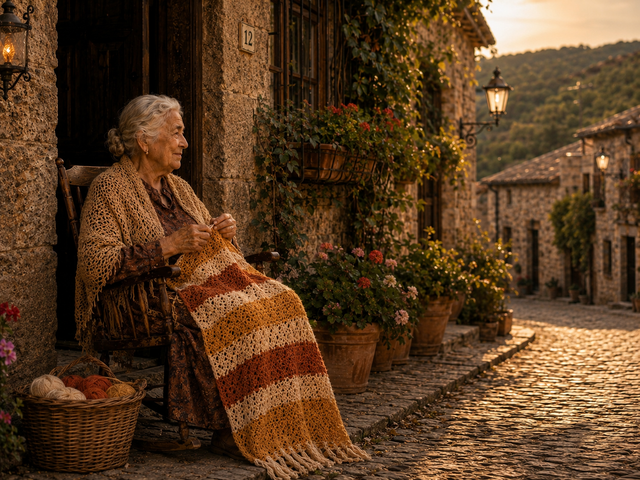
The skein rested on my lap as the afternoon settled in front of the window: cream, terracotta, honey. Discreet colors, but persistent ones. Two blankets, the same stitch, the same patience.
No one asked me to make them. I simply knew when hands had to move ahead of destiny.
To be the babysitter on that street was not a job; it was a way of inhabiting the world. While the parents worked and the noise of adult life piled up elsewhere, I learned to listen, to observe, and to care without getting in the way.
I raised my son that way: with silences that sheltered and gestures that held.
Analicia had not been born yet; nor had Gilberto. Their mothers moved through those months with a different kind of slowness, as if the body knew it was building something unrepeatable. I remembered them from my chair, counting stitches, remembering their youth—how they all had been then, back when they still lived there, back when time felt like a promise and not a warning.
The thread ran through my fingers the way stories do when no one interrupts them.
I saw loves take shape on that very street: some with noise, others with silence. I also saw how fear disguised itself as prudence, and how need learned to call itself duty.
I did not understand then what was happening. No one understands while it is happening. Now I do.
That was why I knitted slowly, as if each stitch could correct something, as if the hands knew before the heart.
I did not know who those children would become. But I knew one thing:
Nothing made with care is entirely lost.
Twenty-five years later, the old textile factory building breathed for the first time in decades.
Analicia Romero Ferrer stopped before the façade with the ease of someone who needs no permission to enter into a conversation with a place. She ran her palm along the worn stone, reading its scars as if they were her own. That structure had been forgotten, bruised by hurried remodels, ignored by those who did not know how to listen to what its walls still said.
“It is not about beautifying it,” she said calmly to the team. “It is about restoring its dignity.”
She did not raise her voice. She did not have to. Her presence was firm without imposing itself, as if the space itself accepted her leadership. At Ecos del Pasado they had learned early on that Analicia did not restore buildings: she gave them back their truth. She understood that preservation was not freezing time, but allowing it to continue honestly.
That was when she noticed him. Not because he came closer, but because he waited.
Gilberto Escalante Obregón remained a few steps behind, notebook in hand, observing without haste. When he spoke, it was after everyone else had finished.
“There is a record from 1923,” he said. “The factory was built by local craftsmen. If we alter the structure of the main arch, the original logic of the space breaks.”
Analicia turned toward him. Not with surprise, but with attention: the kind of attention that is not granted often.
“Do you have the document?” she asked.
Gilberto nodded, extending the notebook carefully, as if he were handing over something fragile. His fingers did not tremble, yet there was an old courtesy in the gesture, a way of being that did not seek the spotlight.
She flipped through it slowly.
Too slowly.
“Thank you,” she said at last. “This changes the approach.”
Their eyes held a second longer than was prudent. It was not discomfort. It was recognition without a name. As if they had both entered a room they already knew, though they had never been there before.
Sometimes love does not appear as a revelation. It presents itself as a pause.
From my window—the same one as always—I thought I had already seen this before. Not them, of course. But yes, the way two people listen to each other without yet knowing how decisive it may be.
I kept knitting.
There are stories that return, not to repeat themselves, but to say at last what was left unsaid. And when that happens, the thread does not break.
It finds its place.